



Best Space Utilization Software in 2026: A Buyer's Guide for Real Estate Leaders
When you pick space utilization software, you're deciding which system you'll trust when a lease renewal or a redesign is on the line. That same choice impacts all the space-planning calls you make in between as well.
The market pulls in several directions at once. Some platforms lead with sensors and measure occupancy directly. Others bolt a space module onto a broader IWMS suite. A third group starts from planning and analytics, ingesting whatever occupancy data you already have.
Each approach answers a different question, and the right fit depends on the decision you're trying to support. This guide walks through seven of the tools real estate leaders and workplace strategists evaluate most often, categorized by how they actually work:
- VergeSense: Unifies utilization signals from sensors and other data sources for planning and operations
- Eptura: An IWMS conglomerate with space and workplace modules
- Spacewell: Workplace management and IWMS with smart-building analytics
- OfficeSpace Software: Booking-led workplace management with AI stack planning
- Trebellar: A planning-and-analytics layer over your existing occupancy data
- Accruent: Space analytics within a broader real estate and asset ecosystem
- Envoy: Workplace management with booking-derived utilization analytics
We'll compare them on data accuracy, decision support, and the depth of their planning, then close with the criteria and questions that separate a good shortlist from a bad one.
Not sure how your space is actually being used today?
See how VergeSense helps real estate leaders and workplace strategists measure utilization, plan with confidence, and act on the data.
At a Glance: Comparison of Space Utilization Software
The table below summarizes how each platform approaches measurement and planning, and who tends to get the most out of it.
|
Tool |
Best For |
Core Approach |
Data Inputs |
Analytics & Planning Depth |
Best-Fit Buyer |
|
VergeSense |
Unified utilization signals from every measurement source for planning and operations |
Combines its own measurement with your existing data sources, then models changes against it |
Infinity Area Sensors, badge, WiFi, room booking, video conferencing |
Scenario modeling on a cross-portfolio behavioral model, portfolio to zone |
Real estate leaders and workplace strategists |
|
Eptura |
Teams standardizing workplace operations across many tools |
IWMS suite spanning Condeco, iOffice, Teem, and more |
Booking, badge, integrated sensors, asset data |
Reporting and space management across a broad suite |
Enterprises consolidating workplace software |
|
Spacewell |
Buildings run on connected space, energy, and asset data |
Workplace management and IWMS with smart-building sensors |
IoT sensors, booking, IAQ, energy, maintenance data |
Space analytics with 2D and 3D floorplans and dashboards |
Enterprises managing many buildings globally |
|
OfficeSpace Software |
Auto-generating stack plans and floor layouts |
Booking-led workplace management with AI Canvas planning |
Booking, moves, badge, floorplan and space data |
Rules-based stack-plan generation via Dojo AI |
Workplace teams focused on stacks and moves |
|
Trebellar |
Unifying occupancy data you already collect |
Analytics and planning layer over external data |
IWMS records, badge, booking, third-party sensors, HRIS |
Scenario modeling trained per customer on your data |
CRE teams with existing data feeds to consolidate |
|
Accruent |
Space analytics inside a real estate ecosystem |
Space management within the Accruent product family |
Badge, lease, facilities and integrated app data |
Analyze and plan modules with restack modeling |
Enterprises already on Accruent products |
|
Envoy |
Visitor, desk, and room experience with utilization on top |
Workplace management with booking-derived analytics |
Booking, check-in, badge, visitor data |
Utilization reporting derived from booking activity |
Teams anchored on booking and workplace experience |
Best Space Utilization Software in 2026
The platforms below span sensor-first occupancy systems, IWMS suites with space modules, workplace management tools, and planning-oriented analytics. As you read, weigh four things:
- How accurately each one measures actual use
- Whether it supports decisions or just reports history
- How it scales across a portfolio
- Whether you can check the outcome against the forecast once a change is in
1. VergeSense
VergeSense unifies utilization signals from every measurement source. Its own entryway and area sensors measure how each space is used, and those readings combine with badge access, WiFi, room-booking, video conferencing, and third-party sensor feeds into one view of occupancy.
The planning side runs on that same signal. VergeSense's Workforce AI Platform, Meridian, reports current-state utilization and forecasts how a lease change, consolidation, or redesign would perform, drawing on a behavioral model trained on 250M+ sq ft of measured workplace data. The figure in a lease business case and the figure behind an operating decision come from the same place.
Selected features
- Predictive Planning: Upload a floor plan and forecast how headcount changes, policy shifts, or redesigns will perform, powered by Meridian, The Workplace AI Platform.
- Large Spatial Model: The behavioral model behind the forecasts, trained on 250M+ sq ft of measured workplace data, so a scenario still holds up where your own history is thin.
- Occupancy Intelligence: Continuous measurement of how space is really used, at portfolio, building, floor, and zone granularity.
- Infinity Area Sensor: A wireless, battery-powered sensor with a roughly 10-year battery and magnetic mount, delivering area-level accuracy of about 95% versus around 85% for WiFi at the floor level.
- Workplace Assistant: Ask how a floor or a site has been used and get the answer from your own historical data, without building a report first.
- Portfolio-to-zone granularity: One platform covers the portfolio right-sizing question and the neighborhood design question without switching tools.
- Integrations: Connects with Microsoft Places, ServiceNow WSD, and dozens of other workplace systems, plus badge, WiFi, room booking, and video conferencing data.
Best for
Real estate leaders and workplace strategists who need a single utilization number the whole organization can work from. It suits teams whose lease cases, redesign plans, and operating decisions all have to trace back to the same evidence. If a signed lease or a build-out depends on the answer, the data supporting the decision has to be accurate.
A real-life example
A global investment bank with 50,000+ employees cut annual cleaning costs by roughly $2M and energy costs by 30% by aligning building operations to real occupancy. It halved cleaning cadence by shifting from fixed cleaning schedules to usage-based, and it connected occupancy data to its building management system for dynamic HVAC control. The savings came from operating space around how it's actually used, not how it was assumed to be used.
Want one utilization number your lease, design, and operations teams can all work from?
A VergeSense specialist can show you what direct measurement changes about the numbers you report today.
2. Eptura
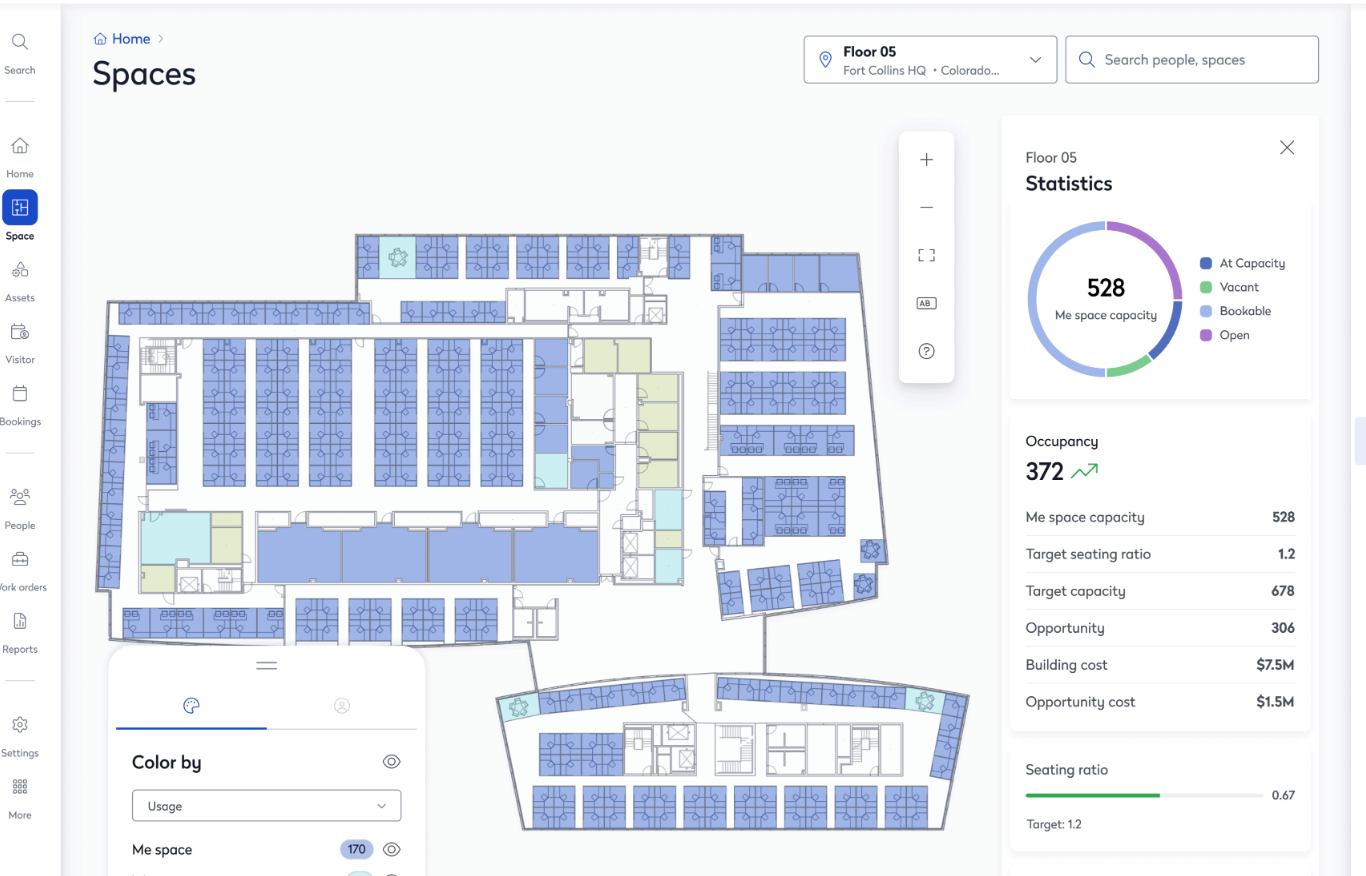
Eptura is an IWMS conglomerate that brings several established workplace tools under one roof, including Condeco, iOffice, Teem, and Locatee. It spans space management, room and desk booking, asset and maintenance workflows, and visitor management. For enterprises trying to standardize a sprawl of point tools, Eptura offers breadth across the full workplace-operations stack rather than a single specialized capability.
Selected features
- Space management and floor planning across a broad portfolio.
- Room and desk booking through Condeco and Teem.
- Asset and maintenance management for facilities workflows.
- Visitor and workplace experience tooling.
- Reporting across the combined suite of acquired products.
Example use cases
- Consolidating separate booking, space, and asset tools into one vendor relationship.
- Standardizing workplace operations across a large, distributed portfolio.
- Giving stakeholders a shared reporting layer over previously siloed systems.
What VergeSense complements
Eptura is strong at running the day-to-day operations of a workplace across many modules. VergeSense adds unified occupancy data and predictive planning underneath it, so the space decisions guided by Eptura are grounded in how rooms and floors are really used.
3. Spacewell
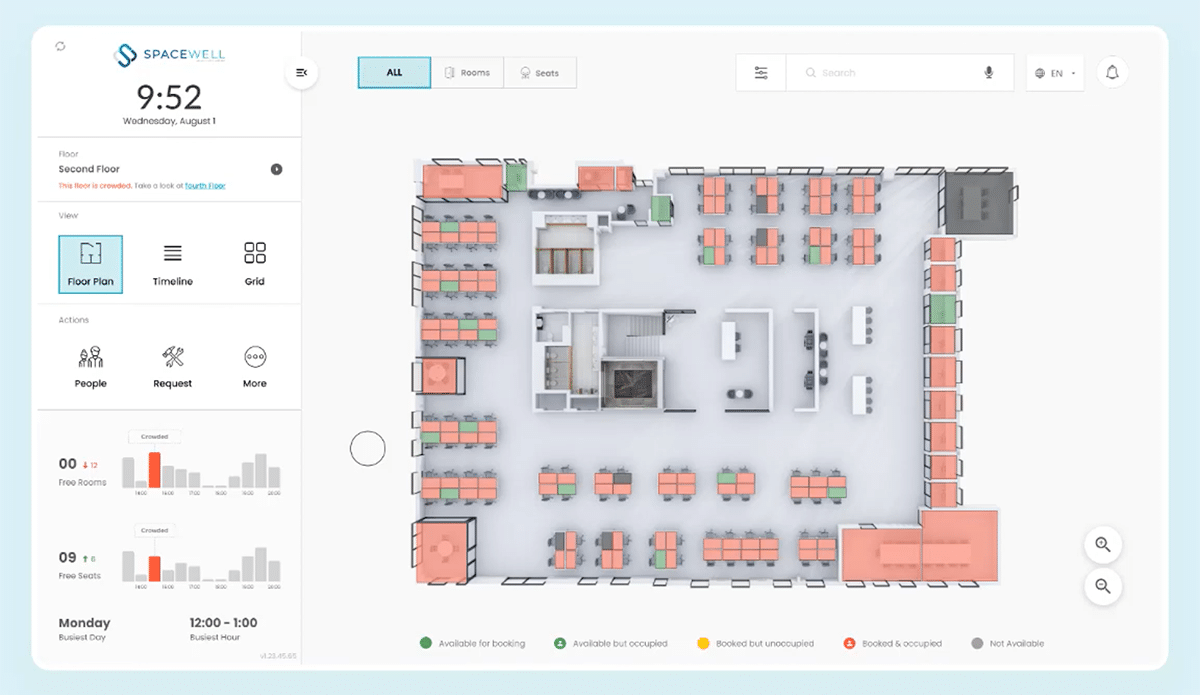
Spacewell is a workplace management and IWMS platform that connects space, energy, and asset data in one system. It pairs smart-building sensors with space booking and interactive 2D and 3D floorplans, and layers analytics on top. Its Workplace, Energy, and Asset modules make it a fit for enterprises running many buildings that want operations, sustainability, and space in a single platform.
Selected features
- Interactive 2D and 3D floorplans with real-time data overlays.
- Occupancy and indoor air quality sensor integration.
- Space booking and reservation management.
- Energy monitoring with AI-powered anomaly detection.
- Asset and maintenance workflow automation.
Example use cases
- Running space, energy, and maintenance from one connected platform.
- Supporting sustainability goals with building performance data.
- Giving employees mobile navigation and service requests across sites.
What VergeSense complements
Spacewell brings deep smart-building operations and a rich IWMS footprint. As a partner, VergeSense plugs in as the occupancy intelligence and predictive planning layer, feeding measured occupancy into Spacewell's floorplans and analytics so its space views reflect how buildings are actually used, and by pulling in data from Spacewell to power Predictive Planning insights in the Meridian platform for right-sizing, occupancy planning, and space design decisions.
4. OfficeSpace Software
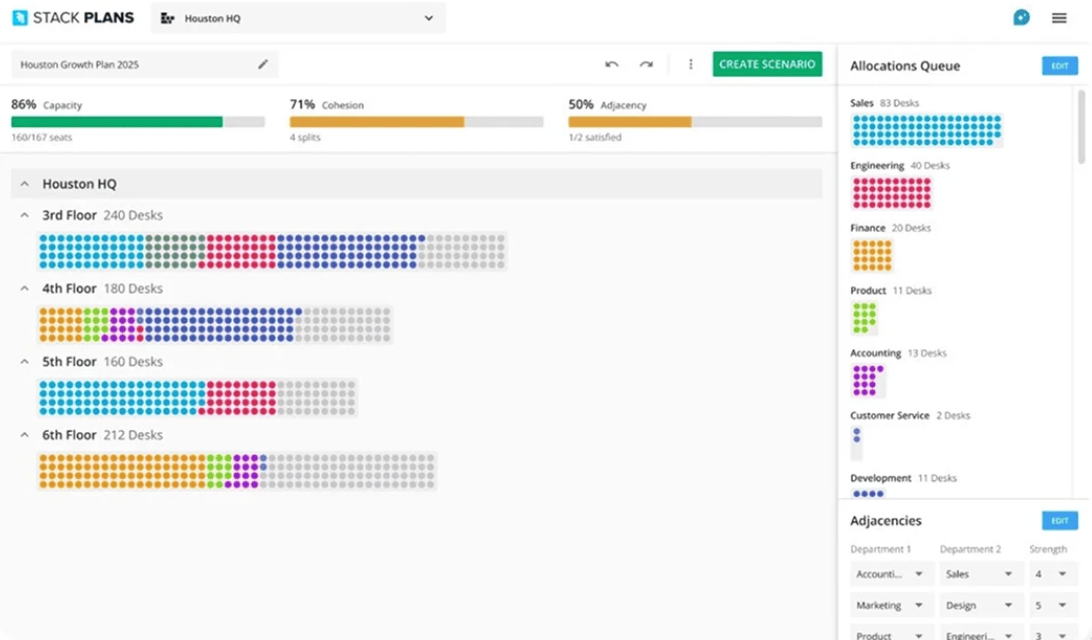
OfficeSpace Software is a booking-led workplace management platform that moved into AI planning with its Dojo AI acquisition and AI Canvas capability. AI Canvas auto-generates floor layouts and stack plans, letting teams iterate designs quickly rather than restacking by hand. Alongside planning, OfficeSpace covers desk and room booking, moves, and space configuration for workplace teams focused on day-to-day operations.
Selected features
- AI Canvas for auto-generated layouts and stack plans, built on Dojo AI.
- Desk and room booking with hoteling support.
- Move management and space configuration.
- Floorplan visualization and wayfinding.
- Reporting on booking and space activity.
Example use cases
- Generating and iterating stack plans faster than manual restacking.
- Managing moves, adds, and changes across floors.
- Running desk and room booking for a hybrid workplace.
The tradeoff
OfficeSpace offers strong rules-based stack-plan generation and broad operational breadth. The tradeoff is that its planning runs on adjacency and rules optimization rather than behavioral modeling trained on cross-portfolio data. A plan that satisfies every team's requested seat count can still under-deliver if real attendance differs from the assumptions entered, which is where sensor-measured occupancy changes the outcome.
5. Trebellar
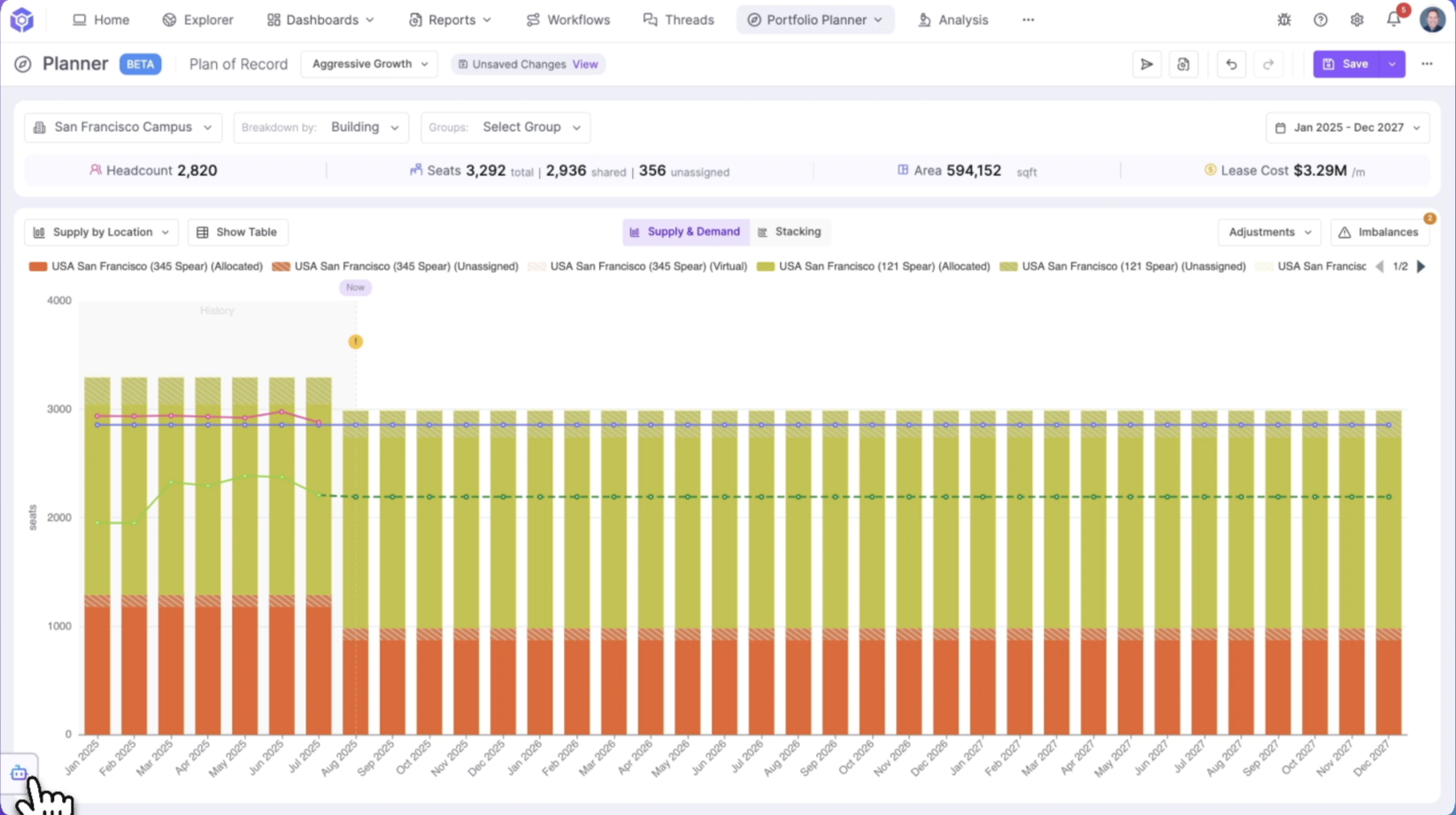
Trebellar is a space-planning and occupancy analytics platform that positions itself as an AI layer for corporate real estate teams. Rather than measuring occupancy itself, it unifies data you already collect, then runs scenario modeling and surfaces insights on top. It's a fit for CRE teams that have multiple existing data feeds and want a single analytics and planning surface over them.
Selected features
- Data unification across occupancy sensors, badge, booking, WiFi, and HRIS.
- CSV and API upload for custom data sources.
- Scenario modeling and predictive analytics.
- An AI companion for on-demand insights.
- Automated reports and customizable dashboards.
Example use cases
- Consolidating scattered occupancy and workplace data into one view.
- Connecting utilization with lease and sentiment data for decisions.
- Producing recurring reports from existing feeds.
The tradeoff
Because Trebellar relies on customer-supplied data, its accuracy and speed depend on the maturity of your existing infrastructure, and its models train per customer with no foundational behavioral model underneath. Gaps in your existing data carry straight through to the forecast, and if you want to validate a change after the fact, you need to set up the measurement yourself.
6. Accruent
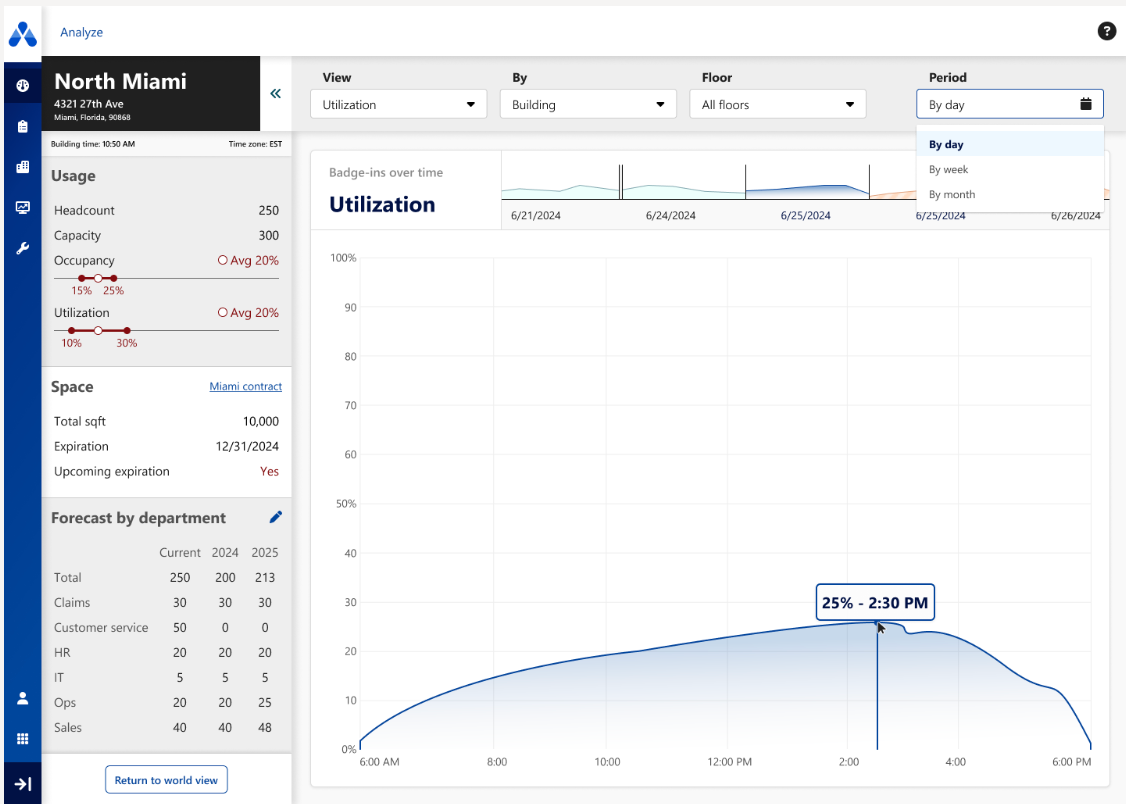
Accruent Space Intelligence is a space analytics and planning product inside Accruent's broader real estate, facilities, and asset ecosystem. It aggregates data from badge access, lease records, and connected Accruent products into a single view, then offers Analyze and Plan modules for portfolio visualization and restack modeling. For organizations already standardized on Accruent, it extends that footprint into space optimization.
Selected features
- Analyze module for real-time portfolio, cost, and utilization visualization.
- Plan module for restack and space-allocation modeling.
- Interactive floor mapping.
- Integrations with EMS, FAMIS 360, and Lucernex.
- A unified data layer across Accruent products.
Example use cases
- Extending an existing Accruent deployment into space analytics.
- Modeling department restacks before implementation.
- Tracking cost and headcount metrics across a global portfolio.
The tradeoff
Accruent Space Intelligence delivers useful space analytics within the Accruent ecosystem. The tradeoff is that its planning relies on booking and badge inputs without sensor measurement alongside them, so it reflects who scanned in or reserved a space more than how that space was actually occupied through the day.
7. Envoy
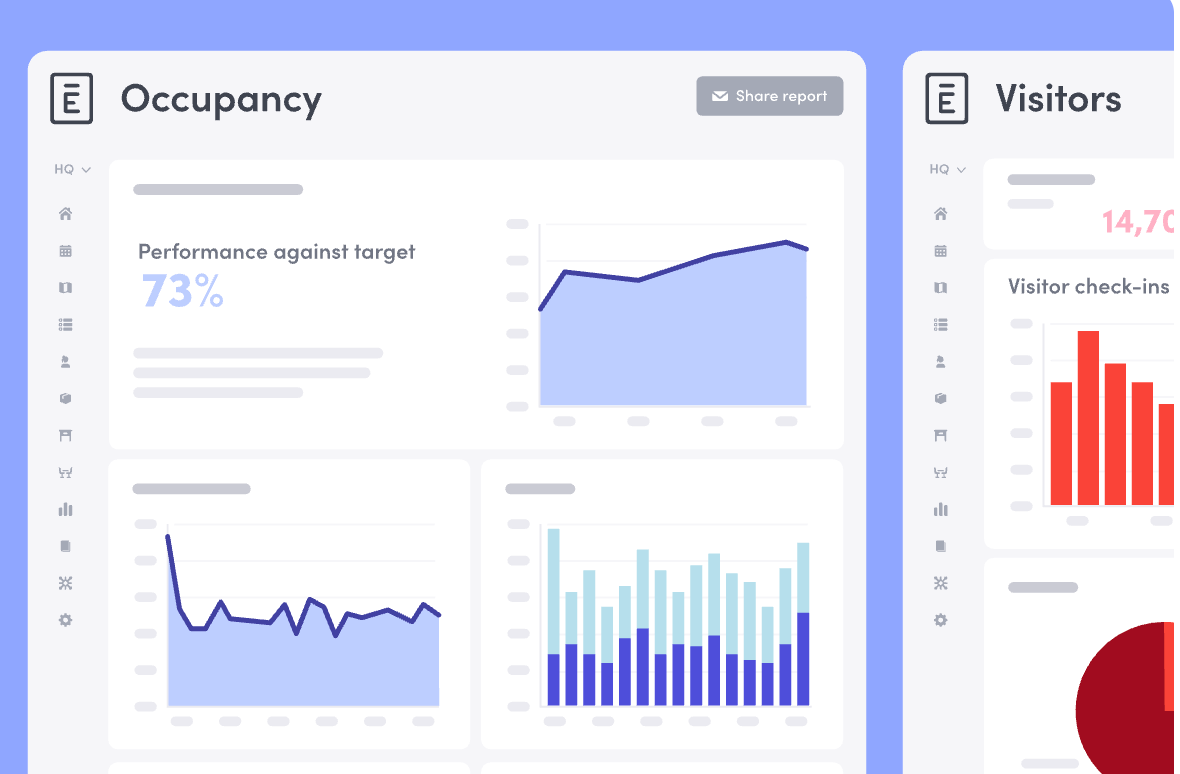
Envoy is a workplace management platform known for visitor management, desk and room booking, and workplace experience, with utilization analytics layered on top. It's a strong fit for teams whose primary need is a smooth booking and check-in experience, and who want reporting on how those bookings translate into space activity. Utilization insight in Envoy comes from that booking and check-in data rather than dedicated sensing.
Selected features
- Desk and room booking with reservation management.
- Visitor management and front-desk workflows.
- Workplace maps and wayfinding.
- Utilization reporting derived from booking and check-in data.
- A broad set of workplace experience integrations.
Example use cases
- Running visitor, desk, and room booking from one platform.
- Reporting on reservation and check-in activity.
- Supporting a hybrid work environment’s day-to-day experience.
The tradeoff
Envoy's utilization analytics are booking-derived, not sensor-measured. That means a desk booked and never used, or a room held by a jacket over a chair while occupied by no one on the reservation, can read differently from what actually happened. This lack of visibility can create costly inconsistencies when it comes to lease or redesign decisions.
Comparing platforms and want to see the difference measurement makes?
VergeSense pairs occupancy data with predictive planning so your space decisions rest on behavior, not booking activity.
Key Features and Capabilities To Prioritize in Space Utilization Software
Not every capability carries equal weight, regardless of whether you're evaluating a dedicated occupancy platform or broader space management software. The features below are the ones that most often separate a platform you'll trust for a lease decision from one you'll only use as a dashboard.
Occupancy Data Accuracy
Everything downstream depends on how well the platform measures reality. You’ll get around 95% accuracy for measurement at the area level, compared with roughly 85% for WiFi at the floor level.
Booking and badge data record intent and access rather than presence, so the difference compounds. A desk booked but empty, or a badge scan with no one at the desk an hour later, distorts every report built on top.
Reporting Versus Decision Support
Ask whether the platform stops at historical dashboards or actually models future scenarios.
A dashboard can tell you a floor ran at 40% last quarter. Decision support looks forward, forecasting what happens to that floor if you consolidate two teams onto it, before you sign anything.
Flexibility in Data Inputs and Deployment
Your occupancy signal rarely lives in one place. The strongest platforms pull from several sources and reconcile the different data points.
- Badge and access-control data
- Room and desk booking systems
- WiFi connection data
- Video conferencing data
- Dedicated occupancy sensors
A platform that can combine these, and add sensor measurement where accuracy matters most, adapts to your environment instead of forcing a single method.
Planning and Forecasting Capabilities
Figure out whether the platform can model how a change will perform before you commit to it. You want scenario modeling that forecasts how headcount shifts, policy changes, or redesigns would perform. Forecasts grounded in a cross-portfolio behavioral model carry more weight than rules that only optimize for adjacency.
Jamie Kinch, VP of Real Estate and Corporate Facilities at Moderna, framed the payoff as speed: "We're constantly looking at how we can iterate faster to improve the experience for our employees... The faster we can iterate, the better we can make the employee experience."
Enterprise Readiness and Scalability
A tool that works on one floor can still fail across a portfolio. Enterprise readiness covers security posture, global deployment, and integration depth with the systems you already run.
Consider how the platform handles many sites, multiple regions, and the reporting needs of stakeholders who never open the tool directly.
Outputs That Different Stakeholders Can Use
Real estate leaders, workplace strategy teams, finance partners, and building operations departments all pull on the same data for different reasons. The best platforms produce outputs each of them can act on.
That might be a portfolio right-sizing view for real estate, a neighborhood design view for strategists, and an operations signal for the teams running the building day to day.
How To Choose Space Utilization Software for Your Team and Workflows
The right space planning software is the one that fits the decisions you actually make and the data you already have. These two lists help you pressure-test both sides before you shortlist.
Questions To Ask Internally
- What specific decisions do we need this data to support, from lease renewals to redesigns?
- Who owns the data and the decisions once the tool is in place?
- What occupancy signals do we already collect, and where are the gaps?
- How accurate does our measurement need to be for the calls we're making?
- Do we need to forecast future scenarios, or only report on the past?
- How many sites and regions must this scale across?
- Which stakeholders need outputs, and in what form?
Questions To Ask Vendors
- Do you measure occupancy directly, or ingest data we supply?
- What is your measurement accuracy, and how is it validated?
- Can the platform model future scenarios before we commit budget?
- What is your model trained on, and does it draw on data beyond our own?
- Which systems do you integrate with, from booking to badge to IWMS?
- How do you handle enterprise security and global deployment?
- How do you validate outcomes after a change is implemented?
Ready to put a platform against your real portfolio?
VergeSense shows real estate leaders and workplace strategists how measurement and predictive planning work on their own space.
FAQs About Space Utilization Software
What Is Space Utilization Software?
Space utilization software measures space usage and helps teams plan around it. It gathers occupancy signals from sensors, badges, and booking systems. The strongest platforms turn those signals into reporting and forecasts you can use for lease, consolidation, and redesign decisions.
How Does Space Utilization Software Differ From a Desk Booking Tool?
The two tools answer different questions. A desk booking tool records intent: who reserved which desk or room. Space utilization software measures what actually happened in the space, which can differ sharply from bookings. Some platforms combine both, but only sensor measurement captures real presence rather than reservations.
What Utilization Rate Should a Workplace Target?
There's no single utilization rate target that fits every workplace. The right rate depends on your policy, space mix, and goals. The VergeSense Occupancy Intelligence Index reports that measured utilization often runs well below assumptions, which is why teams anchor targets to their own measured baseline rather than a benchmark.
Can Space Utilization Software Work Without Occupancy Sensors?
Sensors aren't a hard requirement for space utilization software. Many platforms run on badge, WiFi, booking, and video conferencing data alone. The tradeoff is accuracy, since those sources capture access and intent rather than presence. Adding sensor measurement alongside those sources where it matters most gives the reliable behavioral signal that informed lease and redesign decisions depend on.