

<img height="1" width="1" style="display:none;" alt="" src="https://px.ads.linkedin.com/collect/?pid=2274356&amp;fmt=gif">
Skip to content

LIVE SEPT 23: The 12th Space Planning Summit, with GlobalLogic's Dan Ramirez Save My Seat

video poster image

Right-size Your Portfolio in Hours,
Not Quarters

See exactly where to expand, consolidate, or exit, with the cost impact of each option quantified. Continuous, so you can update your plan when headcount, attendance, or policy changes.


Trusted by 200+ Enterprises Across 50 Countries

BP logo
Cisco logo
Autodesk logo
HP logo
Fresenius logo
Twilio logo
NBC logo
BP logo
Cisco logo
Autodesk logo
HP logo
Fresenius logo
Twilio logo
NBC logo

Space Planning Decisions You Can Defend.

Start with your floor plan, and then get a baseline with benchmarks from 250M+ sq ft of data across enterprise portfolios. Adding your own occupancy data sharpens the plan, and then you can adjust whenever the inputs change.

An interactive workspace layout configuration panel where users can set desk assignment policies, choose between free address or home base seating, and set up initial floor plan parameters.

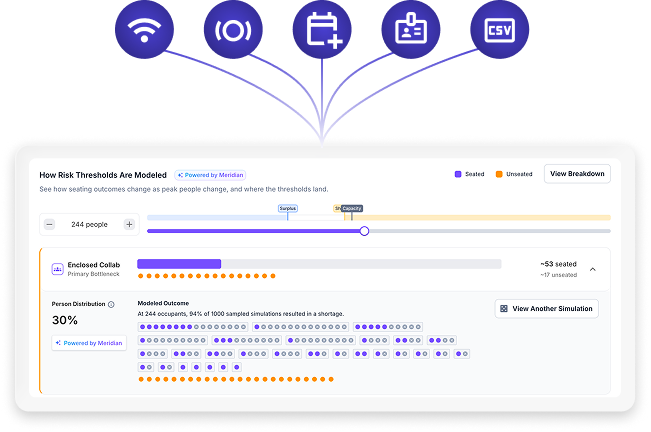
Upload your floor plan and input your headcount projections, attendance policies, and other details. Predictive Planning draws on benchmarks from 250M+ sq ft of similar organizations to generate your plan immediately, no sensors required to get started.

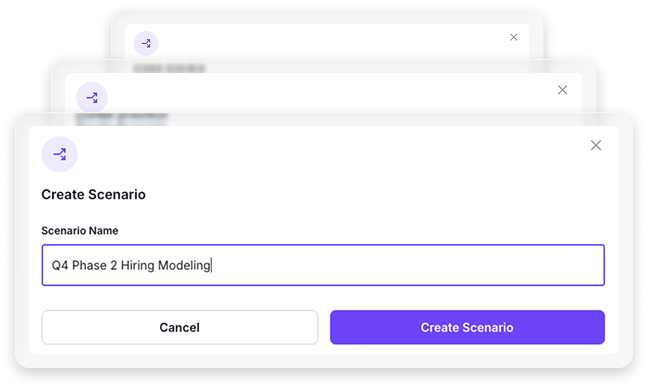
Model lease scenarios, consolidation options, and headcount shifts from day one.
Built for Leaders Who Own the Decision & Have to Justify It

Illustration representing real estate executives evaluating lease scenarios and renewals

VPs and Directors of Corporate Real Estate

You're evaluating lease renewals, consolidations, or exits and you need reliable data to make a call. Meridian gives you the scenario modeling and CFO-ready financials to move from instinct to evidence fast.

Illustration representing workplace managers coordinating headcount and space utilization

Workplace Leaders

You're managing the intersection of headcount planning, policy changes, and workplace experience. When those variables change, and they always do, Meridian helps you understand the effects to experience and your space in real-time.

Illustration representing finance and financial planning analysis teams reviewing real estate cost data

Finance and FP&A Teams

Real estate is one of your largest cost lines, and the business is asking you to find efficiencies. You need data-backed projections, not a consultant's assumptions. Meridian generates the cost savings analysis, payback timelines, and implementation roadmaps you need to make the case.

Operations Leaders: Illustration representing global portfolio management across multiple international sites

Global Portfolio Operations Leaders

Managing 30 sites across 12 countries means you need a streamlined view of trends for better space planning. Meridian scales across your entire footprint, giving you consistent, comparable data everywhere at once.

Everything You Need to Plan with Confidence

How Enterprise Teams Are Planning Smarter & Saving Millions

CHALLENGE

Fresenius needed to make a high-stakes HQ consolidation decision, but lacked the data to know how much space they actually needed versus how much they were paying for.

SOLUTION

VergeSense enabled their CRE team to model right-sizing scenarios with real usage data rather than assumptions or consultant estimates.

RESULT

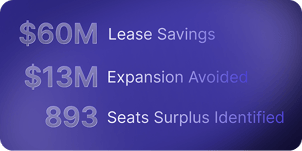
$6M per year in avoided lease costs — $60M over ten years. A decision they made with data, not gut feel, and one they could defend to Finance.

Fresenius Logo

$60M in Lease Avoidance Over 10 Years

One data-backed decision. No consultant. No guesswork. Just 20% utilization that made the answer obvious.

Consultants Deliver a Plan.
Meridian Delivers a Planning Engine.

A consulting engagement is a project. You define scope, wait for analysis, receive a report, and repeat the cycle when anything changes. Meridian from VergeSense is a platform, always-on, updates in real time, and gets smarter as more data flows in. Here's what that difference looks like in practice.

Dimension
Consultant-Led Planning
Planning with Meridian
Time to first answer 3-6 months Minutes to hours
Cost per engagement $250K-1.5M+ Platform subscription
Data freshness Point-in-time snapshot Continuously updated
Scenarios modeled 1-2 per engagement Unlimited, self-serve
CFO-ready outputs Manual assembly Built-in, auto-generated
Ongoing updates Re-engage the consultant Always current, no lag
AI capabilities None Large Spatial Model (LSM)
Portfolio coverage Selected sites only Entire portfolio at once

Frequently Asked Questions

What is occupancy-based portfolio planning?

Occupancy-based portfolio planning uses real-time data on how people actually use office space, rather than historical headcount ratios or lease capacity, to decide where to consolidate, expand, or redesign. It replaces static assumptions with behavioral signals like peak attendance, space-type utilization, and day-of-week patterns. The Meridian Platform takes this further by using the Predictive Planning product to model thousands of scenarios, so teams can right-size with confidence before making any physical changes.

How can I right-size my real estate portfolio without months of consultant studies?

Traditional consultant studies take 3–6 months, cost six figures, and deliver a static report that's outdated by the time it's finished. VergeSense Predictive Planning tool generates scenario-based portfolio plans in hours, not months, powered by a large spatial AI model trained on over 250 million square feet of real workplace behavior. Teams can model headcount changes, lease exits, or hybrid policy shifts side by side and get CFO-ready outputs showing cost impact, capacity breakpoints, and employee experience risk, all without hiring external resources.

What data do I need to start planning if we don't have occupancy sensors yet?

You don't need sensors to get started with Predictive Planning. It uses benchmarks drawn from 250M+ square feet of real-world occupancy data to predict how your spaces are likely being used based on your floor plans, headcount, team mix, and region. This gives you a defensible, data-backed baseline on day one. As you layer in sensor, badge, videoconferencing, Wi-Fi, or other data over time, the model refines its predictions to reflect your actual building behavior.

How accurate are AI-powered workplace forecasts?

Accuracy depends on the quality of the underlying data and the modeling approach. VergeSense's Large Spatial Model uses Monte Carlo simulations, running 1,000+ scenarios per plan, to produce probabilistic forecasts rather than single-point estimates. This means you get a range of likely outcomes with confidence intervals, not just a guess. When connected to live occupancy data from VergeSense sensors (95%+ accuracy) or Wi-Fi, the forecasts become even more precise because the model learns from how your people actually behave.

Can I forecast space needs for headcount growth, hybrid policy changes, or office consolidation?

Yes. Predictive Planning lets you model any combination of headcount growth or reduction, attendance policy changes, hybrid schedule shifts, and lease decisions. You input the variables, and the model instantly shows the supply-demand impact, including where you'll run out of conference rooms, desks, or focus spaces first. Teams can compare scenarios side by side and quantify the financial and employee experience tradeoffs of each option.

What does a CFO-ready portfolio plan actually include?

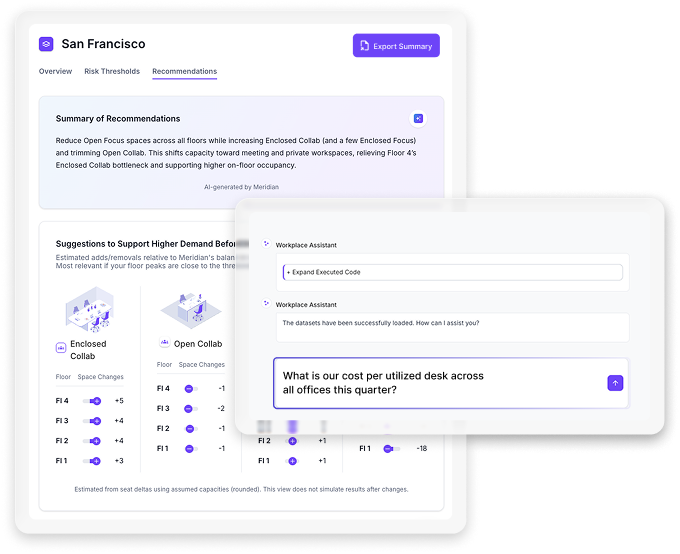
A CFO-ready plan translates occupancy intelligence into financial language: cost savings per scenario, payback timelines, capacity surplus or shortage by building, and employee experience risk scores. Predictive Planning generates AI-powered executive summaries with each plan that show exactly where you have too much or too little space, what it's costing you, and what the ROI looks like for each option. Every number traces back to real behavioral data, not assumptions, so you can defend recommendations in leadership meetings.

Does this work for global, multi-site portfolios?

Yes. Predictive Planning is built for enterprise-scale portfolios spanning hundreds of buildings across regions. The Large Spatial Model adjusts for regional work patterns, team composition differences, and local attendance behaviors. You can run scenarios at the portfolio level, like modeling the impact of consolidating three offices into one, or drill down to individual buildings and floors. For unmeasured sites, the model uses industry benchmarks to extend benchmarks across your entire portfolio from day one.

What is the Large Spatial Model and why does it matter for workplace planning?

The Large Spatial Model (LSM) is VergeSense's AI foundational model, trained on eight years of real-world workplace data across 250+ million square feet. Unlike simple occupancy dashboards that report what happened yesterday, the LSM predicts how people will interact with space under different conditions. It generates "Usage Fingerprints," behavioral profiles that capture how an office actually works, and uses those to simulate realistic outcomes before you make any changes. It's the difference between planning on averages and planning on behavior.

Can I integrate my lease data and IWMS with VergeSense?

Yes. VergeSense integrates with major IWMS systems to bring lease, asset, and reservation data into a unified view of your portfolio. You can also add your building's actual lease costs, annual lease cost, OPEX, lease length, and expiration date, directly in Predictive Planning's Building Settings. That cost data now surfaces alongside every forecast, so every scenario comparison carries real financial context, not just space and headcount numbers. The Large Spatial Model is also available via API for technology partners building planning, experience, or smart-building tools.

What ROI can I expect from occupancy-based portfolio planning?

ROI varies by portfolio size and market, but the primary savings come from avoiding unnecessary lease renewals, consolidating underutilized space, and right-sizing before costly build-outs. Customers have used VergeSense data to uncover buildings running at 20% utilization and redirect that spend. Predictive Planning quantifies the financial impact of every scenario, so the business case is built into the output, not assembled after the fact.

Connects to the Systems You Already Use

IWMS
image 42
image 11
image 12
image 14
image 13
BMS
image 15
image 16
image 17
Booking
Screenshot 2026-03-09 at 11.13.45 PM 1
image 18
image 19
Screenshot 2026-03-09 at 11.13.45 PM 3
image 20
image 44 (1)
Group 8496

Design Today. Simulate Tomorrow.

Predictive Planning simulates what happens before you change a space. Occupancy Intelligence shows what's happening after. Together: model, change, measure, iterate. It starts with the floor plan you already have.