
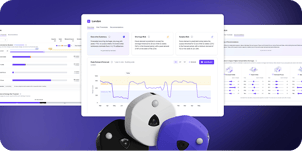



Run the Building for Less. Without the Complaints.
Cleaning schedules, HVAC runtimes, staffing levels, and vendor scope, all set for a building that's no longer full. Meridian ties them to measured occupancy, so spend follows use and you can show service levels still hold where it mattered.

.png?width=100&height=53&name=Layer_1%20(1).png)
.png?width=150&height=15&name=Layer_1%20(2).png)
.png?width=50&height=50&name=Layer_1%20(3).png)
.png?width=150&height=33&name=Layer_1%20(7).png)
.png?width=100&height=30&name=Layer_1%20(4).png)
.png?width=50&height=51&name=Layer_1%20(6).png)

Cleaning crews follow fixed routes regardless of occupancy. You’re paying to clean floors that nobody used, while occupied spaces wait until the next scheduled cycle.
Staffing decisions are based on calendar bookings, not reality. Conference rooms show 80% booked but only 50% actually occupied. You’re staffing for phantom demand.
HVAC runs at full capacity in empty wings. Building systems operate on schedules, not demand. Energy costs stay high even when attendance drops by half on Mondays and Fridays.
Reactive maintenance wastes time and money. You find out a space is broken when someone complains, not when the data tells you something changed.

.png?width=911&height=801&name=Group%208488%20(1).png)


Real-Time Occupancy Visibility
See live occupancy across every building, floor, and space type. Know instantly which areas are active and which are empty, without relying on calendar bookings or manual walk-throughs.

BMS & Building System Integration
Connect occupancy data directly to building management systems, HVAC controls, and lighting systems. Occupancy signals trigger real-time adjustments so building systems respond to actual demand.

Automated Cleaning Triggers
Send cleaning crews where they’re needed based on occupancy, not fixed schedules. When a meeting room is vacated or a floor reaches a usage threshold, cleaning workflows trigger automatically through ServiceNow or your existing FM platform.

Dynamic Stacking & Space Allocation
Use occupancy patterns to consolidate usage to fewer floors on low-attendance days. Close and de-commission unused floors to save on cleaning, HVAC, and security, while maintaining experience on active floors.

Staffing Optimization
Align security, reception, catering, and maintenance staffing to actual attendance data. See demand curves by day, hour, and building, and right-size contract labor accordingly.


saved with space booking
automation
.svg)
energy savings
(Deutsche Bank)
.svg)
energy savings
(Oil & Gas)
A Smarter Way to Run Your Building
Calendar bookings show intent. Occupancy data shows reality. The gap between them is where operational waste lives.
| Legacy Approach | With Meridian |
|---|---|
.svg) Fixed cleaning schedules regardless of usage Fixed cleaning schedules regardless of usage |
 Demand-triggered cleaning based on actual occupancy Demand-triggered cleaning based on actual occupancy |
|
HVAC runs on timer-based programs |
HVAC adjusts in real time to actual headcount |
|
Staffing based on calendar bookings |
Staffing aligned to measured attendance patterns |
|
Find problems when employees complain |
Proactive alerts when usage patterns change |
|
One operating model for every day |
Dynamic stacking that adjusts to daily demand |
|
Manual reporting on facility utilization |
Real-time dashboards with automated alerts |