

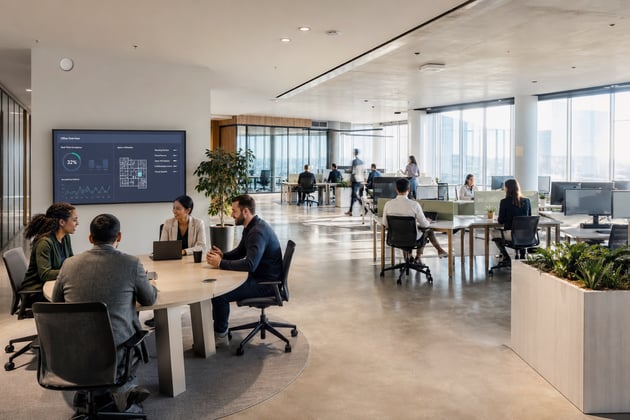

For years, occupancy planning meant hiring a consultant, waiting for a study, then acting on insights that risked being out of date.
That model is giving way to continuous measurement. CRE leaders making portfolio decisions in 2026 increasingly want occupancy data that stays current between decisions, and planning that can forecast what happens next rather than describe what already happened.
Your options span several broad categories: sensor-first occupancy platforms that measure how space is actually used, workplace management platforms that read occupancy mostly through bookings and schedules, and the legacy consulting-led advisory model that still anchors major portfolio strategy. This guide compares six of them:
- VergeSense: Enterprise workplace AI platform with predictive planning
- Density: Sensor-first occupancy measurement with real-time people counting
- OfficeSpace: Booking-led workplace management with utilization analytics
- Kadence: Hybrid scheduling and workplace management with attendance analytics
- Trebellar: An AI analytics layer that unifies existing corporate real estate data
- Legacy consulting firms: Advisory-led portfolio strategy and periodic occupancy studies
Curious how occupancy patterns are shifting across enterprise portfolios?
See the latest data on utilization, peak demand, and planning gaps across 210+ enterprise portfolios in this VergeSense research report.
At-a-Glance Comparison of Occupancy Planning Approaches
Here is how the six approaches compare on method, data inputs, and how far each one takes you past reporting.
|
Tool / Approach |
Best For |
Core Method |
Data Inputs |
Analytics and Planning Depth |
Best-Fit Buyer |
|
VergeSense |
Confident real estate and workplace decisions, from today's utilization to long-term portfolio strategy |
Multi-source occupancy intelligence plus AI predictive planning on the Large Spatial Model |
Infinity sensors, badge, WiFi, room booking, video conferencing |
Portfolio-to-zone measurement plus forecasting and post-change validation |
CRE and workplace leaders making lease and portfolio decisions |
|
Density |
Real-time people counting in measured spaces |
Radar sensors feeding live dashboards |
Density sensors, API |
Real-time and historical reporting |
Teams that want granular live occupancy measurement |
|
OfficeSpace |
Day-to-day workplace management and moves |
Booking-led management with rules-based space planning |
Floor plans, badge and booking history, headcount, third-party sensors |
Utilization reporting plus stack planning |
Workplace ops teams managing bookings and moves |
|
Kadence |
Coordinating hybrid schedules and bookings |
Scheduling and booking platform with AI planning |
Bookings, attendance, calendar and HR integrations |
Attendance analytics plus scenario planning |
Hybrid workplace teams coordinating people and spaces |
|
Trebellar |
Unifying fragmented CRE data for analysis |
AI analytics layer over customer-supplied data |
Lease, badge, booking, HRIS, partner sensors, CSV |
Reporting, dashboards, scenario modeling |
CRE teams consolidating existing data sources |
|
Legacy Consulting Firms |
Portfolio strategy, transactions, and advisory |
Consultant-led occupancy studies and benchmarking |
Surveys, badge snapshots, HR rosters, point-in-time counts |
Periodic strategic recommendations |
Enterprises needing transaction and portfolio advisory |
Best Occupancy Planning Tools and Approaches in 2026
The breakdown below weighs each approach on the same axes: how accurately it measures occupancy, how far it goes past reporting into decision support, how well it scales across a portfolio, and whether it can close the loop from measurement to action. Categories differ, so the right fit depends on which decision you're trying to make and who owns the data after the work is done.
1. VergeSense
VergeSense brings together your existing workplace data and its own measurement to show how space is used and forecast what comes next.Both capabilities, Occupancy Intelligence and AI-driven Predictive Planning, run on the company's platform, Meridian.
This gives you continuous, portfolio-wide occupancy data and can model space changes against measured behavior. Its Large Spatial Model is trained on 250M+ sq ft of measured workplace data, so decisions rest on how people use space, not survey estimates or a single week of badge counts.
Selected features
- Predictive Planning: Upload a floor plan and model headcount growth, policy shifts, or neighborhood changes against measured behavior, with no sensors needed to begin.
- Large Spatial Model (LSM): The forecasting engine trained on 250M+ sq ft of measured workplace data across 210+ enterprises.
- Occupancy Intelligence: One trusted picture of space use that unifies badge, WiFi, room booking, video conferencing, and sensor data.
- Infinity Area Sensor: A wireless, magnetically mounted sensor with roughly a 10-year battery and passive occupancy detection, delivering about 95% area-level accuracy versus roughly 85% for WiFi at the floor level.
- Workplace Assistant: A conversational way to retrieve occupancy answers and reports without building dashboards by hand.
- Portfolio-to-zone granularity: Measurement and planning that scale from the whole portfolio down to a single neighborhood or zone.
- Integrations: Connections to Microsoft Places, ServiceNow WSD, Juniper Mist, and Cisco Meraki, among 50+ integrations.
Best for
CRE and workplace leaders who need continuous, portfolio-wide occupancy data and want to forecast and validate space decisions without repeated consulting studies.
A real-life example
A food and consumer goods manufacturer with 5,000+ employees cut its headquarters footprint by 75% after six months of measured occupancy data showed its 42,000 sq ft Chicago HQ running at 5% average capacity and peaking at 25%. The result was $715K in annual cost avoidance, and a lease exit and sublease decision its CFO could defend, rather than an estimate of how much space the business really needed.
Want to see how your own sites are actually being used?
A VergeSense specialist can walk you through your portfolio and where measured demand differs from the plan.
2. Density
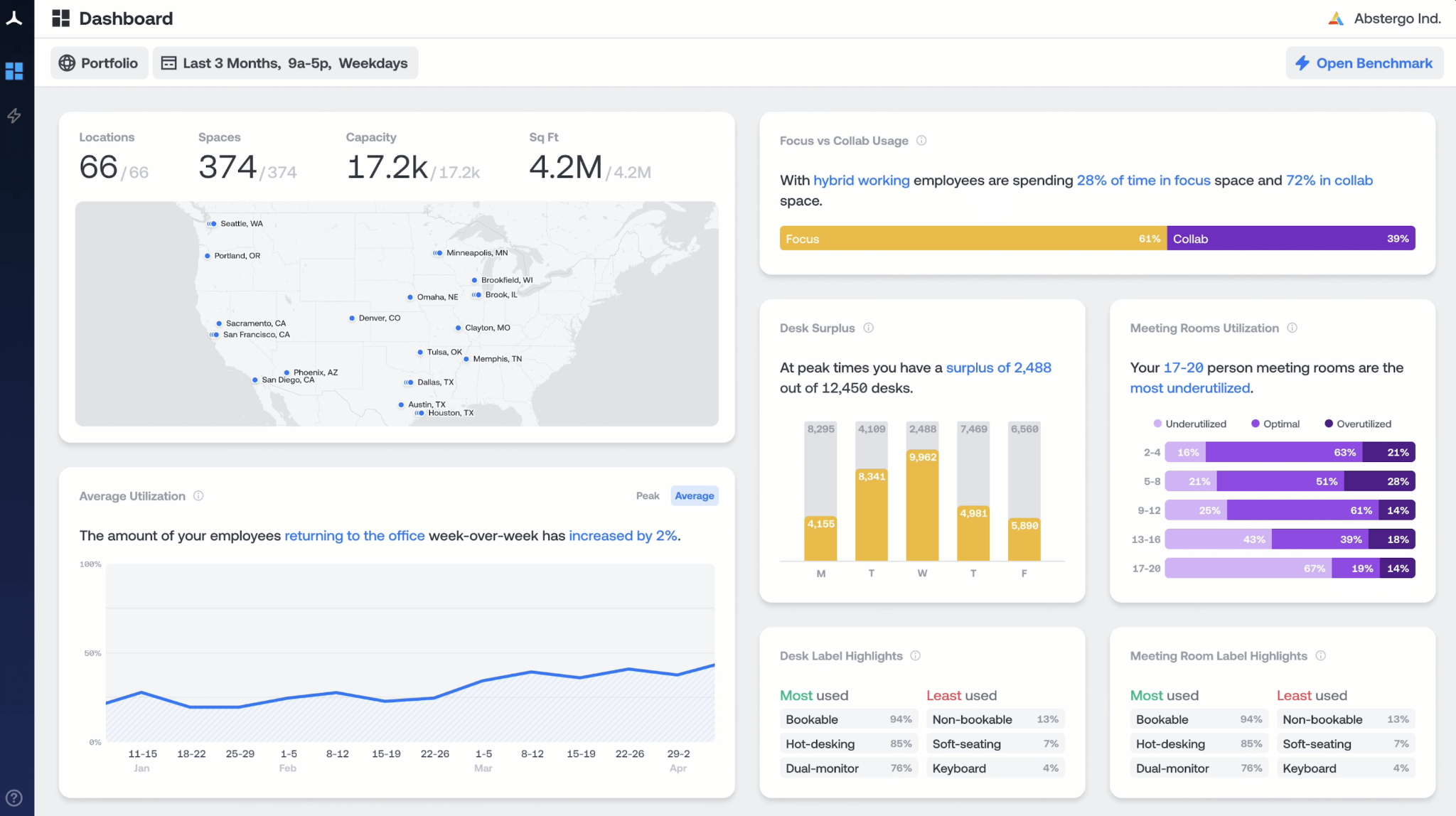
Density is a sensor-first occupancy platform built around real-time people counting. Its radar sensors anonymously count how many people occupy a space and feed live and historical dashboards, so workplace teams can see how rooms, desks, and open areas fill through the day. The focus is precise, real-time measurement of the spaces where sensors are installed.
Selected features
- Open Area sensor: Anonymous people counting across open floors and shared spaces.
- Entry sensor: Doorway counting for building and floor-level occupancy.
- Real-time dashboards: Live and historical occupancy views with low data latency.
- API integrations: Programmatic access to real-time and historical occupancy data.
Example use cases
- Confirming real-time meeting room and desk availability.
- Measuring peak demand in high-traffic open areas.
- Feeding occupancy data into other workplace systems through the API.
The tradeoff
Density leads on granular, real-time measurement, but it stops at reporting what happened rather than modeling what happens next. Teams still need a separate way to turn those counts into portfolio and lease decisions.
3. OfficeSpace
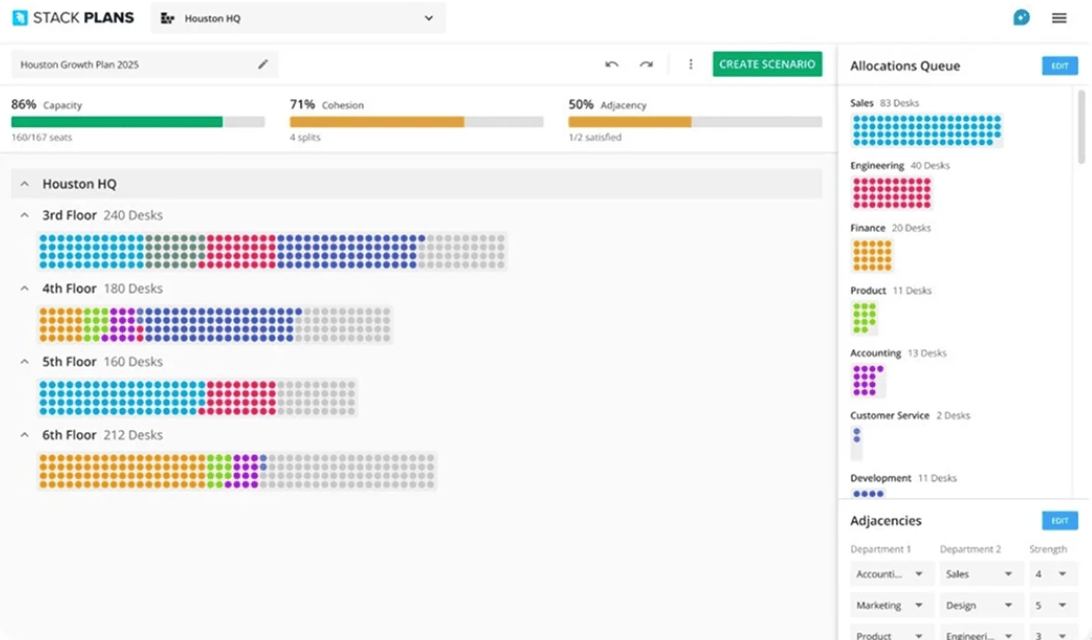
OfficeSpace is a workplace management platform built around desk and room booking, moves management, and space planning. After acquiring Dojo AI, it added AI-assisted stack planning and scenario comparisons. It's strongest as the day-to-day operating system for facilities teams handling bookings, visitors, wayfinding, and moves, with utilization reporting layered on top.
Selected features
- Desk and room booking: Reservations with smart nudging and automated check-ins.
- Moves, adds, and changes: Stack planning and move management across floor plans.
- AI-assisted space planning: Rules-based stack plans and scenario comparisons.
- Visitor management and wayfinding: Front-desk and navigation tools.
- Portfolio analytics: Real-time utilization and portfolio reporting.
Example use cases
- Managing daily desk and room reservations.
- Running moves and reallocating seats across floors.
- Reporting utilization from bookings and integrated sensors.
The tradeoff
OfficeSpace optimizes the space you define against planner-set constraints, and it depends on your own floor plans, booking history, and third-party sensors for data. It doesn't generate its own portfolio-wide occupancy signal or forecast behavior from a cross-enterprise model, so accuracy tracks the quality of the data you feed it.
|
See the full VergeSense vs OfficeSpace comparison |
4. Kadence
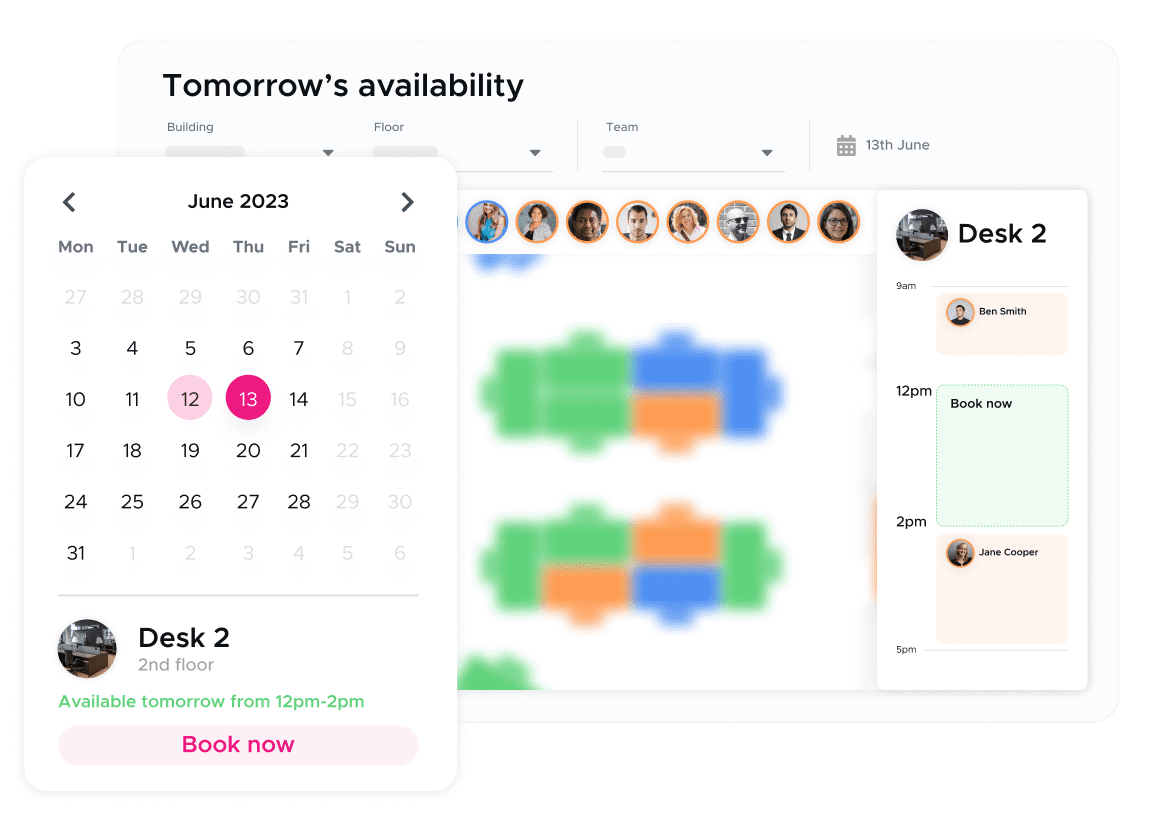
Kadence is a workplace management platform focused on coordinating hybrid work. It combines desk and room booking, visitor management, and team scheduling with occupancy analytics and AI-assisted scenario planning. Its strength is helping people and teams coordinate which days they come in and where they sit, using attendance and booking data rather than sensor measurement.
Selected features
- Desk and room booking: Reservations tied to team schedules.
- Team scheduling: Coordinating which days teams come in.
- Visitor management: Front-desk check-in and hosting.
- Workplace analytics: Attendance and occupancy insights drawn from bookings.
- AI scenario planning: Modeling space changes from attendance patterns.
Example use cases
- Coordinating hybrid schedules across teams.
- Booking desks and rooms around who's in.
- Analyzing attendance patterns to inform space decisions.
The tradeoff
Kadence reads occupancy mostly through bookings and check-ins, which capture intent more than actual presence. Booked-but-empty desks and unbooked drop-ins can skew the picture, so its planning rests on scheduling data rather than measured behavior.
5. Trebellar
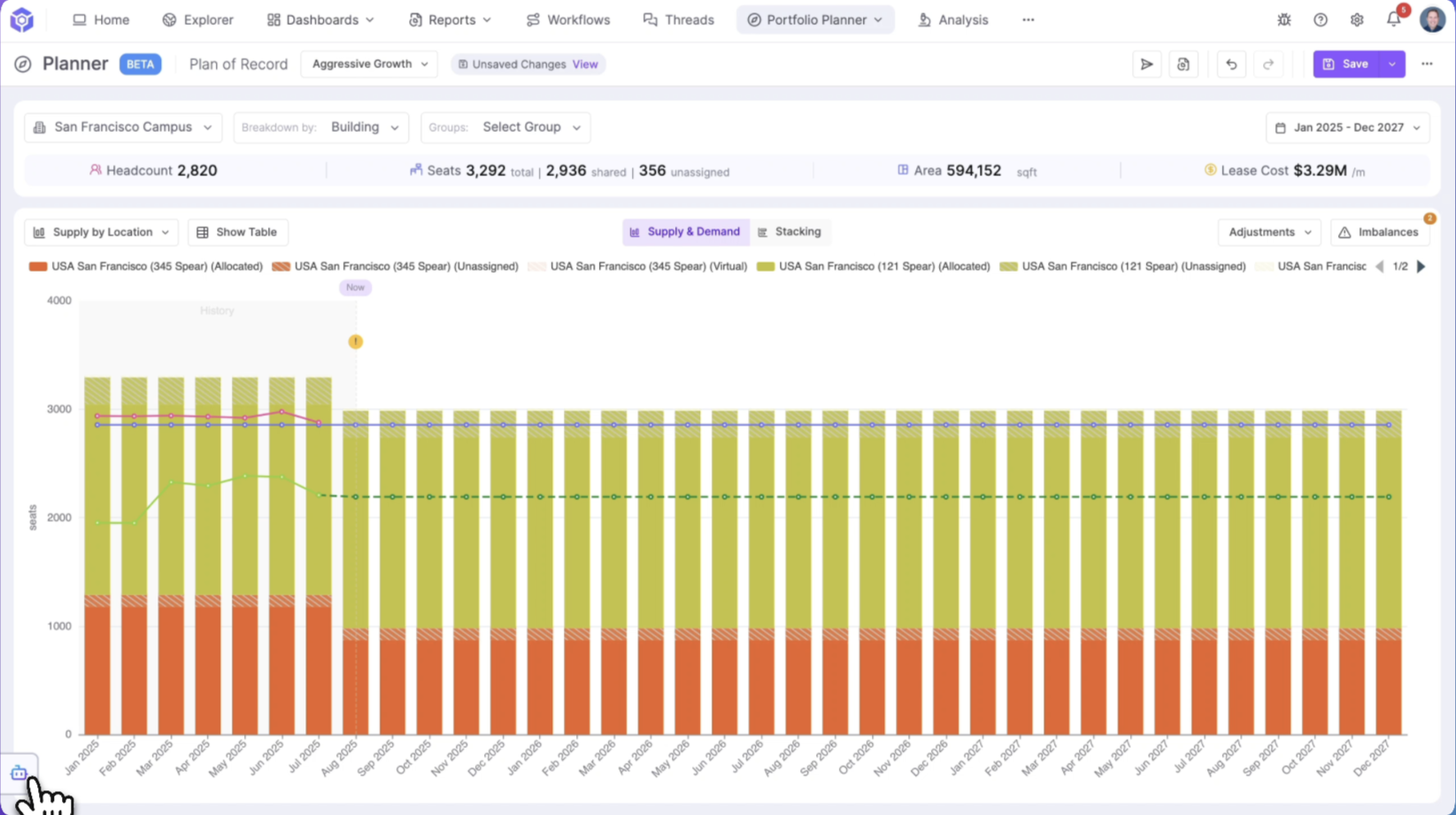
Trebellar is an AI analytics and planning layer for corporate real estate teams. It unifies fragmented data, including lease and cost records, badge logs, booking systems, HRIS, surveys, and partner sensors, into dashboards, reports, and scenario models. It doesn't generate its own occupancy data. Instead, it turns whatever data you can supply into forecasts and recommendations.
Selected features
- Explorer: Navigation and discovery across unified data.
- Reports: Automated insight generation.
- Dashboards: Dynamic performance monitoring.
- Planner: Scenario modeling and strategy.
- Broad integrations: Lease, badge, booking, HRIS, sensor, and CSV inputs.
Example use cases
- Consolidating siloed CRE data into one view.
- Modeling cost and space scenarios from existing records.
- Correlating utilization with employee sentiment.
The tradeoff
Trebellar's models are only as good as the data you bring, and it trains per customer rather than on a cross-enterprise dataset. Without its own sensing, coverage gaps in the source data carry straight through to the forecast, and validating a change after the fact needs separate instrumentation.
6. Legacy Consulting Firms
Legacy consulting firms bring decades of portfolio strategy, transaction advisory, and workplace design experience to occupancy planning.
Their occupancy studies, benchmarking, and lease advisory have long anchored major real estate decisions, and they remain the trusted advisors many enterprises turn to for strategy, negotiation, and change management. The traditional model runs as a periodic engagement: a team gathers data, studies the portfolio, and delivers recommendations.
Selected features
- Portfolio strategy: Long-range planning across a real estate portfolio.
- Occupancy studies: Point-in-time assessments of how space is used.
- Benchmarking: Comparison against market and peer data.
- Lease and transaction advisory: Negotiation and site selection support.
- Change management: Guiding workplace and policy transitions.
Example use cases
- Setting long-range portfolio and workplace strategy.
- Negotiating leases and site selections.
- Guiding large workplace transitions.
What VergeSense complements
The advisory relationship stays central. VergeSense helps consulting teams deliver faster, defensible recommendations built on the client's own data, unifying the badge, WiFi, and booking sources they already have and modeling scenarios in minutes, not months. Consultants bring the judgment and transaction expertise, and VergeSense keeps the underlying data current between engagements.
Want to see the utilization numbers for your own industry and region?
The Occupancy Intelligence Index Explorer lets you filter utilization and peak demand by industry, region, and day of the week.
Key Features and Capabilities to Prioritize in Occupancy Planning
Whichever category you land in, these are the capabilities that decide whether an occupancy plan holds up.
Occupancy Data Accuracy
A bag on a chair, a jacket over a seat, a laptop open while someone steps away for coffee. The space is taken, but a motion sensor often marks it empty.
Accuracy varies by method. For example, VergeSense area sensors measure occupancy at around 95% accuracy at the area level, versus roughly 85% for WiFi-based estimates at the floor level. Whatever the source, a plan inherits every error in the data underneath it.
Most sensors register active presence only. The Infinity Area Sensor also detects passive occupancy, reading signals like a bag left on a chair, which closes the gap presence-only sensors miss.
Reporting vs. Decision Support
Ask whether an approach stops at historical reporting or carries you into forecasting and scenario modeling.
A dashboard can show you a site ran at 45% occupancy last quarter. Decision support tells you what happens to that site if you consolidate two floors, before you sign the renewal.
Jason Finneran, Workplace Experience Specialist at Bread Financial, described what that looks like: "We've been leveraging occupancy data to give new life to spaces that aren't being used much. For example, our entryways and lobbies weren't getting much traffic, so we decided to add more comfortable seating and turn them into areas where people feel comfortable gathering for a quick meeting or coffee."
Flexibility in Data Inputs and Deployment
Badge swipes, WiFi associations, room bookings, video conferencing signals, and sensor data each capture a different slice of how space gets used.
The strongest approaches ingest multiple inputs and don't force a rip-and-replace deployment, unifying the data you already have and adding measurement where you have none.
Planning and Forecasting Capabilities
The question is whether an approach can forecast what happens when you change the space.
Look for the ability to model headcount growth, policy changes, and neighborhood right-sizing against measured behavior, then check the outcome against the forecast once the change is in.
Enterprise Readiness and Scalability
Portfolio decisions span dozens of sites and thousands of spaces. An approach that works for one floor may not scale to a global footprint.
Enterprise readiness means portfolio-to-zone granularity, integrations with the systems you already run, and security and support that match your scale. Ask how many sites and countries a vendor's largest deployments actually cover.
Outputs That Different Stakeholders Can Use
A CRE leader, a workplace strategist, and a CFO each need a different view of the same data, and the outputs have to work for all three.
Look for portfolio dashboards for executives, zone-level detail for planners, and cost figures finance can put in a business case.
How to Choose an Occupancy Planning Approach for Your Team
Work through these questions before you shortlist, first internally, then with each vendor.
Questions to Ask Internally
- What decision are we actually trying to make: a lease renewal, a redesign, or a right-sizing?
- How accurate does our occupancy data need to be for that decision?
- Do we want a point-in-time study, or continuous data between decisions?
- Which data sources do we already have, and where are we blind?
- Who owns the data and the plan after the engagement ends?
- How many sites and spaces does this need to scale to?
- Which stakeholders need outputs, and in what form?
Questions to Ask Vendors
- How is occupancy measured, and how accurate is it at the area and floor level?
- Does the platform forecast outcomes, or only report what happened?
- What data inputs can it ingest, and does deployment require new hardware everywhere?
- How does it scale from a single floor to a global portfolio?
- What does the forecasting model train on?
- Can we validate a change after it's made using the same system?
- Which enterprise systems does it integrate with out of the box?
Working through portfolio decisions without continuous data to back them?
See what continuous, measured occupancy would change about your next lease or consolidation decision.
FAQs About Occupancy Planning
What Is Occupancy Planning?
Occupancy planning is the practice of deciding how much space an organization needs, what types of spaces to provide, and where teams should sit, based on how people actually use the workplace. Done well, it aligns real estate cost with real demand across a portfolio.
How Does Occupancy Planning Differ From Space Utilization Tracking?
Utilization tracking measures how space is used right now. Occupancy planning uses that measurement to decide what to change: forecasting demand, modeling scenarios, and right-sizing the portfolio. Tracking tells you what happened; planning turns it into lease, design, and headcount decisions.
What Data Sources Are Most Reliable for Occupancy Planning?
Area-level sensor measurement is the most reliable single source. VergeSense area sensors run at around 95% accuracy, versus roughly 85% for WiFi estimates. The strongest plans combine sensors with badge, WiFi, room booking, and video conferencing data for a complete picture rather than relying on one input.
How Often Should Occupancy Plans Be Updated?
Traditional consultant-led studies capture a single window every few years. Continuous data from sensors, badge, WiFi, and booking systems keeps the plan current year-round, so decisions rest on recent behavior rather than a stale snapshot. For major lease or design decisions, the underlying data should be current, not months old.
Can Occupancy Planning Work Without Installing Sensors?
Yes. Predictive Planning models space performance from an uploaded floor plan using the Large Spatial Model, with no sensors required to start. Sensors add continuous measurement and let you validate changes after the fact, but forecasting can begin before any hardware goes in.