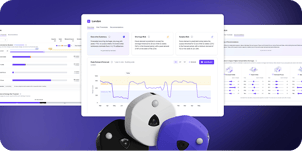

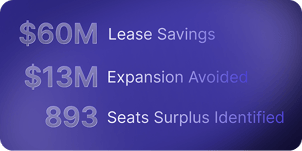



Your booking system says the floor is 85% utilized, your badge data says 60%, and your sensor dashboard shows something different. Leadership wants to know whether to renew that lease or consolidate two neighborhoods, and you're reconciling spreadsheets instead of making the call.
This guide walks you through six space management software platforms used by corporate real estate, workplace experience, and facility management leaders.
You'll see how they differ on occupancy measurement, planning capability, and how to deploy them, then identify which capabilities matter most for your team's decisions.
This guide covers:
- Connecting office space planning to lease and portfolio decisions
- Making faster decisions with predictive planning
- Optimizing space mix across your portfolio
- Identifying bottlenecks before they impact productivity
- Understanding your true capacity beyond seat counts
Stop choosing between depth and coverage
VergeSense gives you Predictive Planning, accurate space-level data from sensors, and Wi-Fi-based portfolio coverage, all in one platform.
At-A-Glance Comparison of the Best Space Management Platforms
The table below compares six leading platforms across the dimensions that matter most to facilities, workplace, and CRE teams.
|
Tool |
Best For |
Core Approach |
Analytics & Planning Depth |
Deployment Model |
Best-Fit Buyer |
|
VergeSense |
Enterprise CRE teams, workplace strategy, and FM teams needing occupancy intelligence plus planning |
Sensor-first occupancy intelligence with AI-powered predictive planning |
Deep: scenario modeling, headcount forecasting, design recommendations |
Software only (Predictive Planning and/or Wi-Fi occupancy,) or sensors + software |
Multi-site portfolios, right-sizing, hybrid policy evaluation |
|
Eptura |
Large CRE teams wanting one vendor across operational workflows |
IWMS suite covering space, asset, maintenance, booking, visitor management |
Moderate: operational reporting, limited forecasting |
Software suite with optional sensor integrations |
Enterprises prioritizing operational breadth over planning depth |
|
OfficeSpace |
Teams prioritizing booking, moves/adds/changes, and modern UI |
Space management + booking with interactive floor plans |
Moderate: utilization reporting, booking analytics |
Software platform with sensor integrations |
Mid-market and enterprise teams wanting modern UI over legacy IWMS |
|
Robin |
Hybrid-first orgs optimizing employee booking experience |
Workplace experience platform centered on desk and room booking |
Light to moderate: booking-driven analytics, limited planning |
Software platform with sensor integrations |
Teams whose space decisions are largely informed by booking patterns |
|
Tango (Locatee) |
Enterprises needing fast portfolio coverage without hardware |
Wi-Fi-based occupancy analytics |
Moderate: Building and floor-level analytics, limited forecasting; cannot detect desk-level occupancy |
Software-only (existing Wi-Fi infrastructure) |
Enterprises with mature Wi-Fi infrastructure, fast deployment priority |
|
Density |
Teams prioritizing real-time measurement accuracy |
Sensor-first people-counting platform |
Light to moderate: real-time dashboards, limited planning |
Sensors + software |
FM teams focused on measurement accuracy for specific spaces |
Best Space Management Software in 2026
The six platforms below represent the categories CRE, workplace, and facilities teams evaluate: IWMS suites, modern space management with desk booking and planning, workplace experience tools, Wi-Fi-based analytics, and sensor-first occupancy intelligence.
1. VergeSense
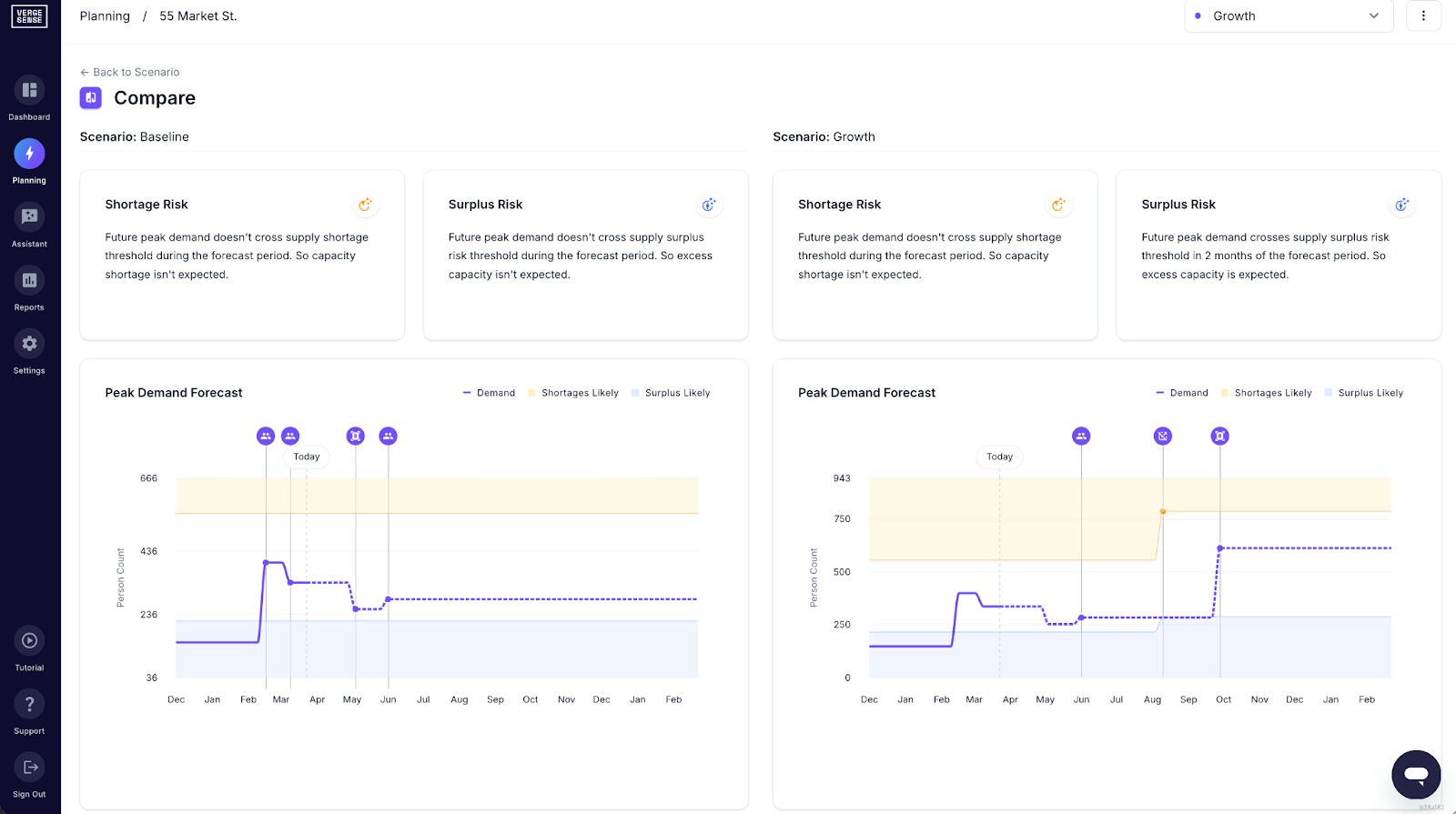
VergeSense is built for enterprise CRE, workplace, and facilities teams that need accurate occupancy data and the ability to turn it into planning, design, and portfolio decisions.
The platform pulls occupancy data from sensors, Wi-Fi, badge systems, and booking tools into a single canonical model, then feeds it into Predictive Planning for forecasting and scenario modeling: headcount changes, hybrid policy shifts, and consolidations.
Predictive Planning is powered by the Large Spatial Model, a proprietary AI model trained on 200M+ square feet of real workplace behavior across 200+ enterprises. It runs 1,000+ Monte Carlo simulations per scenario, so forecasts come as probabilistic ranges, not single-point guesses.
The result is forecasts grounded in how your portfolio actually gets used, and decisions you can defend with the data behind them.
Selected features
- Predictive Planning: Forecast future space needs based on headcount, hybrid policy, and historical patterns. Model consolidation or redesign scenarios without waiting for new sensor deployments.
- Large Spatial AI Model: The behavioral AI model behind Predictive Planning - the industry’s only purpose-built model for space planning. Trained on 200M+ square feet across 200+ enterprises, it generates probabilistic forecasts even for unmeasured spaces.
- Passive occupancy detection: Infinity Area Sensors detect whether a space is truly in use or just claimed at 95% accuracy. A bag on a chair counts as claimed but not occupied; critical for measuring wasted space.
- Wi-Fi Occupancy: Deploy occupancy analytics across your portfolio in days using existing Wi-Fi infrastructure (85% accuracy, no hardware required); perfect for square foot measurement and portfolio-level planning.
- Unified analytics: Reconcile sensors, Wi-Fi, badge, and booking data into one platform, so you can stop wrangling data and spend more time on strategic tradeoffs.
- Workplace Assistant: AI-powered natural language interface for space planning questions. For example, "Which neighborhoods are underutilized on Tuesdays?"
- 50+ integrations: Connect to your existing workplace stack, including IWMS, ticketing, calendars, and building systems.
- Trigger-based workflows: Automate actions based on occupancy thresholds, such as adjusting cleaning schedules when a floor drops below 30% utilization.
Best for
- Teams managing multi-site or global portfolios that need consistent occupancy measurement and planning across buildings
- Real estate and workplace leaders right-sizing or consolidating space, who need defensible forecasts for leadership
- Organizations evaluating hybrid workplace policy impact and needing to model scenarios before committing to floor plan changes
- Facilities teams moving from reactive operations to proactive planning, driven by actual work environments' usage patterns
Case study: How a global life science company turned occupancy data into a redesigned employee experience
A global life sciences company found employees spent nearly 3× more time in collaboration spaces (42%) than at desks (14.5%), but layouts hadn't kept up. With VergeSense data, the company built a real-time employee experience app and automated room releases to cut ghosted meetings, redesigning the office around how people actually worked.
For facilities and workplace teams ready to turn occupancy data into a portfolio strategy, explore VergeSense space optimization solutions.
2. Eptura
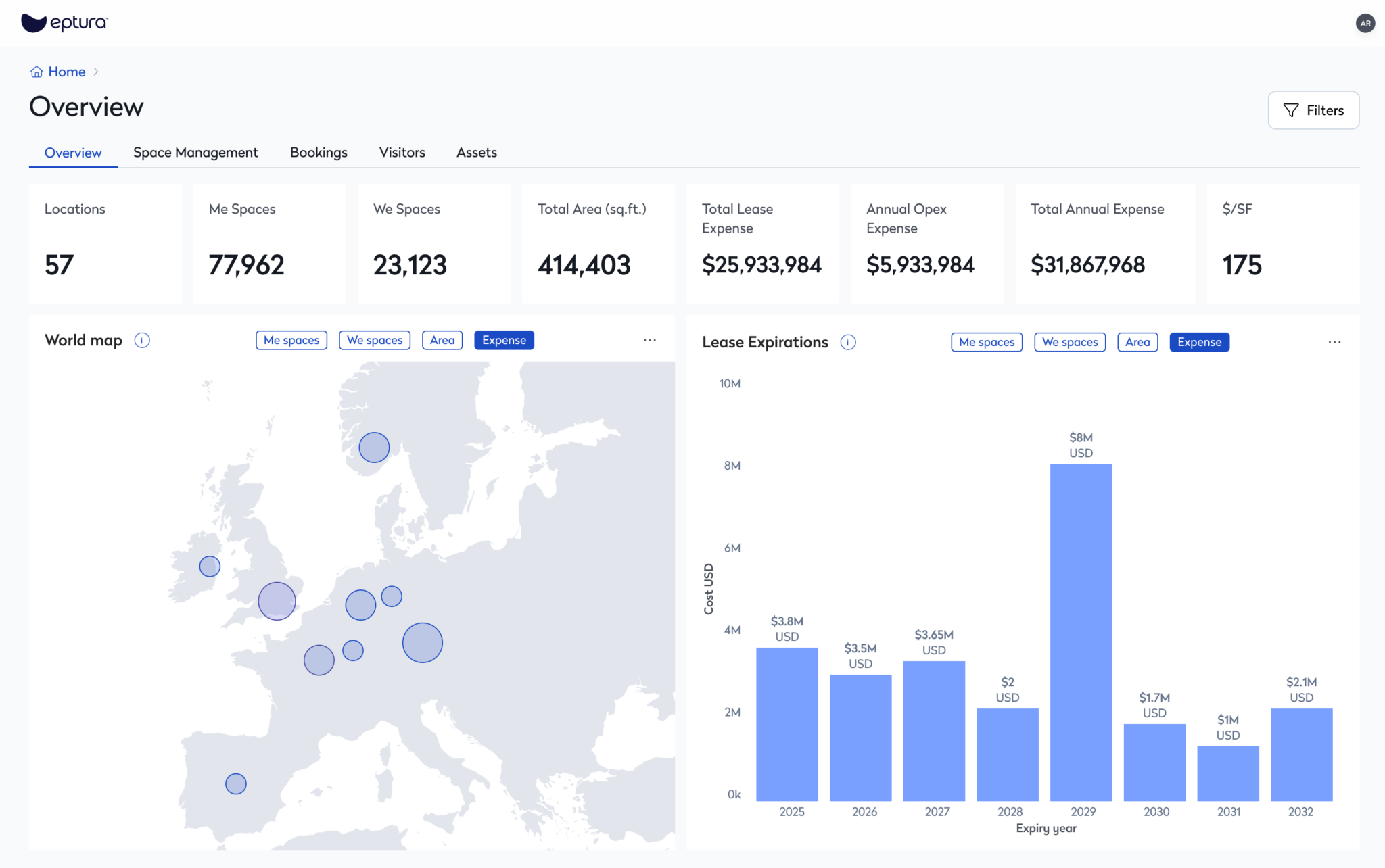
Eptura is an IWMS suite formed from the merger of iOFFICE, SpaceIQ, Archibus, and Condeco. It targets large corporate real estate teams seeking one vendor across operational workflows: asset management, maintenance, visitor management, space planning, and booking.
Selected features
- IWMS modules spanning asset management, maintenance ticketing, visitor management, and space allocation
- Desk and room booking with calendar integrations
- Floor plan and CAFM tools for space configuration and moves/adds/changes
- Third-party sensor and Wi-Fi integrations for occupancy data, rather than native occupancy measurement
- Operational reporting across facilities workflows
Best for
Large corporate real estate teams prioritizing operational breadth across work orders, assets, bookings, and space allocation. IWMS platforms manage what exists today rather than forecast what's coming, so teams focused on capacity forecasting or scenario modeling should plan to layer in a specialized planning tool.
3. OfficeSpace
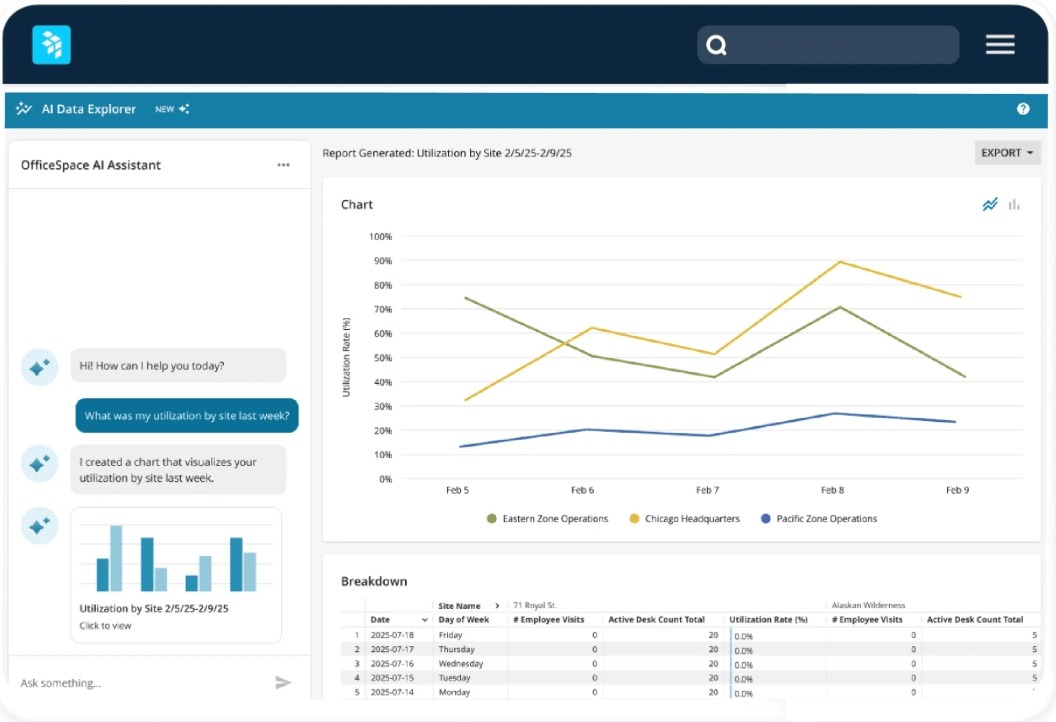
OfficeSpace is a space management and booking platform focused on desks, rooms, moves/adds/changes (MAC), and floor plans. It serves teams whose primary work is booking management and space configuration.
Selected features
- Desk and room booking with calendar sync
- Move/add/change workflows for space reconfigurations
- Interactive floor plans and stack plans for multi-floor portfolio visualization
- Visitor management and check-in
- Third-party sensor integrations for utilization data, with planning inputs dependent on connected data quality rather than native occupancy measurement
Best for
Teams prioritizing booking and MAC workflows. Mid-market and enterprise organizations seeking a user-friendly interface for space management. OfficeSpace is strong for design and layout questions and weaker for capacity and demand forecasting, so teams needing to model consolidation scenarios or forecast future space needs should plan to layer in additional planning capabilities.
4. Robin
Robin is a workplace experience platform centered on desk and room booking. It's most often chosen by hybrid-first organizations where the primary goal is employee experience and booking convenience.
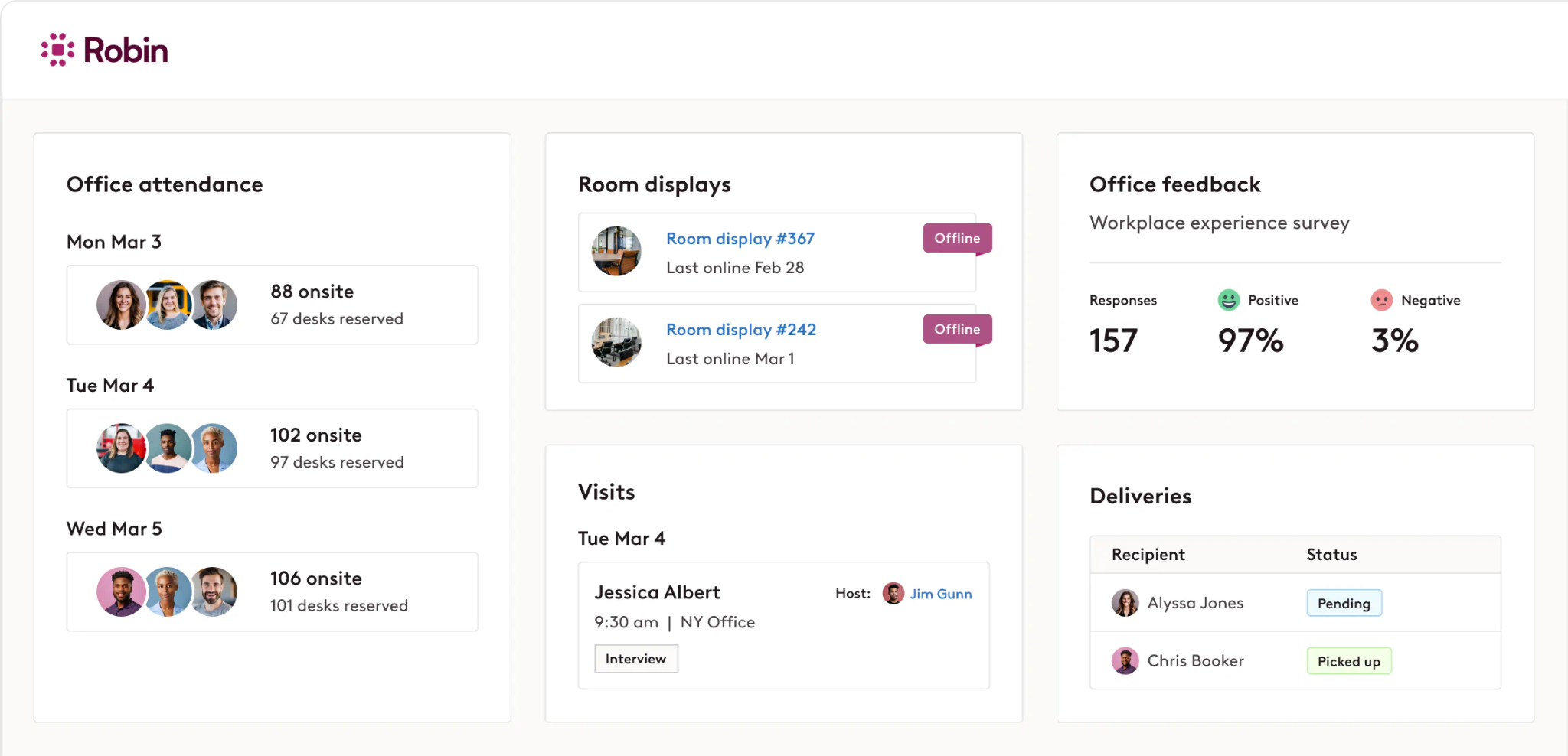
Robin is a workplace experience platform centered on desk and room booking. It's most often chosen by hybrid-first organizations where the primary goal is employee experience and booking convenience.
Selected features
- Desk and room booking with a focus on employee experience
- Workplace maps and wayfinding to help employees navigate the office
- Visitor management and check-in workflows
- Booking-driven analytics showing reservation patterns and no-show rates
- Calendar, sensor, and Wi-Fi integrations (sensor data requires third-party hardware)
Best for
Hybrid-first organizations where the primary goal is employee experience and booking convenience. Booking data captures intent (who reserved a space) rather than measured occupancy (who actually used it and for how long), so teams with planning, forecasting, or right-sizing needs should layer in occupancy intelligence to close that gap.
5. Tango (Locatee)
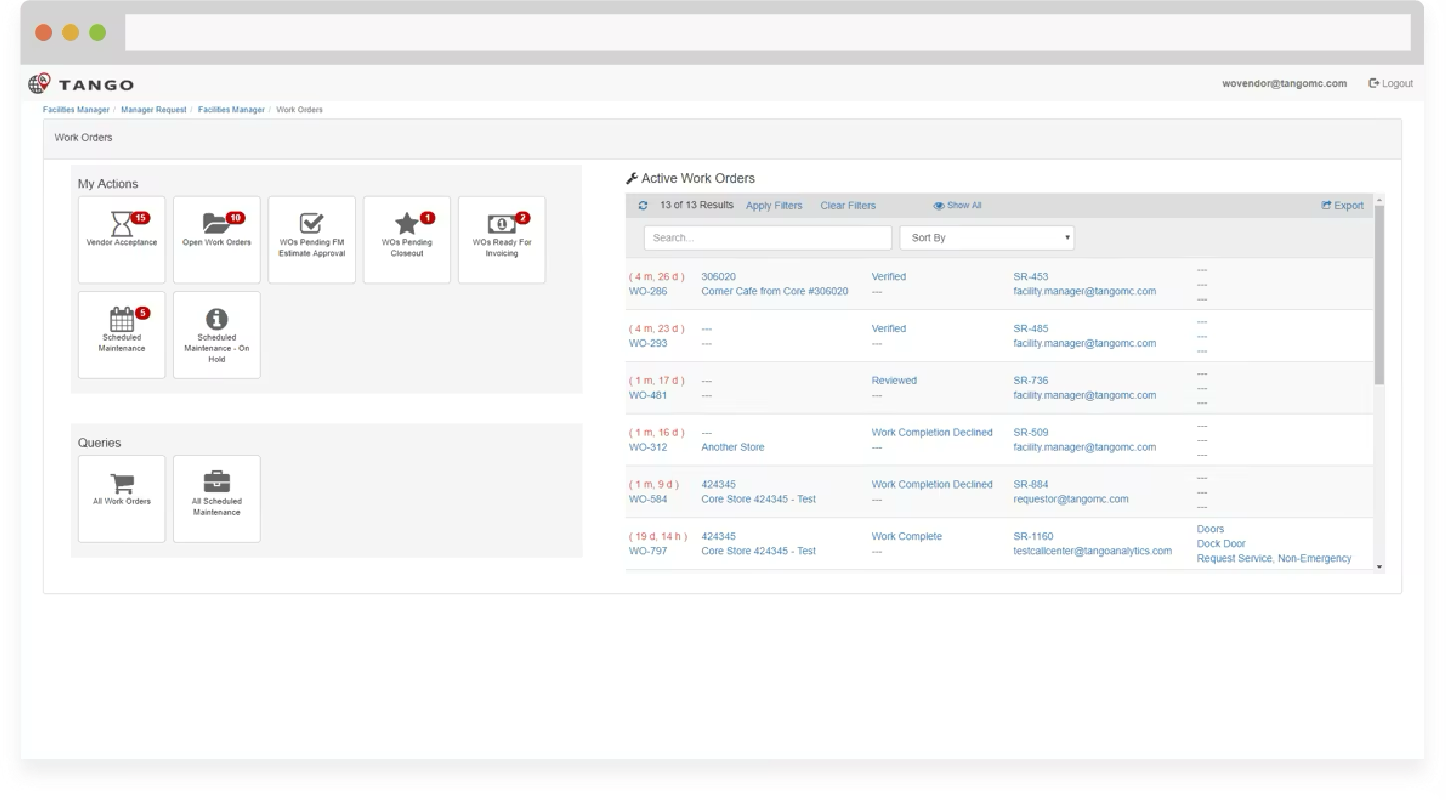
Tango Analytics' Locatee product is a Wi-Fi-based occupancy analytics platform for enterprises that want fast portfolio coverage without deploying hardware. It uses existing Wi-Fi network data to estimate occupancy across buildings, floors, and zones across your real estate portfolio.
Selected features
- Wi-Fi-based portfolio analytics using existing network infrastructure, no hardware required
- Building, floor, and zone-level occupancy views, with the caveat that Wi-Fi cannot reliably detect occupancy at the desk level
- IWMS integrations for operational workflows
- CRE-friendly reporting focused on portfolio-level trends
- Multi-site deployment that scales quickly across distributed portfolios
Best for
Enterprises with mature Wi-Fi infrastructure that need fast deployment for portfolio-level questions like comparing utilization across regions or supporting lease renewal decisions. Wi-Fi-based data misses occupancy from people not connected to the network, and cannot achieve desk-level accuracy, so teams running neighborhood design, workpoint-level planning, or continuous hybrid policy optimization will need sensor-based data to fill that gap.
6. Density
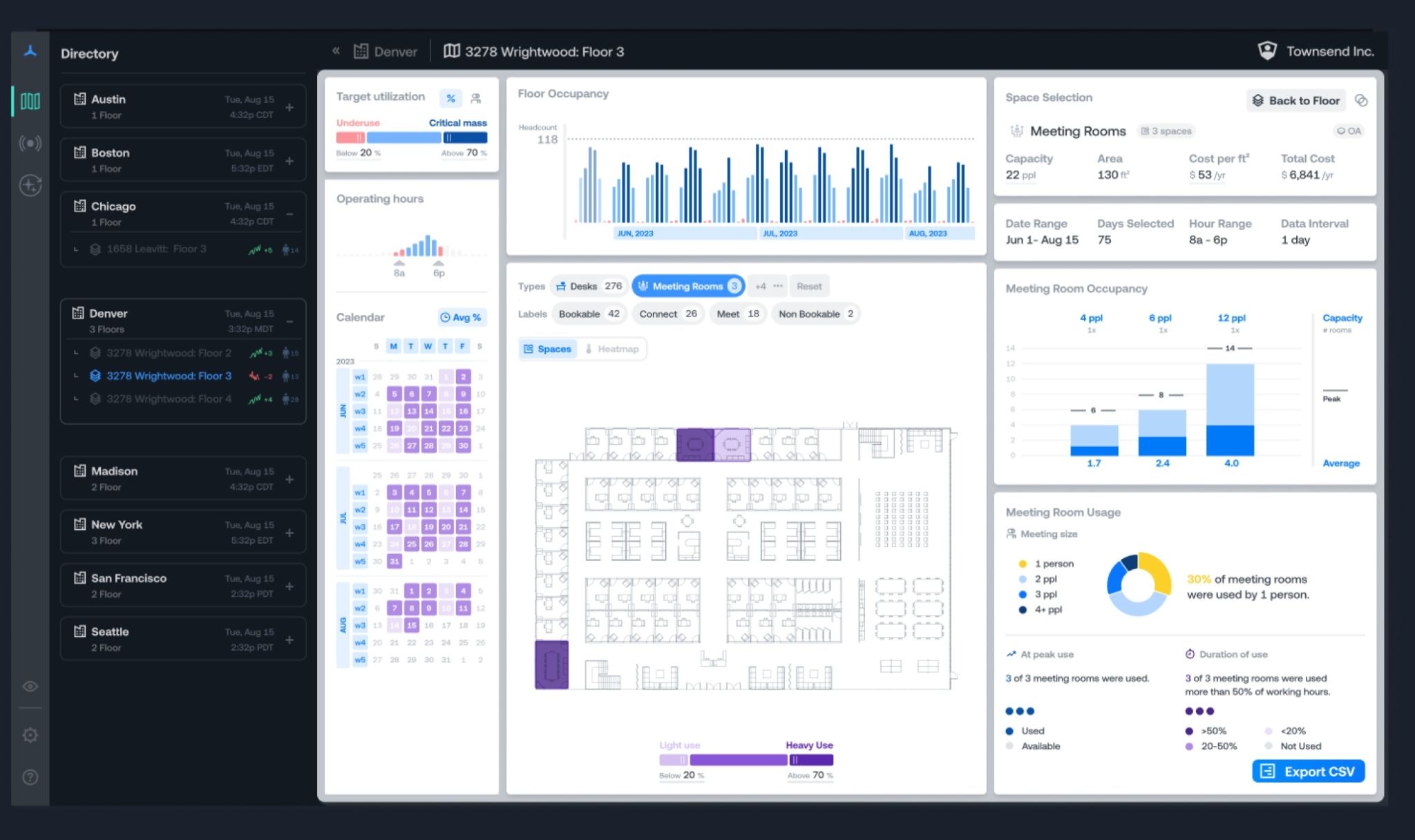
Density is a sensor-first people-counting platform that uses radar and time-of-flight sensors for accurate occupancy measurement at entryways, conference rooms, and high-traffic zones. The platform tells you how many people are in a physical space, when they arrived, and how long they stayed.
Selected features
- Entryway and area sensors with high people-counting accuracy using radar and time-of-flight technology
- Real-time dashboards showing current occupancy across spaces
- Comparison and benchmarking tools for tracking trends over time
- API access for integrating occupancy data into other platforms
- People-counting at the body level, without passive occupancy signals like claimed-but-unoccupied space
Best for
FM teams prioritizing real-time people-counting accuracy at specific spaces (entryways, conference rooms, high-traffic zones) where precise body counts drive operational decisions like cleaning schedules or capacity alerts. Density measures who is in a space; it does not forecast future space needs, model consolidation scenarios, or detect passive occupancy, so teams running portfolio planning or hybrid policy evaluation will need to layer in scenario modeling and passive occupancy sensing.
Key Features and Capabilities To Prioritize in Space Management Software
These capabilities determine whether your platform enables real decisions or just delivers visibility into current usage.
Occupancy Data Accuracy You Can Trust
Badge swipes tell you who entered a building, but not how many people are working on the third floor. Booking data shows reservations, while half of your space utilization goes untracked when you rely on those signals alone.
Per VergeSense's Workplace Index (9th Edition), average capacity usage held between 9–11% globally while peak usage reached 52–60%. Peaks consistently triple or quadruple the average, which means the rooms people need most run at capacity during peak collaboration windows, even when overall floors look underused.
Passive Occupancy Detection
A laptop bag on a chair counts as claimed but not occupied, and that distinction matters when you're deciding whether to shrink a neighborhood or adjust cleaning schedules. Passive occupancy detection senses whether a space is truly in use, even if someone is not physically present.
This ground-truth data shapes better decisions around layout, capacity, and service. VergeSense's area sensors deliver this at 95% accuracy.
Ability To Unify Multiple Data Sources
Sensors, Wi-Fi, badges, and booking systems each measure different signals and report different numbers. A canonical occupancy platform where all in one source feeds into a single truth removes the friction of reconciling separate dashboards.
Look for software that ingests multiple data sources, applies a consistent methodology, and surfaces that unified view across the organization.
Planning and forecasting capabilities
Scenario modeling lets you test assumptions before committing to leases or consolidations. What happens to capacity if headcount grows 20%? What if in-office attendance shifts from three days to four?
Predictive Planning capabilities help you answer these questions before spending capital. The best forecasting platforms are powered by behavioral models trained on real workplace data (VergeSense's Large Spatial Model is trained on 200M+ square feet across 200+ enterprises), so forecasts come as probabilistic ranges rather than single-point guesses.
Enterprise readiness and integration depth
Multi-site deployments require platforms that handle diverse building types, space configurations, and data environments across your portfolio.
Connect to your existing workplace tech stack: IWMS for asset and maintenance workflows, building access systems for badge data, calendar platforms for booking signals, and ticketing systems for service requests. The best integrations extend your current tools rather than replace them.
Outputs That Different Stakeholders Can Actually Use
Facilities teams need floor-level heatmaps and cleaning triggers. Workplace strategy leaders rely on neighborhood utilization trends and design recommendations. Real estate requires cost-per-person and portfolio benchmarks. Leadership expects executive summaries showing trade-offs and ROI.
The same unified data model has to surface differently for each audience. When it does, adoption spreads and occupancy data drives real decisions at every level.
How To Choose Space Management Software for Your Real Estate Team
Narrow the field using the questions below. Start internally to understand your current environment and decision-making needs, then use vendor questions to evaluate how each platform delivers on those requirements.
Questions To Ask Internally
Start by understanding your current environment and what you're trying to solve. These questions help you scope the right capabilities and deployment approach for your team.
- Current vs. forecast needs: Are you solving today's reporting gaps, or preparing for portfolio consolidation, headcount growth, or hybrid work changes over the next 12–24 months?
- Current data sources: What signals do you already have: badge swipes, booking systems, Wi-Fi logs, spreadsheets? Which ones are reliable, and which systematically over- or under-count actual usage?
- Granularity needed: Do you need portfolio-level trends, floor-by-floor comparisons, neighborhood utilization, or desk-level insights? The answer determines whether you need sensors, software-only analytics, or both.
- Primary goal: Are you optimizing employee experience, reducing real estate costs, informing design decisions, or justifying space changes to leadership?
- Deployment flexibility: Can you deploy sensors across the portfolio, or do you need a software-first approach using existing Wi-Fi, badge, and booking infrastructure?
- End users: Who will use the platform day-to-day? FM teams, workplace strategy, CRE, and finance? Tools that surface decision-ready insights for each audience outperform analyst-only dashboards.
Questions To Ask Space Management Software Vendors
For space planning software providers, ask about these capabilities to understand how each platform delivers on your requirements.
- How is occupancy measured, and what's the accuracy? Ask for specifics: passive vs. active detection occupancy, sensor type, Wi-Fi methodology and integrations supported, and accuracy benchmarks for different space types.
- Can the platform detect passive occupancy? An occupied desk with a jacket draped over the chair registers differently than one with just a bag on it, yet most systems can't tell the difference.
- What data sources does the platform unify? Sensors, Wi-Fi, badge, booking, and building systems should reconcile into one canonical model, not separate dashboards.
- Does the platform forecast, or only report history? Retrospective dashboards show what happened. Predictive intelligence shows what's coming and what to do about it.
- What is the platform's forecasting model trained on? A behavioral model trained on real workplace data across hundreds of enterprises will produce more credible forecasts than rules-based extrapolation from your single portfolio.
- Can you model headcount changes, policy shifts, or floor plan redesigns? Scenario planning is the difference between "here's what happened" and "here's what happens if we consolidate two floors."
- What's the deployment timeline and time-to-value? Ask how long it takes from contract signature to actionable insights, not just time to first dashboard login.
- How does the platform integrate with your existing stack? Look for depth of integration with your IWMS, building systems, ticketing tools, and calendars.
- What outputs does the platform provide for leadership? Finance and executives need different views than FM analysts. Ask whether the platform surfaces decision-ready insights for each stakeholder.
Ready to move from reactive reporting to forward-looking planning?
See how VergeSense forecasts demand, models scenarios, and supports decisions before capital is committed.
Get a demo
FAQs About Space Management Software
What is space management software?
Space management software helps corporate real estate, workplace, and facilities teams measure how space is actually used and make data-informed decisions about capacity, design, and portfolio strategy. Modern platforms unify occupancy data from sensors, Wi-Fi, badge systems, and booking tools into a single view.
How is space management software different from IWMS?
IWMS (Integrated Workplace Management Systems) cover asset tracking, maintenance, leasing, and space. Space management software solutions are purpose-built for occupancy intelligence and planning. IWMS tells you what space you have. Modern office space management software tells you how it's used and what to do next.
Do real estate and workplace teams need sensors to get value from space management software?
Not necessarily. Sensors provide the foundation, but modern platforms like VergeSense combine multiple data sources. Most teams start with existing Wi-Fi and badge data, then add sensors for higher accuracy in specific areas. The key is unifying all sources into one view for better decisions.
What's the difference between space management software and occupancy intelligence?
Occupancy Intelligence is the measurement layer: how many people are in a space, when, and for how long. Space management software uses that intelligence, plus booking, badge, and other signals to support planning, forecasting, and design decisions. Occupancy Intelligence is the input. Space management software is the decision engine.
Can space management software support planning, or is it just for reporting?
Legacy tools stop at dashboards. Modern platforms like VergeSense include Predictive Planning capabilities that let you model headcount changes, test hybrid policy scenarios, and forecast space needs before committing to leases or renovations.

.jpg)