


Best Office Space Management Software in 2026: 6 Tools Compared
If you're evaluating office space management software solutions, the key question is whether the tool tracks what people booked, or if it actually shows how your office is used for forward-looking planning decisions.
Those are different jobs. A booking calendar tells you a desk was reserved, but it can't tell you whether anyone sat there, or whether the floor you're about to renovate is half-empty by 2 PM.
When the decision on the table is a lease renewal or a multi-floor redesign, booking data can overstate how much space you actually need.
This guide covers six platforms across four categories: sensor-first occupancy platforms, IWMS suites, desk and room booking tools, and planning-focused decision platforms.
- VergeSense: Measured occupancy intelligence with AI-driven predictive planning for enterprise real estate teams
- OfficeSpace Software: Booking-led workplace management platform with AI space planning
- Eptura: Enterprise worktech and IWMS suite spanning assets, space, and workplace experience
- Robin: Desk and room booking platform built for hybrid coordination
- deskbird: All-in-one desk booking and office scheduling tool with utilization analytics
- Trebellar: Workplace analytics platform that models portfolio scenarios on data you already own
Not sure whether your current tools show real usage or just bookings?
See how VergeSense helps real estate and workplace leaders measure occupancy, forecast demand, and plan offices with confidence.
At-a-Glance Comparison of Office Space Management Software
Here is how the six platforms compare on the dimensions that drive a space decision, from what they measure to who they suit best.
|
Office Space Management Software |
Best For |
Core Approach |
Data Inputs |
Analytics & Planning Depth |
Best-Fit Buyer |
|
VergeSense |
Portfolio-scale space planning decisions |
Sensor-first measurement plus predictive planning |
Owned sensors, third-party sensors, plus badge, WiFi, booking, and video feeds |
Measured occupancy through forecasting and scenario models |
Enterprise RE and workplace teams |
|
OfficeSpace Software |
Day-to-day workplace management |
Booking and space configuration with AI planning |
Third-party sensor feeds, bookings, floor plans |
Reporting and rules-based stack planning |
Facilities teams running hybrid operations |
|
Eptura |
Unifying assets, space, and experience |
IWMS suite across operational workflows |
Space records, work orders, integrated feeds |
Utilization insights inside broader IWMS workflows |
Enterprises consolidating worktech systems |
|
Robin |
Hybrid booking and coordination |
Desk and room booking with attendance tracking |
Bookings, calendars, check-ins |
Booking and attendance reporting |
Teams prioritizing employee booking experience |
|
deskbird |
Desk booking and week planning |
Scheduling-led workplace management |
Bookings, check-ins, attendance trends |
Booking and attendance analytics |
Mid-market teams standardizing hybrid scheduling |
|
Trebellar |
Scenario modeling on existing data |
Data-agnostic analytics layer |
Customer-supplied badge, WiFi, and third-party sensor data |
Scenario modeling gated by input quality |
Teams modeling on data they already own |
Best Office Space Management Software in 2026
We selected and ordered these tools using four criteria that separate a reporting dashboard from a decision platform: the accuracy of the occupancy data underneath it, whether it supports decisions or only reports on the past, how flexibly it deploys across a portfolio, and whether it carries you from measurement all the way to planning.
1. VergeSense
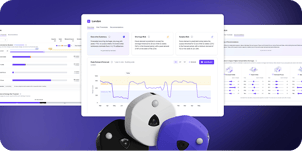
VergeSense is an occupancy intelligence and planning platform built for enterprise real estate and workplace teams. It measures how space is used, then turns that measurement into forecasts and scenario models so you can plan offices before you commit budget.
The platform pairs owned area sensors with feeds from badge, WiFi, booking, and video systems, giving you one measured view across the portfolio rather than a patchwork of assumptions. That measurement and the forecasting built on it run on the company's platform, Meridian, whose Large Spatial Model is trained on 250M+ sq ft of measured workplace data.
Selected features
- Predictive Planning: Upload a floor plan and forecast how a layout will perform, so you can model demand by neighborhood and space type before construction begins.
- Large Spatial Model: An AI model trained on 250M+ sq ft of measured workplace data, so you get a behavioral baseline from day one rather than starting cold.
- Occupancy Intelligence: Continuous, measured occupancy at roughly 95% accuracy at the area level, compared with roughly 85% for WiFi-based counting at the floor level.
- Meridian, The Workplace AI Platform: The platform that unifies measurement, forecasting, and automation into plans leaders use for data-based decision-making.
- Workplace Assistant: An information-retrieval tool that lets you ask questions about how your space has been used and get answers from your own occupancy data.
- Infinity Area Sensor: A wireless, battery-powered sensor with a magnetic mount and roughly a 10-year battery life, so a portfolio-wide rollout needs no cabling or construction.
- Integrations: Connections to Microsoft Places, ServiceNow WSD, Juniper Mist, and Cisco Meraki, so occupancy data flows into the systems you already run.
Best for
Enterprise real estate and workplace teams that make portfolio-scale decisions, where the cost of being wrong on a lease or a floor redesign runs into the millions. VergeSense fits teams that want measured ground truth first, then forecasting on top of it, rather than a booking tool with a reporting tab.
A real-life example
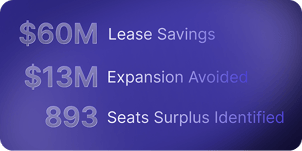
A fast-growing cybersecurity company avoided $1.5M in buildout costs by using VergeSense occupancy data instead of a planned full-floor redesign. Sensor data showed that large conference rooms sat underused while demand for small two-person meeting spaces far outran supply.
Rather than fund an expensive renovation, its workplace team installed 50 two-person phone booths where the data showed the greatest need. The move also compressed the design decision cycle from eight weeks to two.
Want to see what measured occupancy would change about your floor plans?
A VergeSense specialist can walk you through your own portfolio, room by room.
2. OfficeSpace Software
OfficeSpace Software is a full-stack workplace management platform for facilities and real estate teams running hybrid operations. Its 2025 acquisition of Dojo AI added AI-driven space planning through its AI Canvas capability. The breadth is the draw: booking, moves, facilities, and planning sit in one place, powering workplace management for 2,000+ teams and more than 113 million square feet.
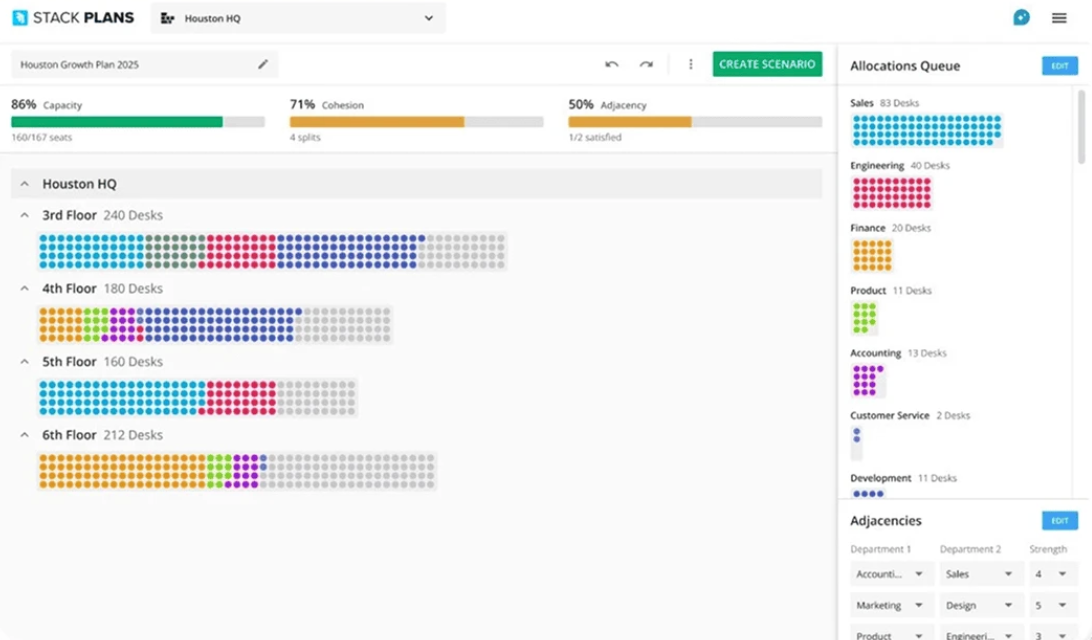
Selected features
- AI Canvas: Stack and scenario planning powered by the Dojo AI acquisition.
- Desk and room booking: Real-time availability with smart booking nudges.
- Wayfinding and neighborhoods: Floor plan navigation and team-based zoning.
- Visitor management: Guest check-in and host notifications.
- Workplace analytics: Portfolio reporting and utilization dashboards.
Example use cases
Facilities teams coordinating daily hybrid operations across a campus, running moves and adds, and giving employees a single app to find desks, rooms, and colleagues. It suits organizations that want one broad workplace management system rather than a specialized occupancy tool.
The tradeoff
OfficeSpace is Vista Equity-backed and covers a wide surface area, but its AI planning optimizes team placement against adjacency rules and constraints rather than forecasting how people will actually behave. It also doesn't own its occupancy data, relying instead on third-party sensor feeds, so the measurement underneath the plan is only as good as the hardware you bolt on separately.
3. Eptura
Eptura is an enterprise worktech platform that spans asset management, space management, and workplace experience in a single IWMS suite. It was named a Leader in the 2026 Gartner Magic Quadrant for Workplace Experience Applications, and it's built for organizations consolidating maintenance, real estate, and employee-experience workflows onto one system of record. Space records, work orders, and moves all live in the same place.
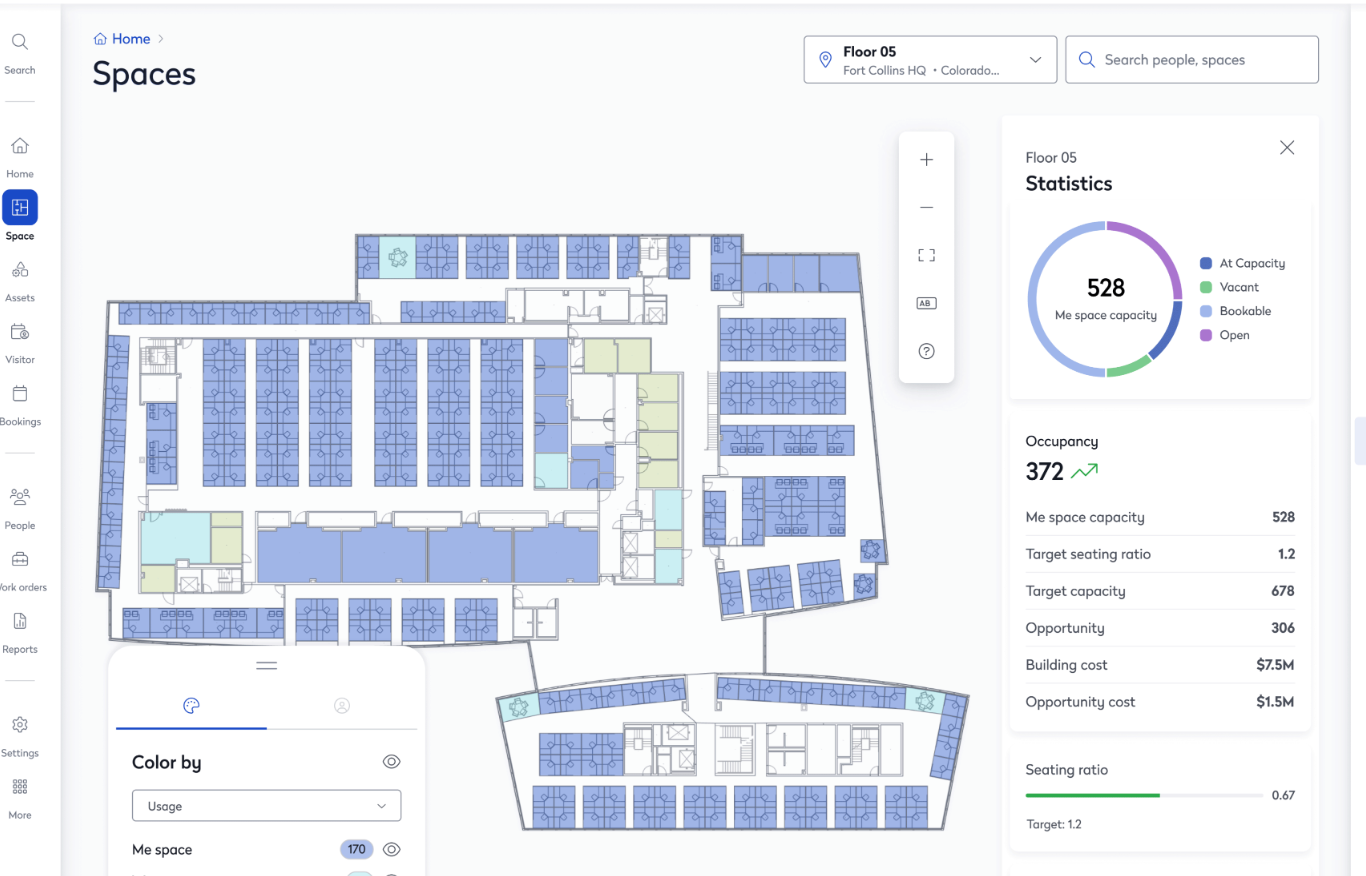
Selected features
- Asset management: Work orders, preventive maintenance, and asset lifecycle tracking.
- Space management: Move coordination, floor plans, and portfolio utilization records.
- Workplace experience: Week planning, desk booking, and visitor management.
- Portfolio optimization: Utilization insights across the real estate footprint.
- Broad integrations: Connections into Microsoft, Autodesk, and other enterprise systems.
Example use cases
Enterprises that want one platform to run facilities maintenance, manage the space inventory, and coordinate hybrid work, rather than stitching together separate tools for each. Eptura fits teams whose priority is a unified system of record across the whole worktech stack.
What VergeSense complements
Eptura is a VergeSense integration partner. VergeSense supplies measured occupancy data into the IWMS and space workflows, so the space records inside Eptura reflect how rooms and floors are actually used rather than how they were configured. Together they close the gap between the plan of record and the reality on the floor, giving both the operational system and the occupancy layer the same ground truth.
4. Robin
Robin is a desk and room booking platform built for hybrid coordination. It helps employees reserve desks, rooms, and other resources through the tools they already use, including Teams, Slack, and Outlook, while giving workplace teams attendance tracking and a real-time view of the office. Its strength is booking convenience and the day-to-day mechanics of getting people into the right seats.
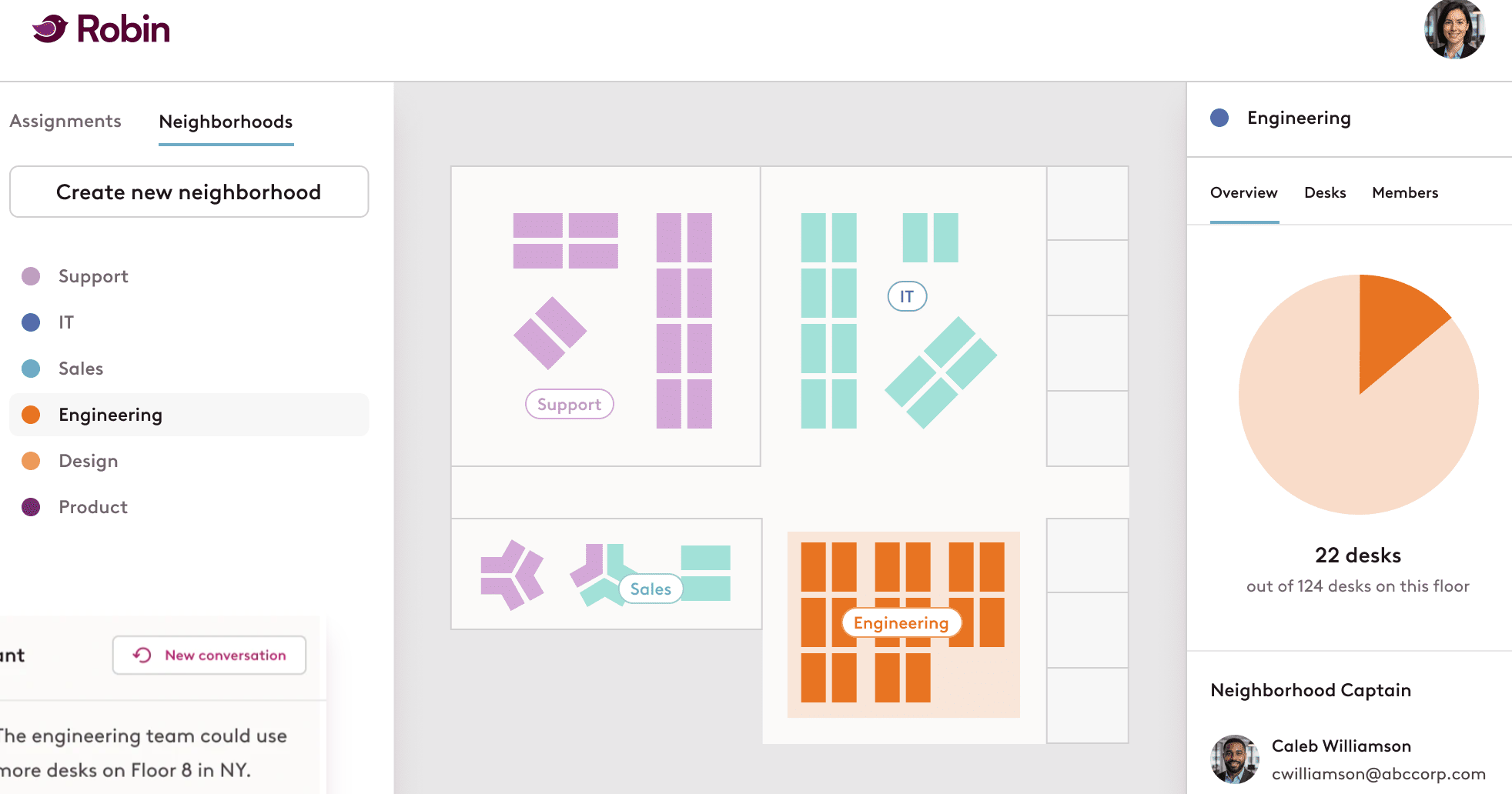
Selected features
- Desk and room booking: AI-assisted reservations across desks, rooms, and resources.
- Hybrid coordination: In-office policies, attendance tracking, and scheduling.
- Space planning: Collaborative floor plan edits and layout recommendations.
- Meeting management: Calendar sync with Microsoft 365 and Google Calendar.
- Visitor management: Check-ins, badges, and host notifications.
Example use cases
Teams that want a smooth booking experience as the front door to the office, coordinating who comes in on which days and making rooms easy to reserve. Robin fits organizations prioritizing employee-facing convenience and hybrid scheduling.
What VergeSense complements
Robin handles the booking side well. VergeSense adds ground-truth occupancy underneath it, measuring whether booked desks and rooms are actually occupied so you can spot ghosted reservations and right-size supply. The two integrate, letting Robin manage the reservation while VergeSense verifies the reality, which matters when booking data alone would overstate how much space you really need.
5. deskbird
deskbird is an all-in-one workplace management tool centered on desk booking and week planning, with 10,000+ offices managed on the platform and its strongest adoption across Europe. It simplifies desk and resource booking, meeting room management, and visitor handling, and layers in analytics on office attendance and space usage. Employees can book without leaving Teams, Outlook, Slack, or Google Calendar, which drives adoption.
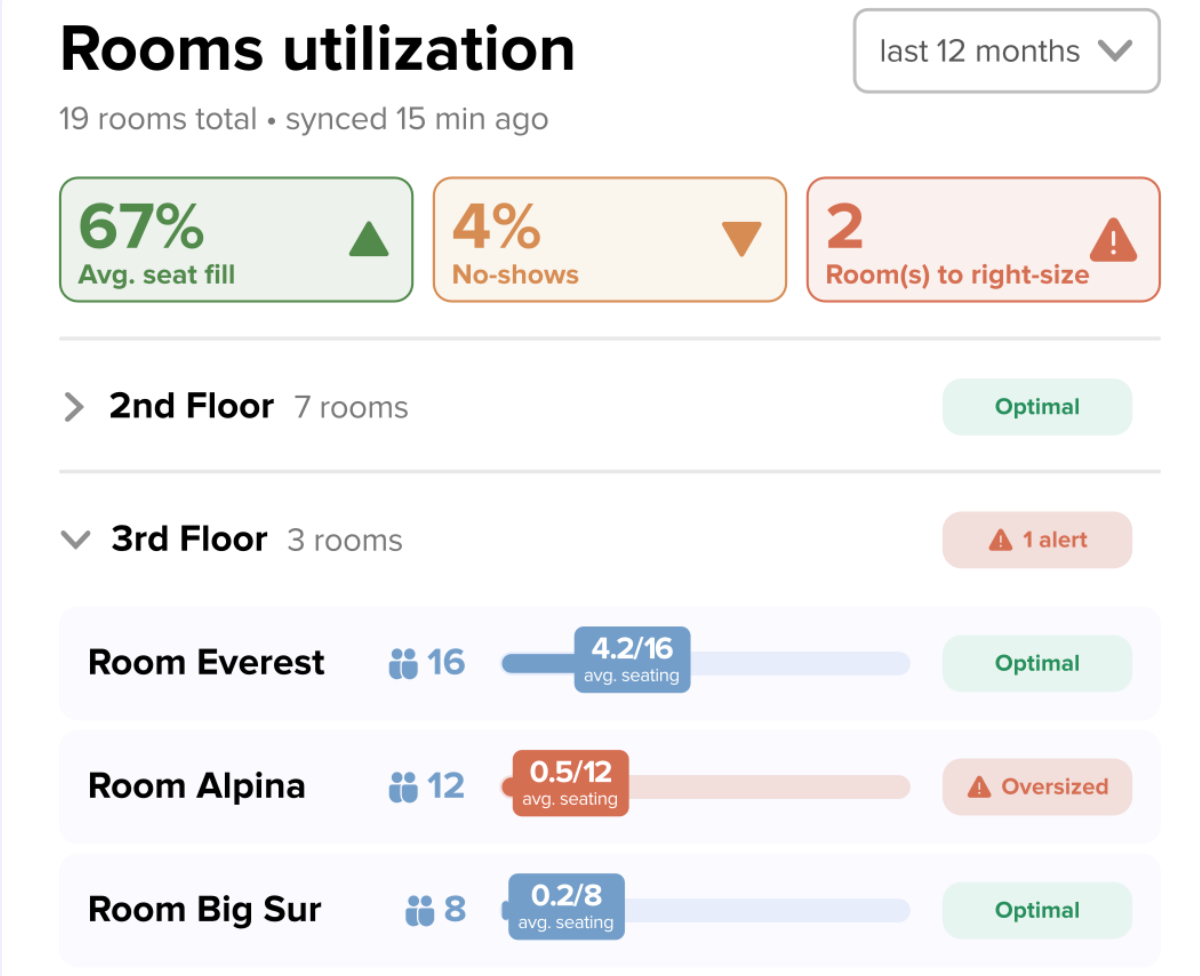
Selected features
- Desk booking: Reservations across multiple locations and floors.
- Week planning: Attendance coordination for hybrid teams.
- Room and resource booking: Meeting rooms, parking, and visitor management.
- Office analytics: Attendance trends and floor-level usage views.
- Agentic workplace: Connections to Microsoft Copilot and other AI tools.
Example use cases
Mid-market teams standardizing hybrid scheduling and wanting high employee adoption of a booking tool that lives inside existing chat and calendar apps. It fits organizations whose main need is coordinating attendance week to week.
The tradeoff
deskbird's analytics center on booking and scheduling activity rather than measured occupancy. Attendance trends drawn from reservations and check-ins tell you what people planned, not whether the space was truly used, so the numbers can overstate demand when bookings go unhonored. For portfolio decisions that hinge on real usage, that's a meaningful blind spot.
6. Trebellar
Trebellar is a workplace analytics platform that consolidates real estate data into scenario models and forecasts. It's positioned as an agent-based AI platform for corporate real estate and workplace teams, building a unified data layer on top of the systems a customer already runs. Its focus is scenario modeling, portfolio planning, and decision support, layered over existing infrastructure rather than its own measurement hardware.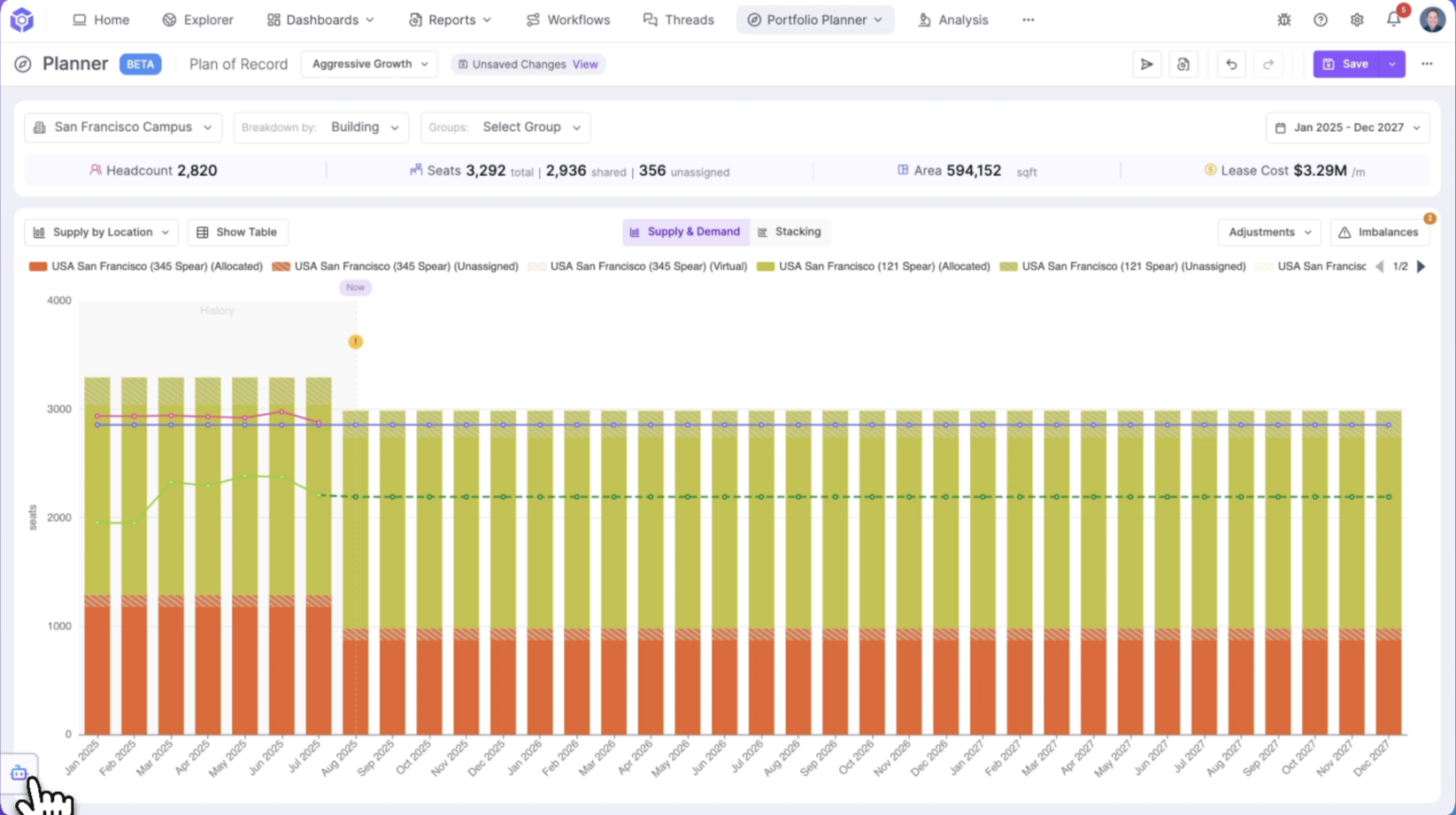
Selected features
- Unified data layer: Aggregation and normalization across multiple source systems.
- Scenario modeling: Portfolio planning and forecasting for strategic decisions.
- AI companion: On-demand insights drawn from connected data.
- Cost and lease analysis: Occupancy, utilization, and lease optimization views.
- Per-customer models: Isolated AI models trained only on each customer's own data.
Example use cases
Teams whose priority is building scenario models on top of data they already own, and that already have the badge, WiFi, and sensor infrastructure feeding clean inputs. Trebellar fits organizations comfortable sourcing and validating their own data before planning.
The tradeoff
Because Trebellar is data-agnostic, its planning outputs depend entirely on the completeness and quality of the inputs you supply, and its per-customer models train only on your data. A five-building portfolio gets AI trained on five buildings of data, with no behavioral baseline if you're starting cold, so you have instrumentation and validation work to do before you can trust what it plans.
Key Features and Capabilities to Prioritize in Office Space Management Software
These are the capabilities worth weighing before you shortlist.
Occupancy Data Accuracy
Everything downstream depends on whether the underlying data reflects reality, and accuracy varies widely by method. VergeSense area sensors measure occupancy at roughly 95% accuracy at the area level, compared with roughly 85% for WiFi-based counting at the floor level.
The difference matters most where the cost of being wrong is highest: lease decisions, neighborhood right-sizing, and post-occupancy verification. Booking data alone can't tell you whether a reserved desk was ever occupied.
Reporting vs. Decision Support
Ask whether the software stops at dashboards or carries you into forecasting and scenario modeling.
A dashboard can show you a floor ran at 40% occupancy last quarter. Decision support tells you what happens to that floor if you consolidate two teams onto it, before you sign anything.
Flexibility in Data Inputs and Deployment
The strongest platforms unify multiple data sources rather than forcing a single feed. Look for a tool that can ingest and reconcile the signals you already generate.
Canonical data sources worth supporting include badge access data, room-booking systems, WiFi connections, videoconferencing data, and occupancy sensors. Deployment flexibility matters too: wireless, battery-powered sensors let you cover a portfolio without cabling or construction.
Planning and Forecasting Capabilities
The question is whether the tool can model how a space will perform before you commit budget.
In practice that means uploading a floor plan and seeing forecast demand by neighborhood and space type before construction starts. Predictive Planning is one example of this; the question to put to any vendor is whether the forecast runs on measured behavior or on assumptions.
Enterprise Readiness and Scalability
Portfolio-scale decisions need portfolio-scale data. Ask for specifics: how many enterprise customers a vendor supports, across how many countries and sites, and how many integrations into the systems you already run.
A vendor whose deployments have all been single-building will struggle to give a global team one measured view of the portfolio.
Outputs That Different Stakeholders Can Use
A real estate lead, a workplace strategist, and a CFO don't need the same view of the same data. The best platforms turn one measured dataset into outputs each stakeholder can act on.
Look for tools that produce both the operational detail a planner needs and the cost case a CFO can take to a lease decision.
How to Choose Office Space Management Software for Your Team
The tools above solve different problems. Working through these questions will tell you which category, and which platform, fits the decisions in front of you.
Mark Karma, Systems Lead for Workplace Digital Insights at Genentech, put the internal test simply: "You can't just be pulling data for no reason. You have to justify it... We've made sure that every piece of data we collect aligns with our business goals and delivers clear value."
Questions to Ask Internally
- What decision are we actually trying to make: daily booking, or portfolio strategy?
- Do we need to know what was booked, or what was truly used?
- Which data sources do we already generate that a platform could unify?
- Who owns the data and the plan after we buy the tool?
- How many sites and how much square footage does this need to scale to?
- Do we need forecasting, or is reporting on the past enough?
- Which stakeholders need outputs, and in what form?
Questions to Ask Vendors
- Does your platform measure occupancy directly, or rely on third-party feeds?
- What's your data accuracy, and at what level is it measured?
- Do you offer a behavioral baseline for new customers, or do we start cold?
- Can you forecast how a space will perform before we build it?
- Which of our existing systems do you integrate with?
- How does deployment work, and does it require cabling or construction?
- What outputs can you produce for executives versus the people doing the planning day to day?
Ready to plan your office around how it's actually used?
See what your portfolio looks like on measured occupancy data, and what that changes about your next lease or redesign decision.
FAQs About Office Space Management Software
What Is Office Space Management Software?
Office space management software helps real estate and workplace teams understand and plan how their offices are used. Tools range from booking systems that manage desk and room reservations to sensor-first platforms that measure actual occupancy and forecast future demand across a portfolio. You can compare the best space management software here.
How Does Office Space Management Software Differ From a Desk Booking Tool?
A desk booking tool manages reservations: who's coming in and which seat they've claimed. Space management software goes further, measuring whether booked space was actually used and turning that data into portfolio decisions. Booking tells you the plan; occupancy measurement tells you the reality.
What ROI Can Enterprise Teams Expect From Office Space Management Software?
It depends on the decisions the data informs. Returns usually come from avoiding an unnecessary lease, cancelling or shrinking a planned buildout, and right-sizing floors ahead of a renewal. The largest savings land before capital is committed, which is why measured occupancy matters more than reporting after the fact.
How Do Hybrid Work Policies Affect the Choice of Space Management Platform?
Hybrid work widens the gap between reserved and used space, which makes measured occupancy more important. Booking data can overstate demand when reservations go unhonored. Teams setting or revising hybrid policies benefit from software that shows real attendance patterns, not just the schedule.
.png)