





Corporate Real Estate Strategy That Survives the CFO Meeting
You've got the CFO review on Thursday. The recommendation on the table is to exit a floor, maybe a whole building, and finance wants to know how confident you are that the office space you're paying for isn't being used, with evidence to back your recommendation.
Too many corporate real estate teams walk into that meeting with a costly gap. Leadership expects a defensible, data-backed recommendation on a decision worth millions of dollars in lease commitments, while the team can only offer a consultant's snapshot from 18 months ago, a stack of badge swipes, and a well-reasoned guess.
The CRE leaders who come out of that meeting with a yes aren't bringing more data. They're bringing a defensible recommendation built on their own data, and can show exactly what will happen if they exit.
A strong corporate real estate strategy closes that gap. It turns portfolio decisions from opinions you defend into conclusions you demonstrate to keep your strategy defensible under financial scrutiny.
What Is a Corporate Real Estate Strategy?
A corporate real estate strategy is the framework CRE leaders use to align portfolio decisions with business goals and financial constraints. It governs the expensive, hard-to-reverse calls, like lease management and renewals, consolidations, expansions, and the mix of space types across the real estate assets the company holds.
It also governs the decisions triggered by the rest of the business. Return-to-office policy changes, shifts in hybrid work models, reorganizations, mergers and acquisitions, and headcount shifts all move space demand and sit with the CRE team.
How teams approach corporate real estate management makes all the difference. Reactive management waits for a lease event, then scrambles to justify a decision with whatever data is on hand. Proactive workplace strategy models the decision in advance, so the recommendation is ready when finance asks.
The core problem underneath all of this is right-sizing. Headcount, attendance, and workforce needs are all moving targets now, and they no longer move together. According to CBRE's 2025 Americas Office Occupier Sentiment Survey, 66% of organizations run below 60% utilization on an average day, which means most portfolios are carrying space the business is paying for but not using.
Every point of unused utilization is money, and at enterprise cost per square foot, this compounds into millions across a property portfolio. A strategy that can't measure that gap can't defend a decision to close it. When occupancy costs come under review alongside other operating costs, underused space is the cheapest saving available, and its size is the one number an outside benchmark can't tell you.
How Corporate Real Estate Strategy Works in Practice
For a corporate real estate portfolio strategy to survive scrutiny, you need a repeatable process that moves from measured data, to modeled scenarios, to a business case finance can sign off on.
The Data Foundation
Every defensible strategy starts with the same question: what usage data does the company currently have? Most CRE teams have more inputs than they realize, they’re just spread across disjointed systems.
Common inputs include badge access data, room-booking systems, WiFi connection logs, videoconferencing data, and occupancy sensors. Each one tells part of the story, and each one has a blind spot. Badge swipes count who entered the building, not whether they sat at a workstation or left after an hour.
The gap is between what most teams have and what a strategy requires. Badge swipes, quarterly surveys, and a consultant's one-time snapshot describe a moment that has already passed. A defensible strategy requires continuous, holistic utilization data that shows how space is actually used, day after day.
The real advantage comes from leveraging your own occupancy data rather than buying someone else's benchmark report, because your measured usage is the number finance can't argue with. As Gary from Indeed put it at the Occupancy Intelligence Summit, "Whether you're retrofitting or whether you're building out, you're spending a hell of a lot of money and you want to feel secure that you're making the best informed decision with the data you have at that time. And if you can have more data, you'll make a better informed decision."
Scenario Modeling and Portfolio Planning
Once the data foundation is in place, the work shifts to modeling. This is where CRE leaders stress-test a decision before committing budget to it. This can include a consolidation, a lease exit, an expansion, a return-to-office policy that changes weekly attendance, a reorganization, or an acquisition that merges two portfolios at once.
The old approach relied on static ratios and one-time consultant studies: a fixed seats-per-employee assumption applied across the portfolio, or an outdated occupancy study. Those methods produce a single answer to a question that has several.
Modern planning replaces that with AI-driven modeling trained on large behavioral datasets. Instead of applying a fixed ratio, CRE leaders can run scenarios against how people actually use space, then stress-test each one for cost and risk. The question you need to ask here is "what happens to cost and employee experience under each option we're considering."
Building the CFO-Ready Business Case
Finance leaders think in cost control, payback timelines, and ROI, and a lease signed today sits on the balance sheet for years. Utilization data doesn't persuade a CFO on its own. So the final stage of the process is translation.
A floor running at 20% utilization is an observation, but the same finding expressed as cost avoidance across the remaining lease terms with a clear payback window is a decision finance can approve.
Packaging that case is often where an experienced advisory partner adds the most value. Translating measured occupancy data into the language of the boardroom, then pressure-testing the recommendation before it reaches leadership, can mark all the difference in getting a strategy funded.
Working through portfolio decisions without continuous data to back them?
See how VergeSense helps CRE leaders build data-backed portfolio plans with CFO-ready evidence.
Corporate Real Estate Strategy With VergeSense
Portfolio right-sizing is the through-line of every decision above, and it's where measured data changes the outcome. Meridian, The Workplace AI Platform, helps CRE leaders model lease exits, consolidations, and headcount shifts, with insights grounded in 250M+ sq ft of measured workplace data.
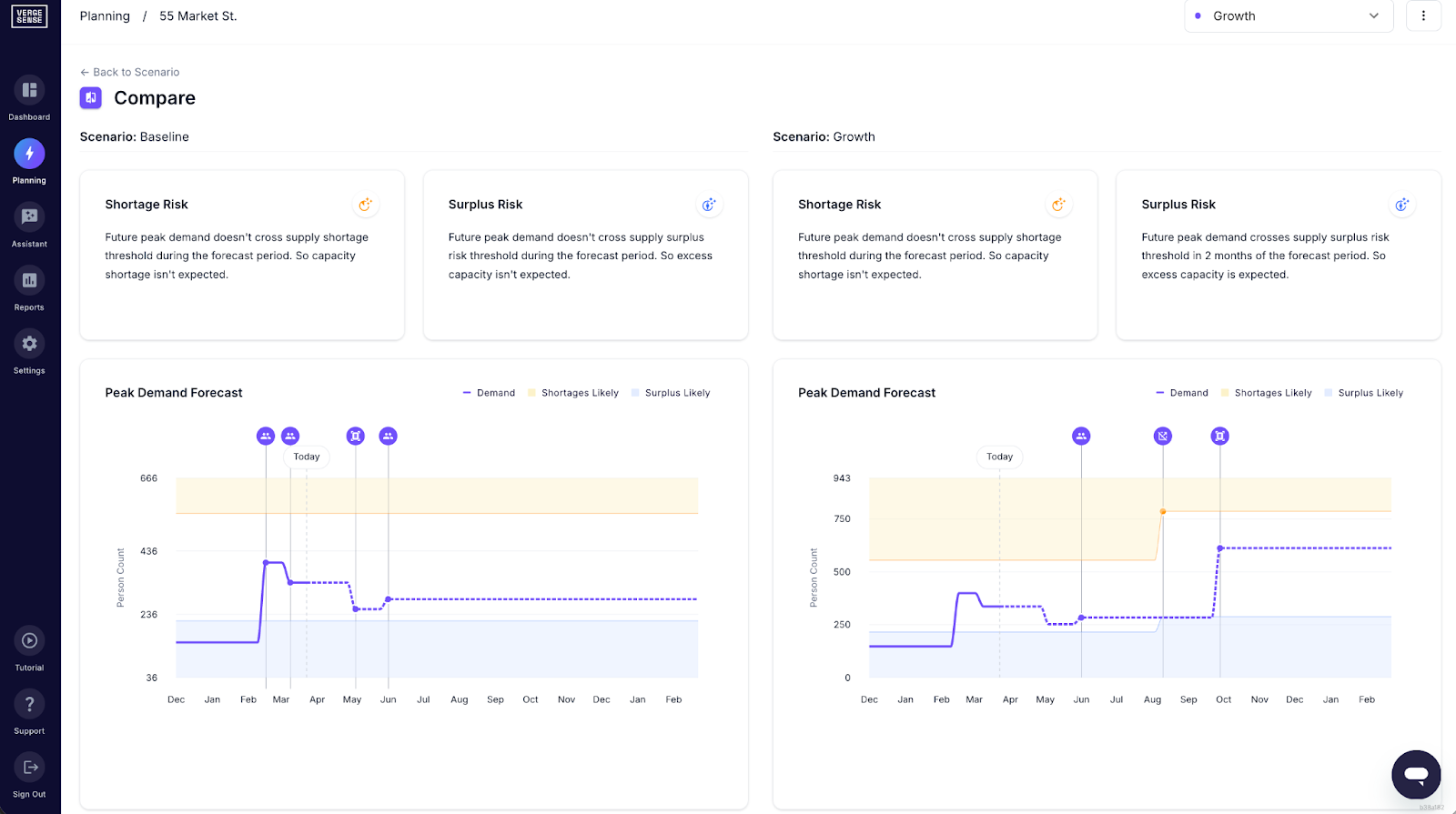
Predictive Planning lets teams run scenarios on spaces they've never sensed, using the Large Spatial Model to forecast demand instead of leaning on a static consultant benchmark. That means a CRE leader can stress-test a consolidation across the whole portfolio, not only the buildings already wired for measurement.
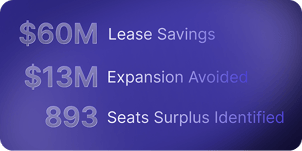
VergeSense customers have saved millions with the platform’s scenario planning capabilities. Fresenius Medical Care faced a consolidation call across two headquarters buildings and, rather than guess, measured actual usage. One building was running at roughly 20% utilization, and that measured finding justified a lease exit worth $60M in lease cost avoidance over 10 years, a strategy built on evidence rather than assumption.
For the translation work, VergeSense Strategic Advisory Services helps CRE leaders package measured data into recommendations that survive the boardroom. The advisory team, led by Brad Golden and Izzy Cannell, works alongside CRE leaders to turn utilization findings into the cost-avoidance and payback framing finance expects.
Common Pitfalls in Corporate Real Estate Strategy
Three bad habits show up repeatedly in CRE strategies, and each one is worth auditing before you build the business case.
Relying on Stale or Incomplete Data
The most common failure is bringing a point-in-time study to a continuous problem. A snapshot taken during one quarter can't account for the way attendance shifts week to week, and a CFO will find the hole in it fast.
Incomplete data is just as risky as stale data. Badge swipes and booking logs describe intent and entry, not actual use, so a strategy built on them alone overstates how full the building really is. The savings hide in the space that looks occupied on paper and sits empty in practice.
Treating Strategy as a One-Time Exercise
Headcount, attendance, and business priorities keep moving, and a strategy that was right last year drifts out of alignment without anyone noticing.
To stay ahead, treat strategy as an ongoing task. JLL's 2026 Global Occupancy Planning Benchmark Report found portfolio optimization is now the top occupancy-planning priority for CRE leaders, which only holds up when the data behind it refreshes continuously rather than once a cycle.
Failing to Translate Space Data Into Financial Terms
Plenty of CRE teams have the data but fail to get buy-in from finance. They present utilization percentages and floor-by-floor heat maps, then watch their CFO disengage because none of it is expressed in dollars. Until the numbers arrive in financial terms, the portfolio reads to finance as a cost center and nothing more.
The fix is to lead with the financial outcome and keep the utilization data as the proof underneath it. A recommendation framed as cost avoidance with a payback timeline is much more likely to get funded than the same finding displayed as an occupancy chart.
Build a Defensible Corporate Real Estate Strategy
With a data-backed read on your own portfolio, you can walk into any engagement already knowing what your space is telling you. So to start:
- Audit your current data sources. Inventory what you already have across badge access, room booking, WiFi, videoconferencing, and any existing sensors, and be honest about each one's blind spots.
- Map the lease dates and renewal options falling in the next 12 to 24 months. These are the decisions with the shortest fuse and the biggest dollar figures, so they set the priority order for everything else.
- Run a baseline scenario model. Establish how your space is actually used today, then model the consolidation, expansion, or exit options against that baseline.
- Build the CFO-ready business case. Translate the strongest scenario into cost avoidance, payback, and ROI before you bring in outside recommendations.
When you show up with evidence and a clear case for cutting costs, every decision gets easier to defend.
Need a corporate real estate strategy that holds up under financial scrutiny?
See how VergeSense helps CRE leaders build data-backed portfolio plans with CFO-ready evidence.
Frequently Asked Questions
How Often Should a CRE Strategy Be Updated?
A CRE strategy should be updated continually. Headcount, attendance, and business priorities shift throughout the year, so a strategy grounded in continuously measured occupancy data stays aligned. Revisit the full portfolio model ahead of any major lease event, reorganization, or RTO policy change.
What Data Sources Are Needed for a Defensible CRE Strategy?
Most teams pull from badge access, room-booking systems, WiFi connections, videoconferencing data, and occupancy sensors when building their CRE strategy. The defensible version relies on continuous, measured utilization data rather than one-time surveys or consultant snapshots, because finance can't argue with your own measured usage.
How Does AI Change the CRE Planning Process?
AI-driven modeling changes the CRE planning process by replacing static seat ratios and one-time studies. Trained on large behavioral datasets, it lets CRE leaders run scenarios and stress-test consolidations, expansions, and lease exits against how people actually use space, including spaces that were never sensed directly.
What Is the Difference Between a CRE Strategy and a Space Plan?
Space planning lays out how a specific floor or building is configured, down to the physical spaces people use day to day. A corporate real estate strategy is the wider framework that aligns every portfolio decision, from lease exits to headcount shifts, with business strategy and financial constraints. Space management sits inside it.

.jpg)