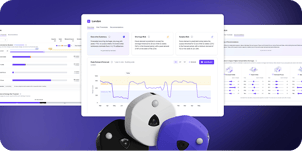

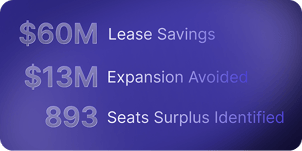



Most real estate and workplace leaders are making space decisions without the full picture. Badge swipes confirm someone entered the building, not where they went or what they used. Booking records capture intent, not behavior, and headcount-driven planning assumes every seat assignment translates into actual attendance.
Meanwhile, lease costs keep climbing, and the pressure to justify every square foot keeps climbing with them. The gap between what the data says and how the office is actually used is where poor portfolio decisions get made.
Office space utilization software exists to close that gap. But the category spans very different approaches. Each measures something different, and each supports a different class of decision.
To build this list, we evaluated each tool on data accuracy, decision-support depth, scalability across portfolios, and the ability to move from measurement to action.
The six that made it span every major approach in the category:
- VergeSense: Occupancy intelligence and predictive planning platform for enterprise CRE and workplace teams
- OfficeSpace Software: Booking-led workplace management with multi-source analytics
- Robin: Desk and room booking with an analytics layer for hybrid teams
- XY Sense: Wide-area sensor hardware with live utilization dashboards
- Basking.io: WiFi-based occupancy analytics that runs on existing access points
- Eptura: IWMS spanning space, asset, visitor, and lease management
Need a clearer picture of how your portfolio is actually used?
See how VergeSense helps CRE and workplace leaders measure real utilization, model future demand, and make confident, data-based portfolio decisions.
At a Glance: Comparing Office Space Utilization Software
Here's how the six office space utilization tools compare across primary use case, data and analytics, and best fit:
|
Tool |
Best For |
Data Inputs |
Analytics & Planning Depth |
Best-Fit Buyer |
|
VergeSense |
Enterprise occupancy intelligence and predictive planning |
Sensors, WiFi, badge, booking, floor plans |
Current-state analytics plus forward-looking scenario modeling, demand forecasting, and CFO-ready outputs |
Enterprise CRE, workplace strategy, and planning teams making portfolio decisions |
|
OfficeSpace Software |
Booking plus analytics on one platform |
Booking, badge, WiFi, third-party sensors |
Retrospective dashboards, heat maps, stack planning tools |
Facilities and workplace teams centered on booking workflows |
|
Robin |
Desk and room booking with reporting |
Booking and attendance data |
Booking and attendance reporting with an AI query assistant |
Hybrid teams coordinating in-office days |
|
XY Sense |
Sensor hardware with live dashboards |
XY Sense sensors |
Live views, heat maps, replays, and utilization reports |
Teams prioritizing wide-coverage sensor hardware |
|
Basking.io |
Fast, hardware-free occupancy trends |
WiFi infrastructure, badge, booking |
Building- and zone-level trends plus lease management views |
Teams needing directional data quickly at low deployment cost |
|
Eptura |
Consolidated workplace operations |
Booking, badge, WiFi, third-party sensors |
Space management, move planning, and role-based KPI dashboards |
Enterprises consolidating workplace operations on one vendor |
Best Office Space Utilization Software in 2026
The six platforms below span the major categories buyers encounter in this market: sensor-first occupancy intelligence, booking-led workplace platforms, sensor hardware vendors, WiFi-based analytics, and IWMS suites. Each entry covers what the tool does well, where it fits, and the tradeoff to weigh before committing.
1. VergeSense
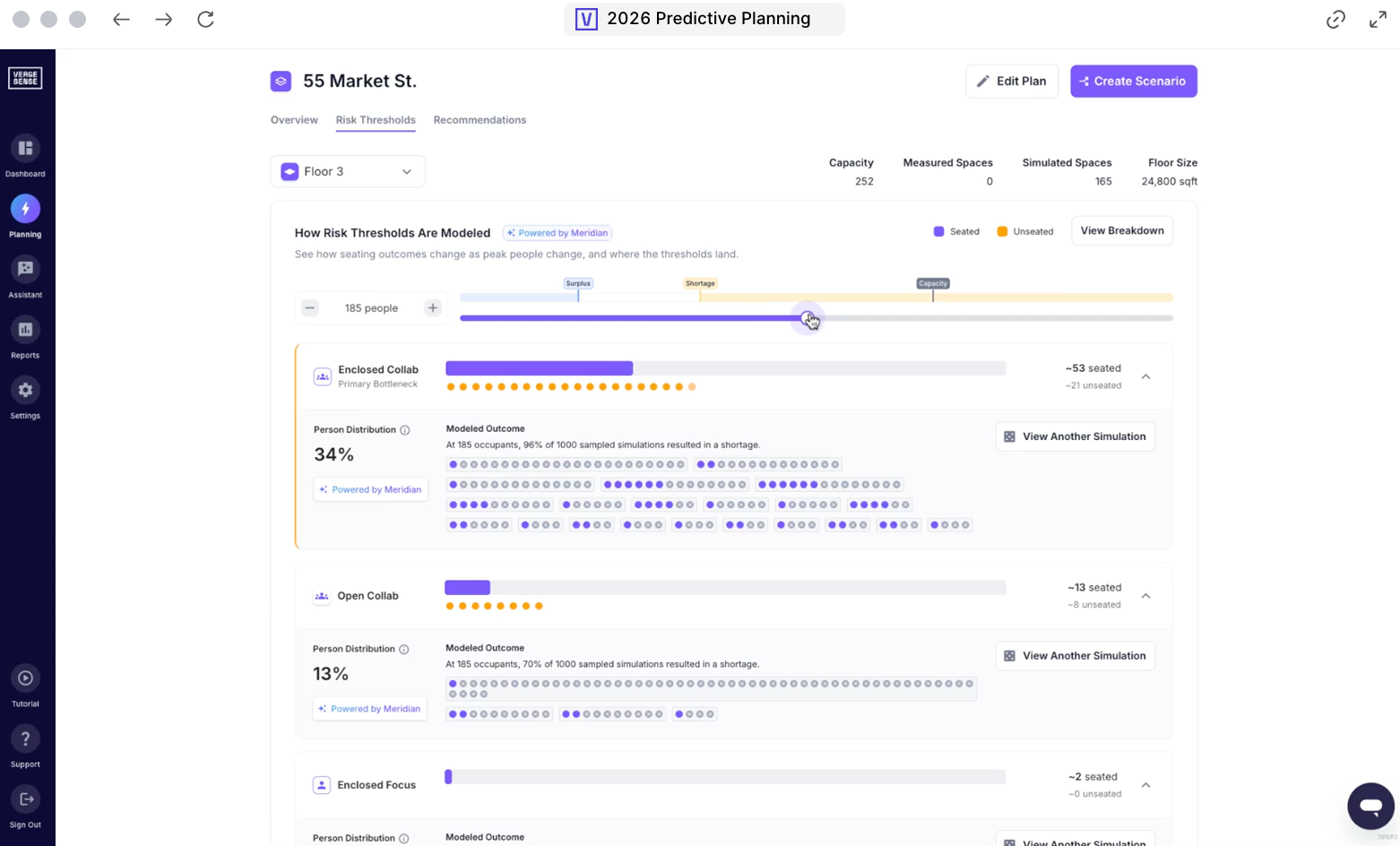
VergeSense is an occupancy intelligence and planning platform built for enterprise CRE, workplace strategy, and space planning teams. The platform measures how space is actually used, from portfolio down to individual rooms, and connects that current-state data to forward-looking decisions through Predictive Planning.
Its planning recommendations are powered by the Large Spatial Model, a foundational AI model trained on 250M+ sq ft of measured workplace data, which lets teams move from describing utilization to modeling what their portfolio should look like next.
Selected features
- Predictive Planning: scenario modeling and future demand analysis grounded in 250M+ sq ft of measured workplace data
- Large Spatial Model: the AI foundation that powers planning recommendations
- Occupancy Intelligence: unified analytics that ingests sensor, WiFi, badge, and booking data into one view
- Workplace Assistant: a natural-language layer for surfacing utilization answers to CRE, workplace, and facilities stakeholders
- Infinity Area Sensor: the only sensor on the market with a 10-year battery life and passive occupancy detection, used for individual high-value spaces like meeting rooms, focus rooms, and neighborhoods — it registers the belongings claiming a space, so a desk with a bag on the chair counts as occupied
- Granularity at every level: portfolio, floor, neighborhood, and zone views in one platform
- Integrations: Microsoft Places, ServiceNow Workplace Service Delivery, WiFi systems like Juniper Mist, and Cisco Meraki, plus support for ingesting badge and videoconferencing data
Best for
- Portfolio right-sizing and lease cost avoidance decisions tied to measured demand
- Identifying under- and over-constrained space types across enclosed focus, open focus, and collaboration zones, and making targeted changes
- Modeling proposed changes, such as RTO shifts or a hybrid steady-state, against actual capacity patterns
- Justifying space decisions to CFO and executive stakeholders with portfolio benchmarks
$715K A Year Avoided: A Real-Life Example
Facing a cost-savings mandate from its CFO, a global food manufacturer used VergeSense to understand how its 42,000 sq ft Chicago headquarters was actually used.
A six-month usage study found the space running at just 5% average capacity, with peaks reaching only 25%: clear evidence the company could operate in far less space. That gave the team the confidence to reduce the HQ footprint by 75%, avoiding $715K a year by exiting and subleasing space it wasn't using.
The decision rested on measured occupancy rather than badge or booking proxies.
Want to see what measured utilization would reveal in your portfolio?
See how VergeSense connects occupancy data to lease, design, and planning decisions your leadership team can act on.
2. OfficeSpace Software
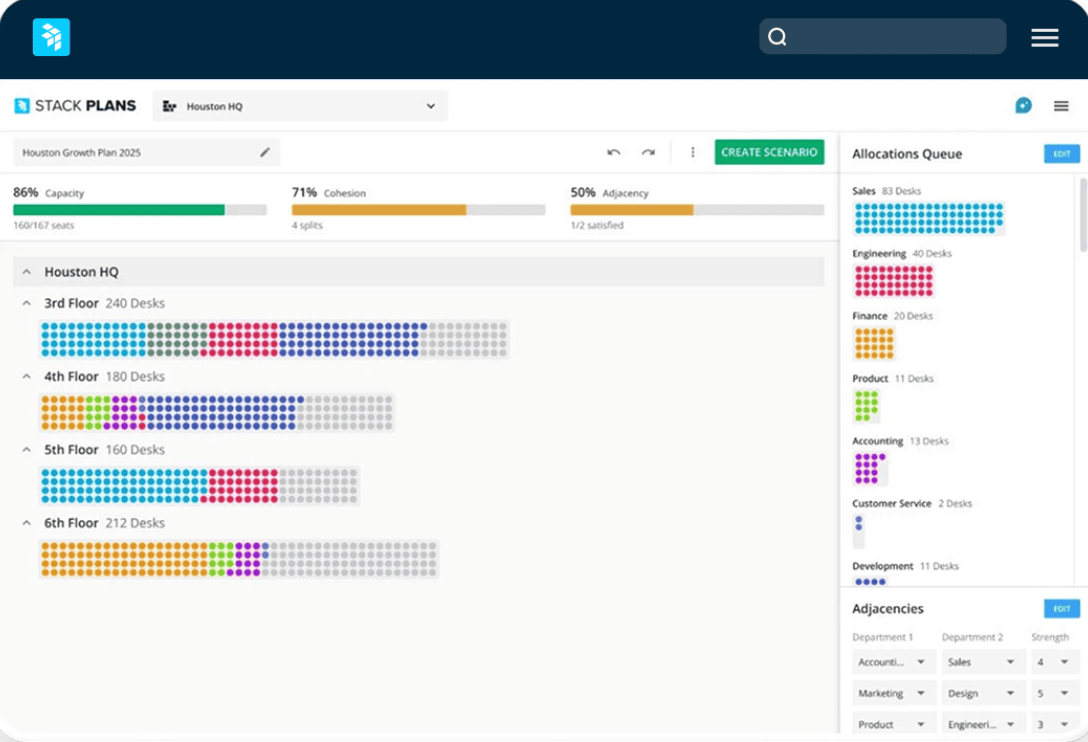
OfficeSpace Software is a booking-led workplace management platform that combines interactive floor plans, desk and room booking, and multi-source analytics in one interface. Founded in 2006 and backed by a $150M investment from Vista Equity Partners, the company serves 800+ customers and has expanded its analytics and planning capabilities, including AI-assisted stack planning tools.
Selected features
- Interactive floor plans, desk booking, and room booking on a single map
- Workplace analytics dashboards combining sensor, booking, badge, and WiFi data
- Insights Agent for plain-language utilization queries
- Heat maps and trend reports across desks, rooms, and floors
- Move management and stacking tools for restacking planning
Example use cases
- Day-to-day booking management alongside retrospective utilization reporting
- Heat-mapping desk and room usage to flag underused spaces
- Cost-and-utilization views for facilities-led space optimization conversations
The tradeoff
OfficeSpace is strongest where booking activity is the dominant signal and the buyer wants booking and analytics on one platform. The platform does not generate its own occupancy data; it ingests it from sensor vendors. Teams that need passive sensor-grade occupancy measurement, or planning that forecasts the impact of demand and behavior rather than optimizing seat assignments, will want to pair it with a deeper occupancy intelligence layer.
3. Robin
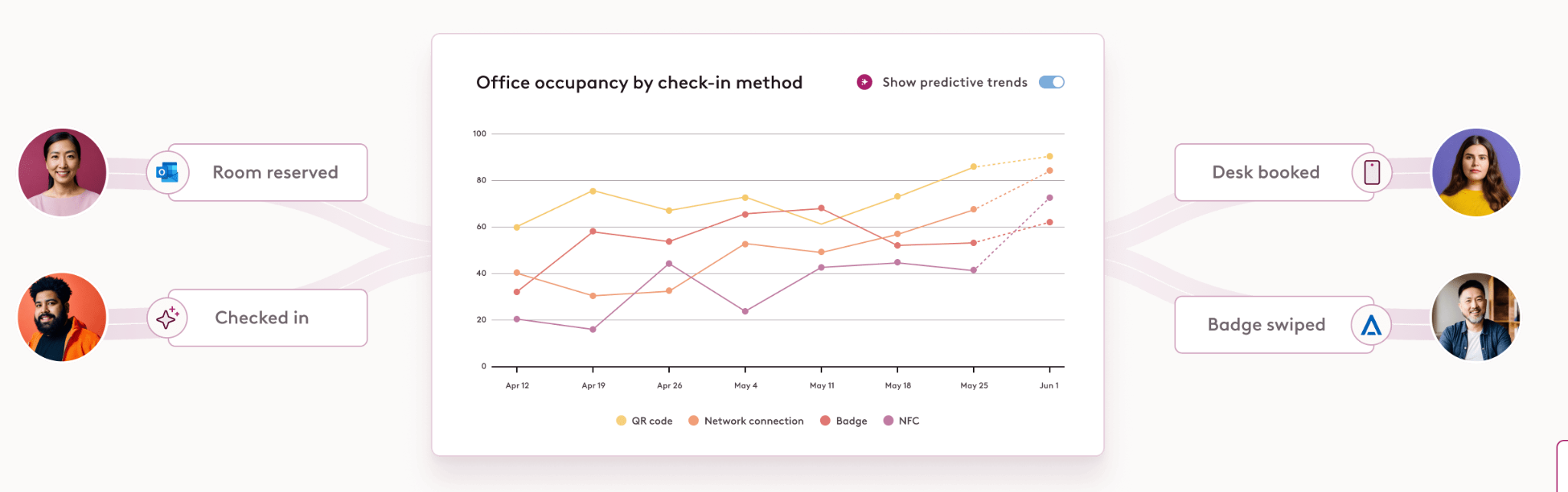
Robin is a workplace experience platform centered on desk and room booking, with an analytics layer built on top of that booking activity. It is a common choice for hybrid teams coordinating who comes in when, and its AI features automate desk selection and surface answers about booking and attendance patterns.
Selected features
- Desk and room booking with hot desking, neighborhoods, and auto-release for no-shows
- Workplace Insights Dashboard and space bookings reports
- Analytics AI Assistant for natural-language queries on workplace data
- Integrations with Google Workspace, Microsoft Outlook, Teams, and Slack
- Hybrid policy and attendance tracking features
Example use cases
- Driving booking adoption and reducing no-show waste
- Reporting on attendance and booking patterns to leadership
- Coordinating in-office days for hybrid teams
The tradeoff
Robin's analytics are strongest when booking activity is the primary input. But booked intent and actual behavior diverge: rooms get booked and ghosted, desks get used without reservations. Teams measuring passive occupancy against booked intent, or modeling future portfolio demand against measured behavior, will run into the limits of booking-derived signal.
4. XY Sense
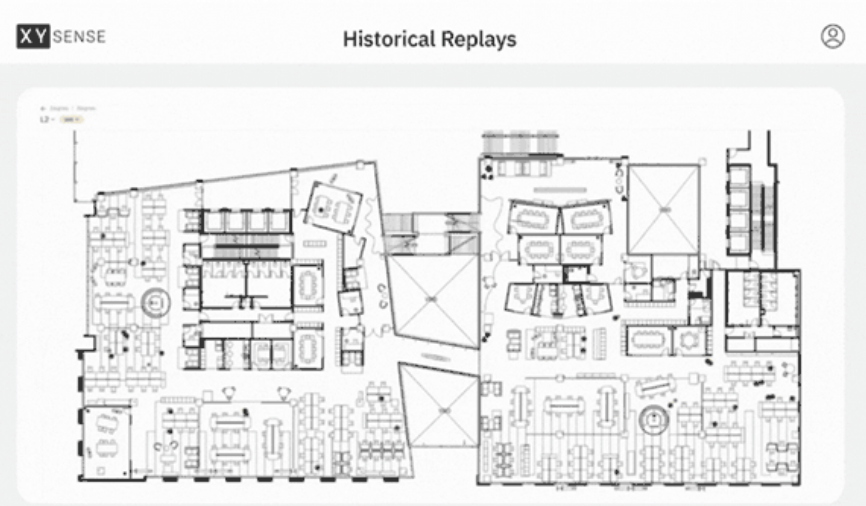
XY Sense is an Australian-founded sensor company that pairs wired occupancy sensors with utilization dashboards. Its Area Pro sensor, launched in March 2026, covers up to 3,000 sq ft per device with on-device AI processing and 2-second update intervals, and the company also offers a wireless Presense sensor for small spaces like pods and phone booths. The platform is strongest in APAC and EMEA markets.
Selected features
- Area Pro wired PoE sensor with wide per-device coverage and frequent update intervals
- Live floor views, heat maps, and replays of how spaces filled over time
- Desk and meeting room utilization analytics
- Senselink daisy-chain cabling to reduce wiring runs versus traditional PoE
- Self-service commissioning and recommissioning tools
Example use cases
- Instrumenting large open-plan areas where wide per-sensor coverage reduces device count
- Live occupancy views and historical replays for workplace teams
- Desk and room utilization reporting from sensor data
The tradeoff
XY Sense is a sensor-first offering: the hardware is capable, but the analytics stop at dashboards and reports. The wired PoE model is a permanent infrastructure commitment that gets complicated in occupied or leased buildings, and the sensors count people but not passive occupancy, so a desk claimed by belongings reads as empty. Teams that need scenario modeling, demand forecasting, or multi-source data unification will need a platform layer the product does not provide.
5. Basking.io
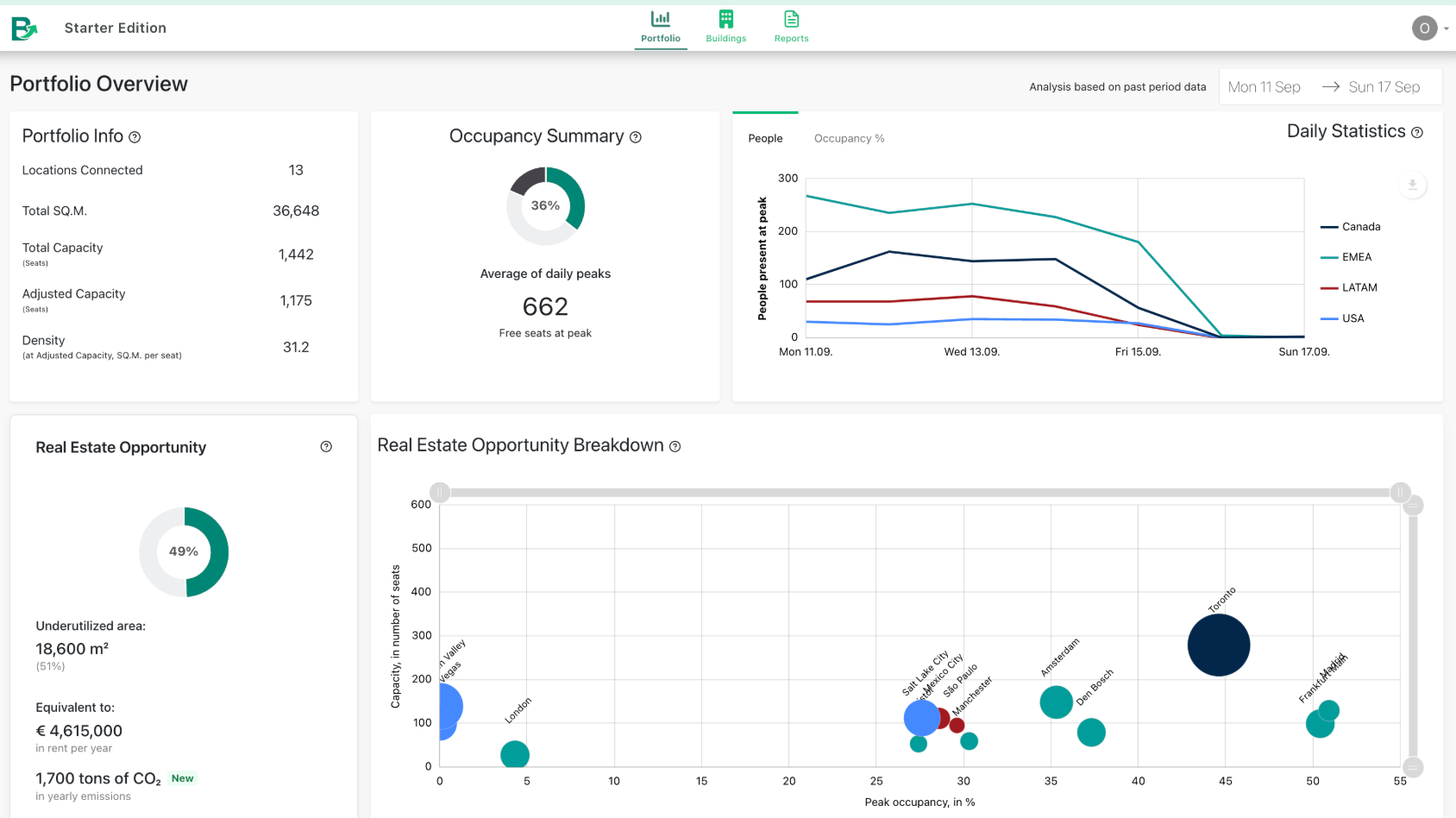
Basking.io is a WiFi-based occupancy analytics platform that uses existing wireless infrastructure as the sensing layer, plus a LeaseOps module that brings lease data and portfolio decisions into the same platform.
Founded in Berlin in 2017, Basking connects to access points via API and estimates occupancy from connected devices, which makes it one of the fastest tools in the category to deploy.
Selected features
- WiFi-as-a-sensor analytics off existing Cisco, Juniper, Aruba, or comparable access points
- LeaseOps for lease data, critical dates, and portfolio decisions in one platform
- Software-only deployment measured in hours, with no new hardware
- GDPR-compliant, anonymized device-level counting
- Cisco DNA Spaces certification and a global deployment partnership with Colliers
Example use cases
- Fast global rollouts where new hardware is impractical
- Lease-aligned utilization views for CRE portfolio decisions
- Building-level and floor-level utilization reporting at low deployment cost
The tradeoff
Basking's strength is rollout speed and existing-infrastructure economics. The constraint is what WiFi can see: it counts devices rather than people, resolves to zones rather than rooms, and cannot detect passive occupancy. Teams that need room-level granularity, person-counting accuracy, or sensor-grade data in dense collaboration zones will want to pair WiFi data with a more precise occupancy layer.
6. Eptura
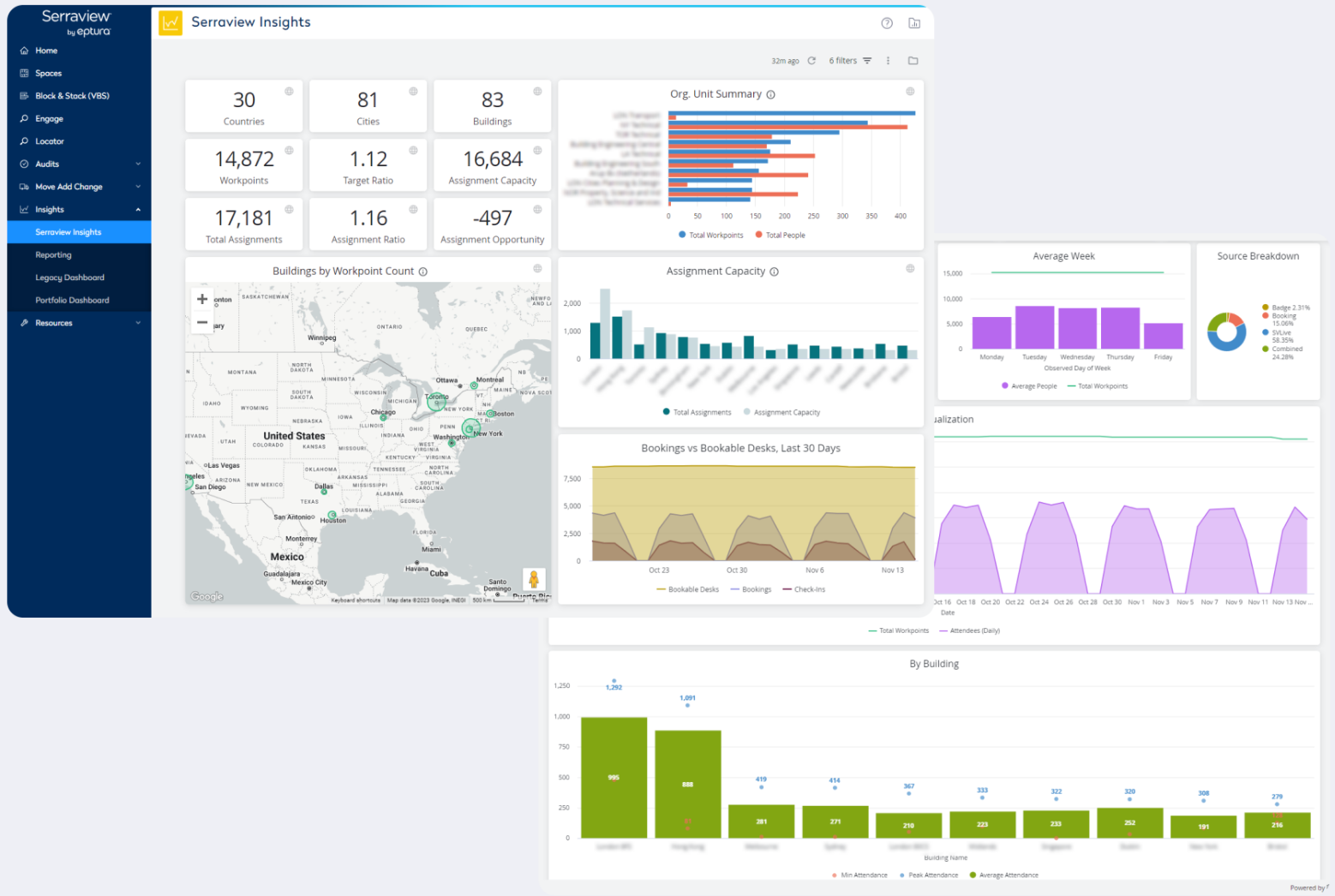
Eptura is a worktech platform formed by consolidating nine acquired companies, including Archibus, Condeco, Serraview, and iOffice, into a single IWMS spanning space, asset, maintenance, visitor, and lease management. It powers workplace operations for a large share of the Fortune 500 and was named a Leader in the 2026 Gartner Magic Quadrant for Workplace Experience Applications.
VergeSense integrates directly with Eptura's Serraview product, feeding occupancy data into its space planning and live floor views.
Selected features
- Space management module with portfolio-, floor-, and desk-level utilization views
- Move management, stack planning, and seat-assignment tools
- Role-based KPI dashboards across utilization, costs, and energy
- Sensor and WiFi integrations, including VergeSense, to enrich IWMS space data
- Visitor, asset, and maintenance modules on the same platform
Example use cases
- Consolidating space, maintenance, asset, and visitor management on one vendor
- Coordinating restacking and seat assignments after policy changes
- Reporting workplace KPIs to leadership inside the IWMS environment
What VergeSense complements
Eptura manages the operational stack; VergeSense supplies the occupancy data and predictive intelligence that stack runs on. Many enterprises run both, with VergeSense sensor data flowing into Serraview's planning and live views while Predictive Planning handles the demand forecasting and scenario modeling the IWMS layer does not cover.
6 Key Features and Capabilities to Prioritize in Office Space Utilization Software
Feature checklists make these platforms look more similar than they are. The questions below are about capabilities, the things that determine whether the software actually changes the decisions your team makes.
1. Occupancy Data Accuracy and Passive Occupancy Detection
Badge data confirms entry to a building, and booking data confirms a reservation was made. Neither confirms a space was used: badge swipes lose the trail past the lobby, and booked rooms sit empty while unbooked spaces fill up.
Closing that gap comes down to the accuracy of your measurement layer. The right sensors detect passive occupancy, registering spaces claimed by belongings while people step away, so real usage is counted whether or not it was ever swiped or booked.
Accuracy also has to hold up over time, which is where battery life matters: sensors that run for years instead of months cut maintenance overhead and electronic waste, keeping the data reliable without a constant replacement cycle.
The difference shows up most at the peaks. The latest Workplace Occupancy & Utilization Index found peak capacity usage reached 60% in 2025 even as averages held between 9% and 11%, which means a portfolio that looks empty on average can still be genuinely constrained on the days that matter. Bookings and badges alone rarely catch that.
2. Reporting Depth Versus Decision Support
Most platforms in this category can tell you what happened last quarter. Far fewer can help you decide what to do next.
The dividing line is whether the platform offers predictive planning, scenario modeling, and what-if capabilities, or stops at retrospective dashboards. If your next big decision is a lease renewal, a consolidation, or a redesign, a heat map of last quarter's usage describes the problem without resolving it. Decision support means modeling the options and quantifying the outcomes.
3. Flexibility in Data Inputs and Deployment
No single data source tells the whole story, so platforms that ingest sensor, WiFi, badge, booking, and floor plan data together beat platforms that lock you into one signal.
Deployment model matters too. Sensor-led deployments deliver the highest accuracy but require hardware; WiFi-led deployments deliver speed at the cost of granularity; booking-led and IWMS-led approaches work from data you already have but inherit its blind spots.
The strongest position is a platform that starts from whichever inputs you have today and adds precision where the decisions justify it.
4. Planning and Forecasting Capabilities
Scenario modeling is the capability gap most retrospective tools cannot close. Headcount changes, policy changes, lease decisions, and floor plan redesigns all hinge on a forward-looking question: what happens to demand if this changes?
Tools that only report history force teams to answer that question with spreadsheets and assumptions. Platforms with forecasting built in can simulate the change before anyone signs anything.
5. Enterprise Readiness and Scalability
A pilot floor and a global portfolio are different problems. Evaluate whether the platform can deploy across regions, cover multiple space types from focus rooms to neighborhoods, and serve CRE, workplace, facilities, and finance stakeholders from the same data.
Integration depth matters at scale: connections to Microsoft Places, ServiceNow Workplace Service Delivery, Juniper Mist, and Cisco Meraki let utilization data flow into the systems those stakeholders already work in.
6. Outputs That Different Stakeholders Can Use
The same utilization data has at least three audiences. Finance needs cost-justification outputs that survive CFO scrutiny, workplace strategy needs experience and space-type data that informs design, and facilities needs operational signals that drive cleaning, maintenance, and servicing.
A platform that produces all three from one dataset eliminates the translation work, and the credibility gaps, that come from each team running its own numbers.
How to Choose Office Space Utilization Software for Your Team and Workflows
The right platform depends on your team's maturity, your existing data environment, and the decisions the software needs to support. Use the questions below to narrow the field before you sit through a single demo.
Questions to Ask Internally
- Are we mainly trying to measure current utilization, or do we need to forecast future space demand?
- What signals do we trust today, whether badge, booking, sensor, or WiFi, and which are we missing?
- Do we need portfolio-level insight, floor-level insight, or neighborhood- and room-level planning detail?
- Are we trying to improve employee experience, reduce real estate spend, support design decisions, or all three?
- Will we need to justify high-cost lease, layout, or consolidation decisions to leadership with hard data?
- How important is deployment flexibility: sensors, WiFi-based, software-only inputs, or all of the above?
- Who will actually use the tool: CRE, workplace strategy, planners, facilities, finance, or design?
Questions to Ask Vendors
- How is occupancy measured, and how accurate is that method in spaces where bookings underrepresent actual use?
- What data sources can the platform ingest besides its own native product?
- Can the platform support planning and forecasting, or is it limited to historical reporting?
- What level of granularity does the product support: portfolio, building, floor, neighborhood, room, desk?
- Can the platform model the impact of headcount changes, policy changes, or floor plan changes?
- What does deployment look like, and what is typical time-to-value?
- How are insights surfaced to different stakeholders, and what outputs are usable in leadership discussions?
- What differentiates the platform from badge data, booking tools, consultants, or general IWMS software?
Ready to see what decision-grade planning data looks like?
Bring your hardest open question, whether a lease renewal, a consolidation, or an RTO shift, and see how VergeSense can show you the impact.
FAQs About Office Space Utilization Software
What Is the Difference Between Office Space Utilization Software and an IWMS?
An IWMS manages workplace operations: space inventory, moves, maintenance, visitors, and leases. Office space utilization software measures how space is actually used and, in the strongest platforms, forecasts how it will be used next. Many enterprises run both, with utilization data feeding the IWMS through integrations.
Is Sensor-Based Occupancy Data More Accurate Than Badge or Booking Data?
Yes, for measuring actual use. Badge data stops at the building entrance, and booking data records intent rather than behavior. Sensors measure presence in the space itself, and passive occupancy detection also captures spaces claimed by belongings, which badge and booking systems miss entirely.
How Long Does It Take to Implement Office Space Utilization Software?
It varies by approach. WiFi-based tools can go live in hours using existing access points. Wireless sensors like the Infinity Area Sensor install in seconds per device with no cabling, so floors come online in hours. Wired sensor deployments and full IWMS rollouts typically take longer because of cabling and configuration work.
How Does Office Space Utilization Software Support Lease and Portfolio Decisions?
It replaces proxies with measurement. Instead of justifying a renewal or exit with badge averages, teams can show measured demand by building and floor, model scenarios like consolidation or policy changes, and quantify the financial impact. One IT services company used this approach to avoid $115K in lease costs and build a repeatable model for evaluating satellite office leases.