

How Predictive Analytics Is Changing the Way CRE Teams Plan Space


VergeSense is the industry leader in providing enterprises with a true understanding of their occupancy and how their offices are actually being used.
For years, space planning has followed the same pattern: collect a quarter's worth of badge data, walk the floors, build a spreadsheet, and hope the assumptions hold long enough to justify the lease decision. The limitations are well understood: the data is outdated before the planning cycle finishes, and the next consolidation or expansion conversation starts from scratch.
That cycle is breaking. A new generation of predictive models, trained on measured occupancy data at portfolio scale, is giving CRE and workplace teams a way to project demand, stress-test scenarios, and right-size space before committing capital.
This piece covers:
- What predictive analytics actually means in a workplace context
- Why static planning methods can’t keep pace
- What changes when your planning inputs shift from lagging indicators to forward-looking forecasts
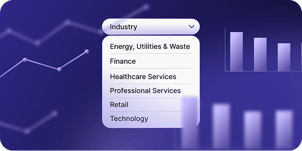
Explore how your office compares against peers in your industry and region
The VergeSense Index Benchmark explorer is an interactive tool built on 250M+ sq ft of measured workplace data from 210+ enterprises across 50+ countries.
What Workplace Predictive Analytics Actually Means
Predictive analytics in the CRE and workplace context refers to forward-looking models that project space demand, identify surplus capacity, and run scenario analysis across a portfolio.
Descriptive analytics tells you what happened: how many people badged in last Tuesday, which floors hit capacity last month, what your average utilization looked like over the past quarter. It's backward-looking by design. Prescriptive analytics goes a step further and recommends a specific action: close this floor, add 40 desks to the east wing, convert these offices to collaboration space.
Predictive space planning analytics sits between the two. It answers the question CRE teams are actually asking: what will demand look like next quarter, and how should we plan for it? Instead of reacting to historical patterns, you're modeling future scenarios with enough confidence to inform lease negotiations, design briefs, and consolidation timelines.
As Kathleen from Takeda put it at the Occupancy Intelligence Summit: "When we talk about demand, we have to know what the typical daily headcount is. How many people do we need to design space for?"
Why Static Planning Is Breaking Down
The core issue is a mismatch between how CRE teams make decisions and the data those decisions rely on. Two problems compound: the inputs are incomplete, and the consequences of acting on them are expensive.
The Data Gap in Traditional Space Decisions
Most lease decisions, neighborhood redesigns, and consolidation plans are still built on badge swipes, anecdotal walkthroughs, and quarterly snapshots. These inputs tell you who entered the building, not how space was actually used throughout the day.
Making matters worse, many of these decisions are outsourced to consulting firms, turning each planning cycle into a lengthy, expensive project. A single portfolio study can cost $500K to $1.5M and take three to six months to deliver, and by the time the findings arrive, occupancy patterns have already shifted.
The Occupancy Intelligence Index, now in its 9th edition and spanning 210+ enterprise customers across 50+ countries, paints a clear picture of the gap. Average capacity usage sits between 9 and 11% globally, while average daily peak usage reaches 30 to 40% before settling back down, and peak capacity tops out at 52 to 60%.
The distance between average and peak usage is where the planning risk lives, and point-in-time studies can't capture it.
The Cost of Getting It Wrong
When planning relies on outdated or incomplete data, inaccuracies build across the decision-making process. Overprovisioned floors carry lease costs, operating expenses, and maintenance budgets for space that sits empty most of the week.
Missed consolidation windows lock capital into underused buildings when the market would have supported a favorable exit. Neighborhood redesigns built on assumptions rather than measured behavior produce spaces that don't match how teams actually work.
CRE teams face this reality every quarter: multi-million-dollar decisions resting on data that was never designed to support them.
How Predictive Analytics Works in Practice for Space Planning
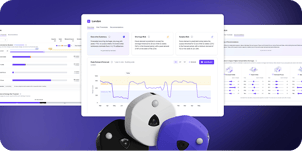
VergeSense built its Predictive Planning capability around three practical applications: forecasting demand across a portfolio, stress-testing scenarios before committing capital, and making the outputs accessible to non-technical stakeholders.
Modeling Demand Across Measured and Unmeasured Spaces
The Large Spatial Model, trained on 250M+ sq ft of measured workplace data, is what makes portfolio-wide forecasting possible. The LSM generates demand forecasts even for spaces without sensors installed, which means teams don't need full sensor coverage to start planning.
The model draws from multiple data inputs: badge access data, room-booking systems, WiFi connections, videoconferencing data, and occupancy sensors. By combining these signals, Predictive Planning produces demand projections that reflect actual workplace behavior rather than policy assumptions or headcount rosters.
Scenario Planning for Lease and Design Decisions
The real value of predictive analytics shows up before capital gets committed. Instead of building a single plan and defending it through approval, CRE teams can run multiple what-if models: what happens if headcount grows 15% in this region, what if we consolidate two floors into one, what if we shift the space mix from individual desks to collaborative neighborhoods.
Each scenario produces a demand forecast grounded in measured occupancy patterns, not rules-based estimates. Narrowing the range of outcomes before signing a lease, not to predict the future with false precision.
Surfacing Insights Stakeholders Can Act On
Planning doesn't happen in a vacuum. Facilities managers, finance teams, and business unit leaders all need access to the data behind a space decision, and most of them aren't going to build their own dashboards.
Workplace Assistant serves as a conversational interface for pulling planning-related insights from historical occupancy data. A stakeholder can ask a direct question ("What was the peak utilization on Floor 3 last quarter?") and get a clear answer without waiting for an analyst to pull a report. It's an information retrieval tool that makes occupancy data accessible to the people who need it at the moment of decision.
What Changes When Planning Becomes Predictive
Instead of asking "how full were we last quarter," CRE teams start asking "what will we need next quarter, and which scenarios should we plan for." That changes the cadence of decision-making, the confidence behind capital commitments, and the speed at which teams can respond to shifts in demand.
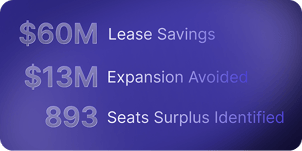
This kind of shift shows up most clearly in specific decisions. One global biotechnology company with headquarters in San Francisco used this approach to avoid $13M in expansion costs. Measured occupancy data revealed that much of their space was being held passively by personal belongings rather than actively occupied. By establishing designated belonging areas and reclaiming that space, the company eliminated the need for a costly expansion, all without displacing a single team.
These capabilities, measured occupancy intelligence, predictive demand modeling, and conversational access to planning data, are what VergeSense connects through its Meridian platform. The point is to put the evidence behind a space decision in one place, accessible to everyone involved in making it.
Putting Predictive Planning Into Practice
If your team is considering a move toward predictive planning, the path forward doesn't require a full technology overhaul on day one. Start with three practical steps.
First, establish a measured occupancy baseline. Whether through occupancy sensors, badge data integration, or a combination of inputs, you need a foundation of actual usage data to build forecasts on. Policy assumptions and headcount rosters aren't enough.
Second, align stakeholders on the planning questions that matter most. Are you evaluating a lease renewal? Redesigning a floor? Considering a consolidation? The model is only as useful as the decisions it's designed to inform.
Third, define the scenarios you need to test. Predictive Planning is most valuable when it's applied to specific capital and design decisions, not run as a general-purpose analytics exercise.
Ready to see how predictive planning works for your portfolio?
VergeSense Predictive Planning helps CRE and workplace teams model scenarios and right-size space with measured data, before demand shifts.
FAQs About Workplace Predictive Analytics
How Does Predictive Analytics Differ From Occupancy Monitoring?
Occupancy monitoring captures real-time or historical data on how space is being used. Predictive analytics builds on that data to forecast future demand, model what-if scenarios, and project how changes in headcount, policy, or design will affect space needs across a portfolio.
What Data Inputs Does a Predictive Planning Model Need to Generate Reliable Forecasts?
Effective predictive models draw from multiple sources: badge access data, room-booking systems, WiFi connections, videoconferencing data, and occupancy sensors. The more signals the model can combine, the more accurate the demand projections become, even for spaces without sensors installed.
Can Predictive Analytics Work for a Single Building or Does It Require a Full Portfolio?
It works at both scales. The Large Spatial Model is trained on 250M+ sq ft of measured workplace data, which means it can generate reliable forecasts for a single building even without full sensor coverage. Portfolio-wide analysis adds additional context, but a single-building pilot is a practical starting point.
.jpg)