




Lease decisions worth millions still get made on badge swipes, headcount projections, and gut feel. Meanwhile the CFO keeps asking the same question in every quarterly review: how much space can we give back without hurting productivity? Most CRE leaders cannot answer it with confidence, because the data underneath the portfolio was never built to answer it.
The gap between policy and behavior makes the problem sharper. According to the Flex Index Q2 2025 Flex Report, required office time climbed roughly 12% from mid-2024 through Q3 2025, while actual attendance moved only 1-3%.
Companies wrote stricter mandates; employees largely kept their existing patterns. A portfolio sized to the mandate, rather than to measured behavior, is sized wrong from day one.
This guide covers what a modern corporate real estate portfolio strategy looks like in 2026: the discipline itself, the inputs it needs, the four-step process that makes it work, the pitfalls that sink it, and how to get started before your next lease event.
Wondering how your portfolio compares to 200+ global enterprises?
The latest VergeSense Workplace Occupancy & Utilization Index benchmarks peak capacity, shortage rates, and the policy-versus-behavior gap across the world's largest measured workplace dataset.
What Is Corporate Real Estate Portfolio Strategy?
Corporate real estate portfolio strategy is the ongoing discipline of matching the physical footprint, owned, leased, and sublet, to how work actually gets done across the enterprise. The unit of measurement is cost per seat used, not cost per seat leased. A portfolio can look efficient on a rent roll and still bleed money if half the seats it pays for sit empty on the busiest day of the week.
It helps to separate portfolio strategy from the disciplines around it. Facilities management runs day-to-day operations. Workplace strategy shapes experience and design. Lease administration executes transactions.
Portfolio strategy sits above all three and sets the targets they execute against: how much space, in which markets, of what type, on what lease terms. When the targets are wrong, every downstream discipline optimizes toward the wrong outcome.
Why Portfolio Strategy Looks Different in 2026
Hybrid work is no longer a transitional question. It is the operating environment, and the measured data confirms it has settled into a durable pattern. Across the 200+ global enterprises in the VergeSense Workplace Occupancy & Utilization Index, average capacity usage held at 9-11% throughout the year while peak reached 52-60%.
That spread is the defining fact of the 2026 portfolio. Average tells you the portfolio is structurally oversized for daily demand. Peak tells you the office still breaks on the days everyone shows up, often in the same space types at the same hours.
Timing adds pressure. Lease maturities from the 2019-2021 signing wave are hitting renewal at the same moment CFOs are tightening capital plans. Every CRE leader holding one of those leases is on a clock, and the renewal decision will be made with or without good data.
Who Owns It Inside the Enterprise
Portfolio strategy typically sits with the VP or SVP of Corporate Real Estate, the Head of Real Estate, or a Portfolio Director, usually reporting to the CFO or COO. The reporting line matters: the strategy lives or dies on whether its owner can speak the CFO's language of cost avoidance, risk, and capacity headroom.
It is also unavoidably cross-functional:
- Workplace Strategy supplies the experience lens
- Finance supplies the capital constraints
- HR supplies the people plan
- Facilities supplies operational reality
Portfolio strategy without those inputs becomes a spreadsheet exercise, internally consistent and disconnected from how the company actually works.
How Corporate Real Estate Portfolio Strategy Actually Works in Practice
A working portfolio strategy follows a repeatable sequence: measure, benchmark, model, justify. Each step builds on the one before it, and skipping ahead is the most common way the process fails.
Step 1: Establish the Measurement Baseline
A jacket draped over a chair, a laptop left open during a coffee run, a meeting room booked but empty since 9 a.m. Badge data sees none of it, and surveys report what people remember rather than what they did.
The baseline step replaces those low-confidence inputs with precise occupancy measurement at the space-type level: ensuring you have the right type of measurement in place across enclosed focus, open focus, enclosed collaboration, open collaboration spaces.
Three numbers matter here, and they answer different questions.
- Average tells you how much space you own that you rarely use.
- Peak tells you the single busiest moment a space ever sees.
- Average daily peak sits between them, and is the number you plan against: the typical high-water mark across normal days, with the one-off all-hands and the empty Friday stripped out.
Peak alone is a trap. Size a portfolio to the busiest hour it ever recorded and you build for a day that happens twice a year.
Average alone is the opposite trap. It buries the hours the office actually runs short. Average daily peak is what a planner can defend in front of a CFO, because it reflects real demand on a real working day.
The Index data shows why both are necessary. Enclosed collaboration spaces hit shortage conditions in the early afternoon, with the Index reporting an 18% shortage rate at 2 PM, exactly the hour in-person collaboration is supposed to happen.
A portfolio that only tracks averages would never see that failure coming.
|
What that looks like in practice:
Takeaway: You can't plan a portfolio you haven't measured, and badge data on its own can't provide the full picture. |
Step 2: Benchmark the Portfolio Building by Building
Start inside your own footprint. Two buildings in the same portfolio can post the same average occupancy and behave completely differently at peak, so the first comparison that drives decisions is building against building. This is on cost per seat used, peak capacity usage, and shortage rate by space type.
Industry and regional benchmarks then add the outside-in view: how your buildings stack up against measured behavior across multiple enterprises, rather than against the static consultant ratios that hide where the real variance lives.
Both views run off the same measured behavior. The thing neither relies on is the static consultant ratio: a fixed seats-per-person assumption that was outdated the day it was published and hides exactly the variance these benchmarks are built to surface.
|
What that looks like in practice:
Takeaway: Benchmark against measured behavior at every level, your own buildings and the wider dataset alike. The only thing worth distrusting is the static consultant ratio. |
Step 3: Model Scenarios Before Committing to Leases
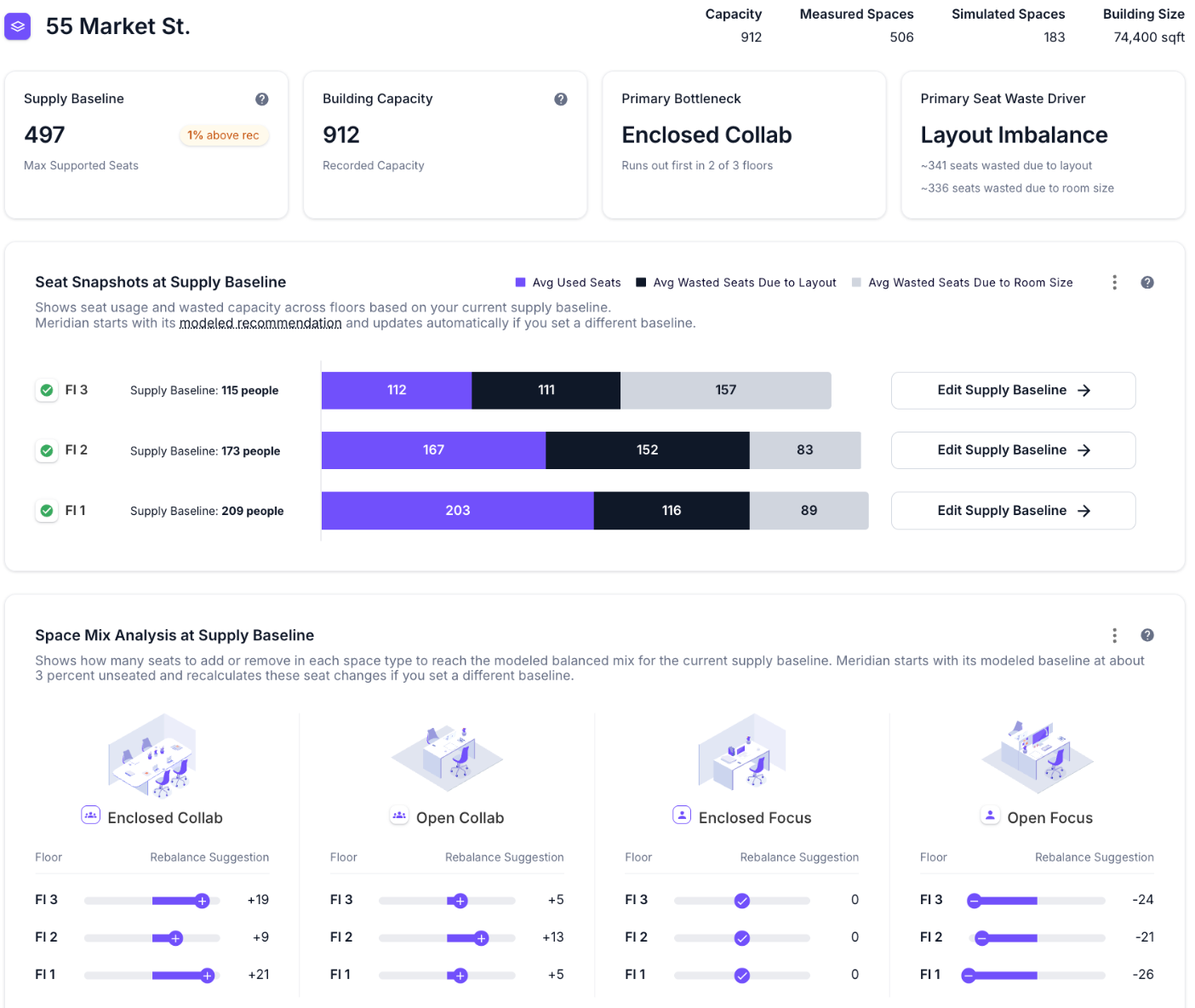
This is where strategy stops being descriptive and allows you to forecast how your buildings will perform with proposed changes. What if the East Coast HQ moves to a four-day mandate? What if the acquired team gets absorbed into existing space instead of keeping its lease?
For years, getting an expert opinion meant booking one. You'd engage a consultant, brief them, wait, and eventually get back a considered answer in a deck. The answer was usually good. But you got one of them, it took months, and you couldn't ask a follow-up without starting the engagement over. The moment your headcount assumptions shifted, the opinion you paid for was describing a portfolio you no longer had.
Predictive Planning gives you that same expert judgment whenever you need it. The Large Spatial Model, trained on 250M+ sq ft of measured workplace behavior, runs each scenario against how space is actually used, not against a rule of thumb, and returns an answer in the time it takes to frame the question. Ask it twice. Ask it ten times. Change one input and re-run. It is a second opinion you don't have to schedule, and it stays current as the portfolio moves underneath it.
For recurring questions, the ones that come up every renewal cycle, no longer have to wait in line behind a statement of work.
|
What that looks like in practice:
Takeaway: The ability to re-run scenarios as conditions change beats a consulting deck that expired the day it was delivered. |
Step 4: Justify the Decision to the CFO and Board
Occupancy data does not move a board. Financial translation does. The final step converts measured behavior into the three terms a board recognizes: cost avoidance, risk, and capacity headroom.
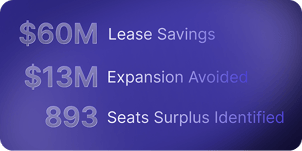
Fresenius Medical Care is a useful reference case. Measured occupancy across its two headquarters buildings showed one building running at roughly 20% utilization, which gave the team the confidence to exit that lease.
The result was $60M in lease cost avoidance over 10 years, a portfolio decision that became a board-level outcome because the data made it defensible.
|
What that looks like in practice:
Takeaway: Occupancy data doesn't move a board; the financial decision it makes defensible does. |
Corporate Real Estate Portfolio Strategy in the VergeSense Context
VergeSense sits in a different category from an IWMS or a desk-booking tool: it is the decision-making layer underneath the portfolio strategy.
The VergeSense platform unifies the measurement layer (Occupancy Intelligence, including the Infinity Area Sensor) and the decision layer (Predictive Planning, powered by the Large Spatial Model) so portfolio decisions are grounded in measured behavior and forward-looking scenarios in the same view.

Coverage scales without re-instrumenting every building. The portfolio-wide stack layers three sources by confidence and cost:
- Predictive Planning for unmeasured spaces, so you can forecast how your portfolio would perform. The Large Spatial Model grounds those estimates in measured behavior rather than assumption.
- WiFi-based counts (Juniper Mist, Cisco Meraki) add real occupancy at the floor and neighborhood level across broad coverage areas, using infrastructure most buildings already have.
- Infinity Area Sensors for the individual high-value spaces where decisions hinge on precise, space-type-level behavior
The result is a single dataset that supports the full sequence above: baseline, benchmark, scenario, justification.
Common Pitfalls in Corporate Real Estate Portfolio Strategy
The failure modes below show up repeatedly across enterprise portfolios. Each one is a version of the same root error: substituting an assumption for a measurement.
Planning Off Headcount Projections Instead of Measured Behavior
Headcount forecasts assume 100% compliance with attendance policy. Measured behavior shows that almost never happens. The Flex Index data makes the point at the market level: mandates tightened significantly while attendance barely moved.
Plan to the forecast and you get overbuilt portfolios in markets where peak never materializes, and undersized ones in markets where it does. The forecast is an input to the model, not a substitute for it.
Treating Policy Change as a Portfolio Strategy
A new RTO mandate is the cheapest, fastest lever a new CEO can pull. But the policy lands on inherited space that was never designed for it. The Index data shows peak capacity reaching 52-60% while average usage held flat at 9-11%; the peaks absorbed the policy, the space did not.
The mandate changes who shows up and when. It does not change the floor plate, the meeting room count, or the space mix. Without a portfolio response, a stricter policy mostly converts a cost problem into an experience problem.
Stopping at How Much Space You Have Instead of How It Is Used
Total square footage answers the wrong question. The Index data shows the mix mismatch clearly: enclosed focus space is 8% of the typical footprint but runs at 77% average occupied capacity whenever it is in use, while open focus space is 69% of the footprint at 85% average occupied capacity.
That open-area load is structural overflow, not designed demand; people work there because the enclosed space they wanted was full.
A portfolio strategy that only counts square feet will keep solving the wrong problem, cutting total space while the shortage in specific space types gets worse.
Outsourcing the Strategy to a One-Time Consulting Study
A six-figure consulting deliverable is a snapshot, and a good one can be genuinely useful at a decision point. The problem is that portfolios move continuously: leases mature, M&A closes, leadership changes, policy shifts. The study describes a portfolio that stops existing shortly after the fieldwork ends.
A static study cannot keep up; a continuous decision support platform can. The right posture treats consulting as an accelerant on top of a living dataset, not a replacement for one.
How to Get Started With Corporate Real Estate Portfolio Strategy
You do not need the full portfolio instrumented to begin. You need an honest inventory, one pilot, and a cadence.
Start by listing what you actually know about utilization today, and label each data source by confidence. Badge swipes and self-reported surveys are low-confidence inputs, and low-confidence inputs produce low-confidence decisions. Knowing where the data is weak is itself a strategic finding.
Then pick one building or one region as the pilot site for measured occupancy. Model two or three portfolio scenarios against it and bring the results to the CFO before the next lease event, while the decision is still open.
Finally, build the operating cadence so the dataset compounds: monthly reviews against measured behavior, quarterly scenario refreshes, and deep dives triggered by lease events. The strategy is the cadence, not the deck.
Curious how your portfolio actually performs against 200+ enterprises in the global dataset?
See where peak capacity, shortage rates, and policy gaps are reshaping portfolio decisions in the latest VergeSense Workplace Occupancy & Utilization Index.
FAQs About Corporate Real Estate Portfolio Strategy
How Is Corporate Real Estate Portfolio Strategy Different From Workplace Strategy?
Portfolio strategy decides how much space the enterprise holds, where, and on what terms, measured in cost per seat used. Workplace strategy decides how that space is designed and experienced. Portfolio strategy sets the targets; workplace strategy, facilities, and lease administration execute against them.
How Much Measured Occupancy Data Do You Need Before You Can Build a Portfolio Strategy?
Less than most teams assume. One pilot building or region with space-type-level measurement is enough to model initial scenarios, and Predictive Planning extends modeling to unmeasured spaces using the Large Spatial Model, trained on 250M+ sq ft of measured workplace data. Coverage can expand as decisions demand it.
How Do AI and Predictive Planning Change Portfolio Strategy?
They replace point-in-time consulting snapshots with continuous, in-house scenario modeling. Instead of commissioning a study per decision, teams test lease exits, mandate changes, and M&A absorption against actual usage patterns in days, then refresh the scenarios as the portfolio changes.
How Do You Justify a Portfolio Decision to a CFO Who Only Sees Lease Cost?
Translate measured behavior into cost avoidance, risk, and capacity headroom. Fresenius Medical Care used measured occupancy showing one headquarters building at roughly 20% utilization to justify a lease exit, producing $60M in cost avoidance over 10 years. Data the CFO can audit beats a recommendation they have to trust.


.jpg)