



Consultants are competing for engagements where clients expect more than frameworks and best practices. They want recommendations they can take to the CFO, backed by numbers.
Occupancy data lives in separate systems. Badge logs, booking platforms, Wi-Fi data, and building management tools. Reconciling them takes weeks before any strategic work can begin.
Tools like Predictive Planning handle the data wrangling so you can spend your time on what clients actually pay for: strategic tradeoffs, scenario modeling, and defensible recommendations that survive CFO scrutiny. You start closer to the finish line with unified occupancy intelligence already flowing.
This guide covers:
- What workplace analytics gives consultants
- How analytics transforms your recommendations from intuition to data-backed strategy
- How to integrate analytics into your practice
- How to build business cases that get client buy-in
Static reports and incomplete data don't win RFPs
See how unified occupancy analytics give you defensible recommendations your clients can take to the board.
Get a Demo →
What Workplace Analytics Actually Gives Consultants
Workplace analytics is the practice of measuring occupancy, utilization, and space performance across portfolios to inform real estate and workplace strategy decisions. Instead of juggling fragmented data across weeks of manual work, unifying these insights upfront lets you focus on evidence-based recommendations clients can defend to leadership and finance teams.
Moving Beyond Intuition to Data-Driven Recommendations
Your client wants to know whether to renew 120,000 square feet or consolidate to 80,000. "Our experience suggests" won't work anymore.
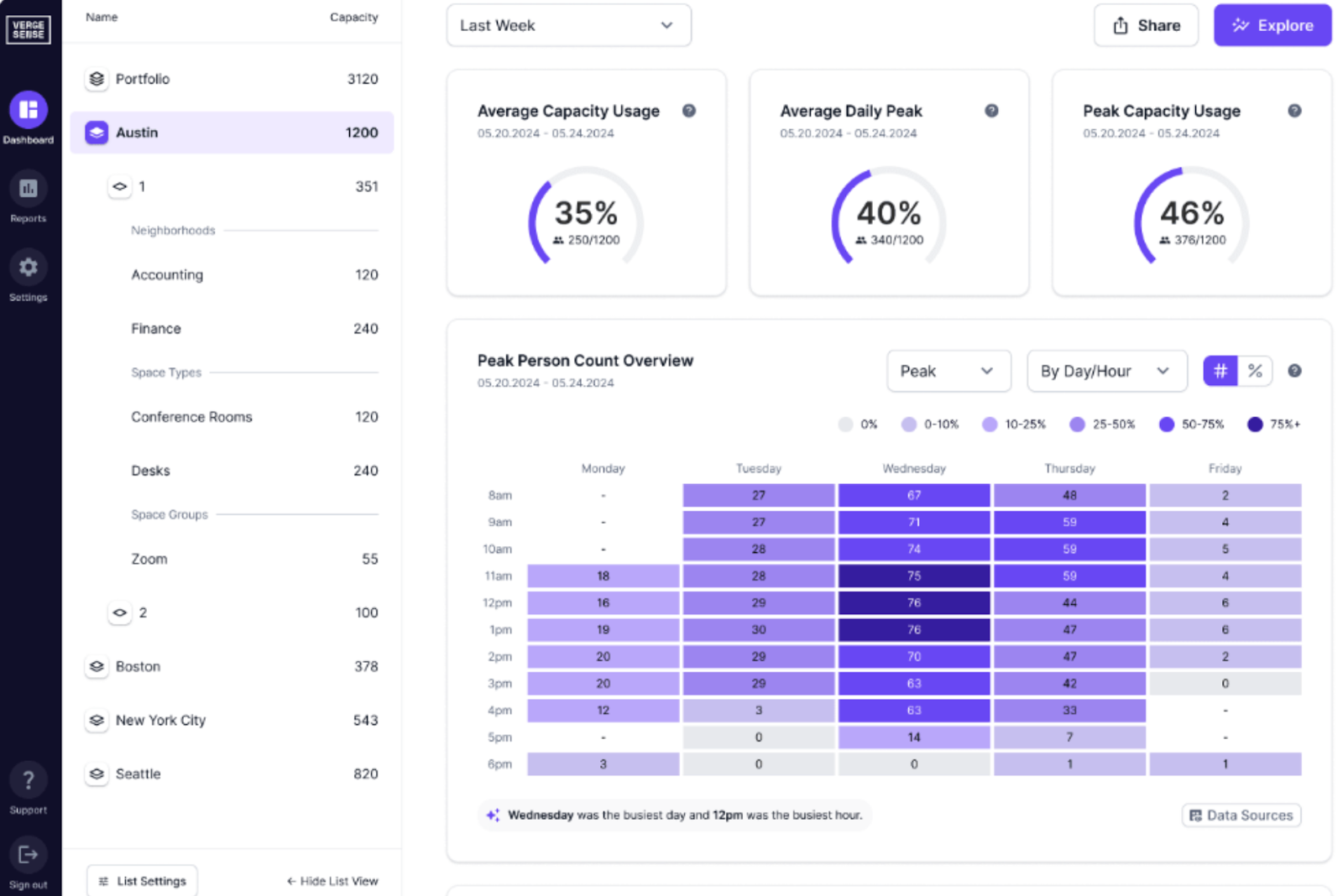
When you can show that average desk utilization sits at 11% but peaks at 54% on Tuesdays and Wednesdays, you surface a real tradeoff: right-size for the average and risk bottlenecks during peak weeks, or design for peaks and pay for empty space most days.
That's a judgment call about culture, budget, and growth plans — the kind clients are paying you to make.
Historical data gathered from sensors, WiFi, space booking systems, badge swipes, and more shows what happened. Forecasting capabilities built on 200M+ square feet of measured data show what's likely to happen under different policies, growth scenarios, or space reconfigurations.
Real estate teams need confidence in quantified projections of future risk and opportunity before they'll approve a lease decision or capital investment.
The Consultant's Edge in a Competitive Market
You can now back every recommendation with your clients' actual occupancy data instead of legacy benchmarks or ratios. That matters when competing against firms still delivering static reports based on surveys or outdated badge data.
For portfolio strategy work, this means faster cycles, more defensible recommendations, and the ability to model scenarios live in the room. When a CFO asks, "What if we reduce our footprint by 20%?" you show occupancy impact, capacity headroom by location, and where experience degrades under pressure.
According to VergeSense's 9th Edition Workplace Occupancy & Utilization Index (Q1 2026), average capacity usage held between 9–11% globally while peak usage reached 52–60% — peaks consistently triple or quadruple the average. Those numbers tell you exactly when and where risk appears, backed by data from 200+ enterprises across 50 countries.
How Workplace Analytics Empowers Consultant Recommendations
Workplace analytics gives you a continuous, ground-truth view of how space is actually being used across the portfolio, so you can plan with confidence instead of estimating from snapshots.
Pair that with your expertise in space strategy, change management, and portfolio optimization, and you deliver recommendations that are measurable, repeatable, and tied to clear ROI projections your clients can defend internally.
Pinpoint bottlenecks
Analytics platforms unify sensor, badge, and booking data into a comprehensive view of space performance across your client’s portfolio.
This allows you not only to get a view of average capacity usage, but also where the system breaks. Which floors hit capacity on Tuesday and Thursday while sitting at 40% on Monday. Which collaboration zones are overbooked while focus rooms go unused. Which locations are structurally undersized for peak demand versus which ones just feel crowded because the space is poorly configured.
This means you can diagnose the right problems and recommend data-driven solutions.
Portfolio decisions need portfolio-level visibility, and the best decisions are made before the pressure hits:
- Should they densify the second floor or invest in more collaboration zones?
- Can they shed 20,000 square feet without impacting peak demand?
- Which locations can consolidate without eroding employee experience?
Predictive Planning lets you answer these before your client is forced into a reactive decision. You're not just reporting what happened, you're showing what's coming and building the case for action now, while there's still room to optimize.
Defend the numbers
The most challenging part in these portfolio-level conversations isn’t necessarily the data collection and analysis, although many teams are still spending too much time on this. The real challenge comes when you have to defend your recommendations to leadership.
Occupancy data from the Index shows peaks that consistently triple or quadruple average utilization across global portfolios. This gap explains why you need both historical data and predictive forecasting capability. Size for the average, and you risk bottlenecks during collaboration-heavy weeks. Size for peaks, and you're paying for empty space most days.
With tools like Predictive Planning, you're not scrambling to re-run the numbers every time the client changes the assumption. You stay focused on the strategic tradeoffs while every "what if" question already has a data-backed answer behind it.
Building Client Trust Through Analytics-Driven Insights
C-suite stakeholders don't decode spreadsheets. Interactive dashboards let you overlay cost-per-square-foot against actual occupancy, compare current state against multiple scenarios, and quantify the financial impact of each.
When a leader can see the impacts to cost, capacity, and employee experience side-by-side, the conversation shifts to considering strategic tradeoffs from all angles.
Crafting Compelling Business Cases with Usage Metrics
The difference between "we think you should consolidate" and "our analysis shows you can reduce footprint by 23% with negligible impact to employee experience" is the difference between a polite nod and budget approval.
Predictive Planning surfaces the metrics that make that case concrete:
- Shortage risk by location: which floors or neighborhoods will hit capacity constraints within 12 months based on current growth and usage trends
- Surplus exposure: where you're carrying excess square footage relative to peak demand, and what that's costing per seat
- Unseated employee rate: the percentage of people arriving on peak days without a guaranteed seat, broken down by floor, neighborhood, and space type
- Space mix gaps: whether the portfolio has the right ratio of focus, collaboration, and amenity space, and where adding or converting specific sizes would relieve the most pressure
- Scenario-level risk modeling: what happens to availability, experience, and cost if headcount grows 10%, a lease is shed, or a floor is reconfigured
Present findings in terms decision-makers already use: cost per occupied seat, utilization during core business hours, and financial impact of right-sizing.
The cleaner your measurement baseline, the tighter your forecasts. Leveraging clients’ occupancy data to inform your forecasts closes the gap between what you project and what actually happens, so your models hold up when leadership revisits them six months later.
When you can show that reducing a 50,000-square-foot floor to 35,000 square feet saves $450,000 annually while still accommodating peak demand, you've given your client a business case they can take to leadership for approval.
How Fresenius Built a $60M Business Case With Occupancy Intelligence
Fresenius wanted to consolidate its North American headquarters but didn't have the evidence to defend its decision, with observations and feedback not enough to take to finance.
However, VergeSense data showed that one of the two headquarters buildings was averaging just 20% utilization — enough proof to confidently let the lease lapse rather than renew it.
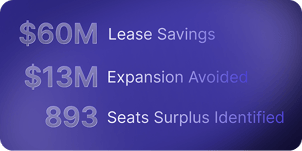
The result: $6M in annual lease avoidance, totaling $60M over ten years. Post-consolidation feedback confirmed they'd sized the remaining space correctly, with no meaningful impact on employee experience.
Integrating Workplace Analytics Into Your Consulting Practice
Selecting the right workplace analytics platform accelerates your path from data collection and analysis and lets you focus more time on considering strategic tradeoffs and defensible recommendations, ultimately what you can deliver to clients.
Choosing and Implementing the Right Analytics Platform
Start by evaluating platforms that support predictive planning and forecasting capabilities. Traditional analytics tell you what happened, but predictive tools show what's likely to happen under different scenarios. This matters when advising a client on whether to renew a 200,000-square-foot lease or consolidate to 150,000.
Predictive Planning lets you:
- Stress-test consolidation or growth scenarios before a lease decision is made
- Flag shortage and surplus risk at the location level, not just the portfolio average
- Quantify risks to employee experience that were previously only qualitative
- Show clients how headcount changes ripple through space demand across regions
- Build forward-looking recommendations that hold up when leadership revisits them six months later
Look for platforms that unify multiple data sources automatically, support passive occupancy detection , and offer analytics visualization capabilities that translate complex utilization patterns into executive-friendly narratives. This is especially important since many space plans were built on assumptions that no longer hold.
Implementation speed matters. The faster you can get started with benchmark data for areas where you don’t have measurement, integrate with existing WiFi, booking, or badge data, or deploy sensors for more precise measurement, the sooner you can deliver confident recommendations.
Ensuring Data Accuracy and Comprehensive Integration
Your recommendations are only as credible as the data behind them. Each data source has blind spots:
- Badge swipes show who entered, not which floors they used
- Wi-Fi logs show connections, but can't distinguish between a packed conference room and someone streaming video at an empty desk
- Booking systems capture reservations but miss the meetings that happen unreserved — the ad-hoc collaboration that often drives in-office time
Platforms like VergeSense handle data unification automatically, combining accurate occupancy sensing (both active and passive) with data from existing building systems. You get validated metrics on peak vs. average occupancy, space type performance, and demand patterns without weeks of manual reconciliation.
For global portfolios, consistency is critical. Utilization data from London, Singapore, and New York needs to be measured the same way and reflect real behavior. Comprehensive coverage across every floor, neighborhood, and room type is what makes your scenario modeling defensible.
Delivering Measurable Value: The Future of Consulting
Clients no longer accept recommendations built on historical benchmarks alone. They expect data-backed strategies with clear ROI and defensible assumptions. For consultants advising on real estate and workplace strategy, workplace analytics has become the competitive differentiator that separates winning proposals from losing ones.
Analytics platforms handle data unification and forecasting so you can focus on evaluating strategic tradeoffs, modeling scenarios, and translating insights into recommendations that leadership can confidently present to the board.
As clients increasingly expect measurable outcomes over strategic frameworks, your ability to integrate workplace analytics into your practice will define whether you're seen as a trusted advisor or a legacy service provider.
Working from incomplete data costs consultants credibility
See how VergeSense gives you the portfolio-level insight to deliver recommendations clients can take to the C-suite.
Get a Demo →
FAQs about workplace analytics for consultants
Do consultants need their own analytics platform?
Not necessarily, but you need reliable access to one. Many consultants partner with platforms like VergeSense to access unified occupancy data without building internal infrastructure.
This lets you focus on strategic analysis while the platform handles data collection and integration. For consultants working across multiple clients, that access becomes a direct competitive differentiator.
How accurate does occupancy data need to be for client recommendations?
Accuracy matters most when it changes the decision. For portfolio-level recommendations like right-sizing a 200,000-square-foot campus or identifying underutilized neighborhoods, you need data accurate enough to distinguish between 40% and 60% utilization.
Sensor-based platforms typically deliver within ±5–10%, which is sufficient for workplace strategy recommendations that clients will defend to finance teams. Comprehensive coverage matters more than laboratory-grade precision.
Can workplace analytics support multi-site or global portfolios?
Yes, and that's where workplace analytics becomes essential. Platforms designed for enterprise portfolios unify data across regions, building types, and time zones, giving you comparable metrics whether you're analyzing London or Singapore.
Look for solutions that normalize data across different sensor types and integrate with existing building systems to ensure consistency in portfolio management recommendations across every market.