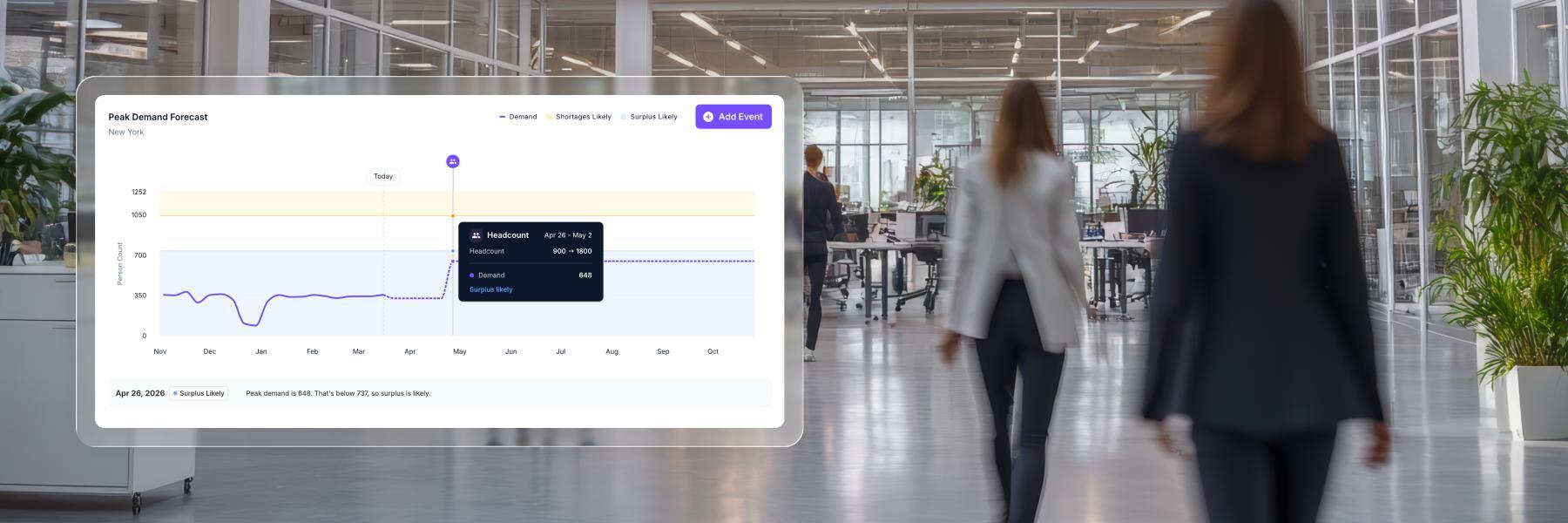




You have a utilization study on your desk recommending a 2027 seat count. Fieldwork wrapped six months ago. Since then, an acquisition closed, two RTO mandates tightened, and the lease decision is due in 30 days. The deck still reads cleanly, but the portfolio it describes is not the one you're signing for.
That gap is the decision in front of most CRE teams: pay six figures for another point-in-time study, or invest in a platform that allows for continuous modelling between studies. Both have a place, with the right call dependent on the decision stage, portfolio size, and who owns the data after the engagement ends.
Yet, the more useful question isn't which to buy, but where each fits.
Workplace analytics platforms have reshaped this decision by giving CRE teams the continuous data layer a consulting engagement would otherwise rebuild every cycle, which frees the consulting work itself for the tradeoffs that need senior judgment. Increasingly, the two stack: platform underneath, advisory on top.
That's why this guide covers both categories: evaluating a platform honestly means setting it against the consulting baseline it now complements more often than it replaces. You’ll learn about:
- VergeSense
- Trebellar
- Kadence
- JLL
- CBRE
- Cushman & Wakefield
Tired of paying for one-off studies that need re-evaluation before the next lease decision?
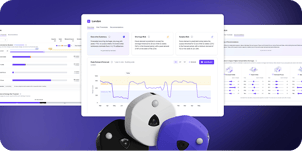
See how VergeSense gives CRE leaders continuous, decision-ready intelligence on portfolio utilization, demand, and space mix, recalculated every time headcount, policy, or attendance changes.
Book a Demo
At a Glance: Workplace Analytics Platforms and Consulting Firms
|
Solution |
Approach |
Data Inputs |
Refresh |
Output |
Best-Fit Buyer |
|
VergeSense |
Real estate planning and design platform powered by the Large Spatial AI Model |
Sensors, WiFi, Badge Data, Video conferencing data |
Continuous |
AI scenario modeling, space design recommendations, and stack planning |
Enterprise CRE leaders running portfolio decisions |
|
Trebellar |
Data-agnostic AI analytics layer; per-customer ML models |
Customer-supplied (badges, WiFi, third-party sensors, CSV, HRIS) |
Continuous |
AI scenario plans, generative reports, market research |
Mid-market teams unifying scattered CRE data |
|
Kadence (SpaceOps) |
Hybrid workplace OS with planning layer on WorkOps signals |
Desk/room bookings, badge swipes, check-ins |
Continuous |
Stack planning, move management, attendance analytics |
Mid-market hybrid teams wanting plan-to-execute in one tool |
|
JLL Workplace Consulting |
Advisory, often paired with occupancy data (powered by VergeSense) |
Pulse studies, partner data |
Project |
Recommendation deck, roadmap |
Teams needing strategic interpretation |
|
CBRE Workplace Consulting |
Advisory bundled into transaction or FM work |
Pulse studies, partner data |
Project |
Workshops, change plans |
Teams inside a CBRE relationship |
|
Cushman & Wakefield |
Advisory focused on change and POE |
Pulse studies, POE, partner data |
Project |
Change roadmap, POE findings |
Build-out with change management |
Best Workplace Analytics Platforms for CRE Leaders in 2026
The six options below fall into two categories: platforms that capture continuous portfolio data your team owns (VergeSense, Trebellar, Kadence), and consulting practices that translate workplace data into strategy and recommendation decks (JLL, CBRE, Cushman & Wakefield). In many engagements, they run together.
1. VergeSense
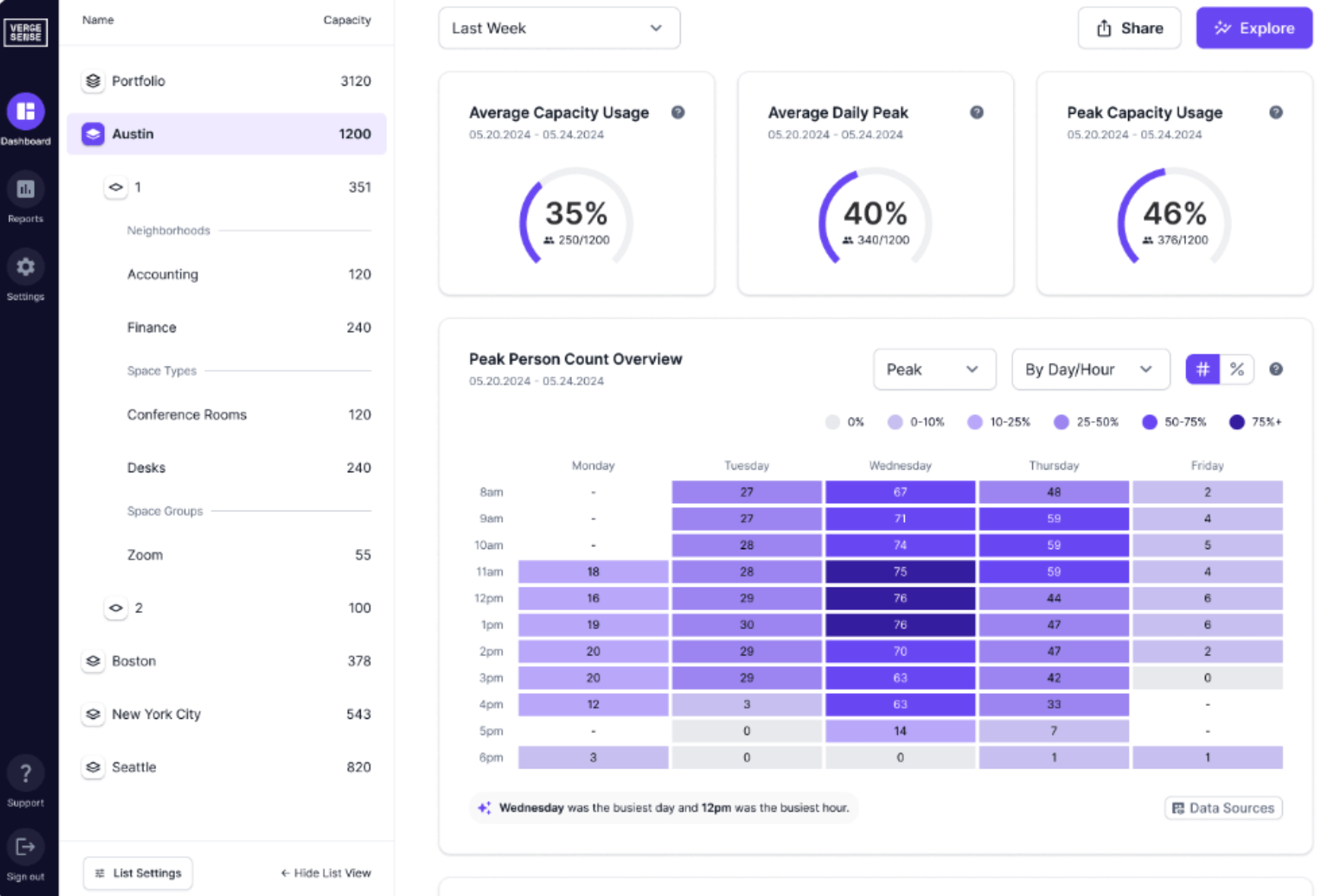
VergeSense is a workplace analytics platform built for CRE leaders making lease, right-sizing, and design decisions on continuous portfolio data and measurement.
What sets it apart is the Large Spatial Model trained on 250M+ sq ft of measured workplace data, which Predictive Planning uses to stress-test neighborhood, floor, and portfolio scenarios before you commit to making changes.
Infinity Area Sensors measure high-value spaces directly; the ability to forecast demand for unmeasured spaces or integrations with existing WiFi, badge, or videoconferencing systems cover the rest. Use it to pressure-test a lease before signing, model a post-M&A consolidation, or run right-sizing scenarios against live data.
Selected features
- Scenario modeling with Predictive Planning: Model neighborhood, floor, and portfolio changes against live occupancy data before signing a lease or making design changes.
- Large Spatial Model (LSM): Proprietary AI model trained on 250M+ sq ft of measured workplace data — scenario outputs reflect how space actually performs.
- Infinity Area Sensor: 95% accuracy for active and passive occupancy detection with 10 year battery life.
- Workplace Assistant: Natural-language interface for CRE, workplace, and facilities leaders to query portfolio data.
- Strategic Advisory Services: Expert advisors who pair Predictive Planning with your portfolio strategy, translating AI forecasts into confident moves on lease events, M&A, and right-sizing.
- Integrations: 50+ integrations across badge, booking, WiFi data, IWMS platforms, and more.
Best for
- CRE leaders running portfolio rationalization, lease renewal, or post-M&A consolidation, where the plan has to hold up across policy, lease, and headcount scenarios before you commit.
- Workplace teams that need precise design guidance: where floor plans break under real demand, and how to reduce surplus space without degrading employee experience.
- Organizations measuring CRE ROI in lease cost avoidance and optimized space mix, not just seat counts.
$764K in Avoided Build-Out Costs Per Floor: VergeSense in Action
A global bank pressure-tested its standardized floor templates with Predictive Planning before committing capital.
Thousands of demand simulations across nearly 2 million sq ft of planned portfolio surfaced a consistent pattern: not enough enclosed focus space, up to 50% of open collaboration zones empty, and up to 8 in 100 employees unseated on a given day.
Based on this, VergeSense's Strategic Advisory Services team recommended converting oversupplied open collab into phone booths using the bank's existing 60- and 120-sq-ft kit of parts.
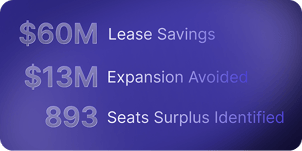
The result: the global bank avoided up to $764K per floor in build-out costs, every employee had access to a seat, and the bank’s design group could validate its floor templates across a full range of simulated demand scenarios.
See Predictive Planning in action
250M+ sq ft of measured workplace data behind every scenario — so your next lease, consolidation, or right-sizing decision runs against how space actually performs.
Book a Demo
2. Trebellar
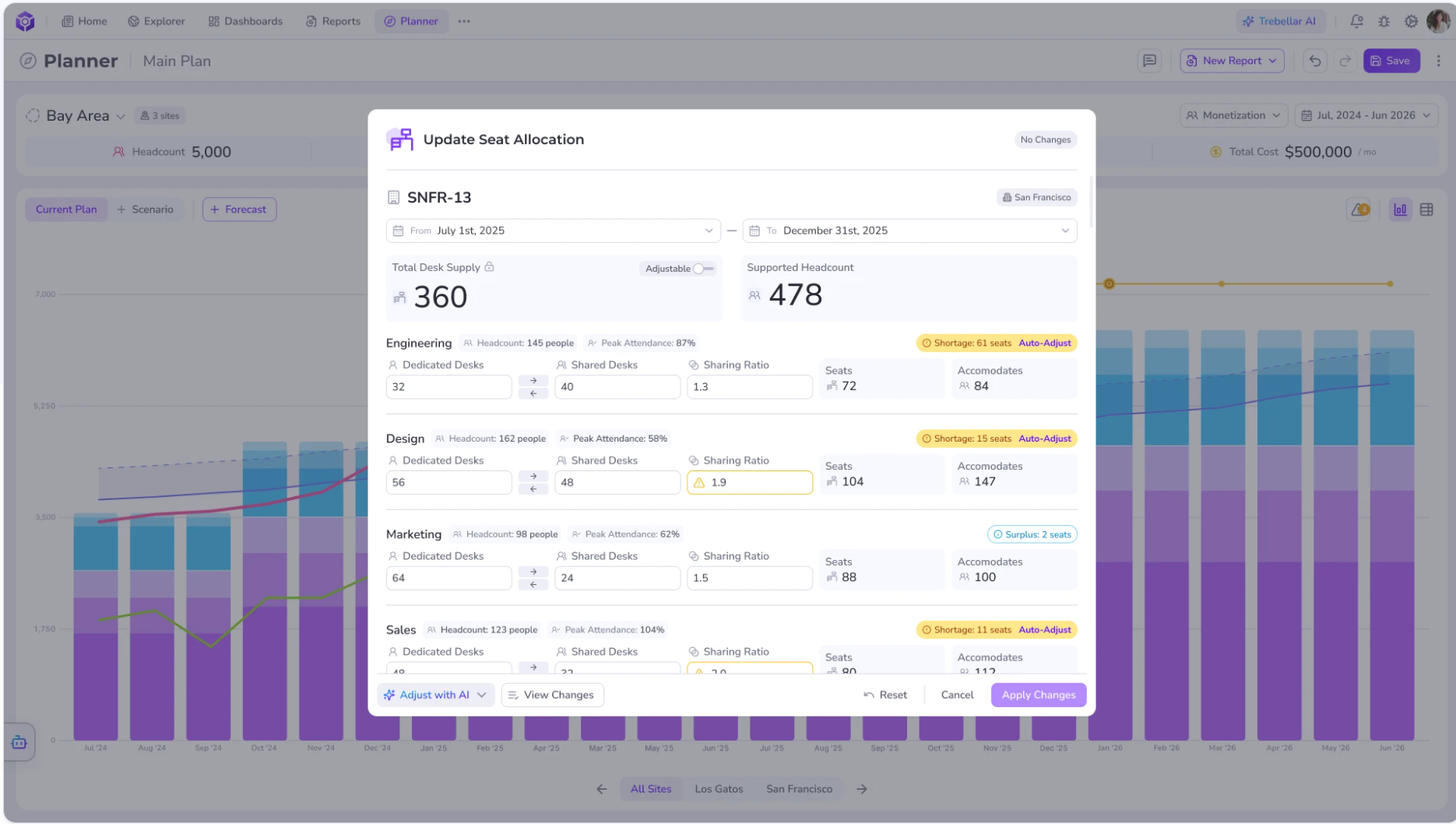
Trebellar is a 2022-founded, San Francisco-based AI analytics platform for CRE teams, raised on a $3.5M Seed and positioned as "the first agent-based AI platform for real estate."
The product is data-agnostic: it ingests what the customer brings — badges, WiFi, third-party sensors (Butlr is a stated partner), HRIS, lease data, CSV uploads — and layers AI scenario modeling, generative reports, and market research on top.
Selected features
- Trebellar AI Agent: Conversational copilot combining Meta Llama, enterprise OpenAI, and per-customer ML models.
- Portfolio Manager: AI scenario modeling, lease optimization, and supply/demand rebalancing, with LiquidSpace flex benchmarks.
- Unified data layer: Data-agnostic ingestion via API, CSV, and partner integrations.
- Generative reports: Natural-language report and presentation generation with PDF/PPTX export.
- Market research: Market comps, amenity analysis, and location scoring for site selection — a use case VergeSense does not address.
Best for
- Mid-market CRE teams unifying scattered data across badges, WiFi, third-party sensors, and HRIS, particularly those weighing site selection alongside portfolio planning.
The tradeoff
Trebellar's ML models train per customer in isolation, so a customer with only five buildings gets AI trained on five buildings rather than recommendations pulled from a broader benchmark data set to draw on.
3. Kadence
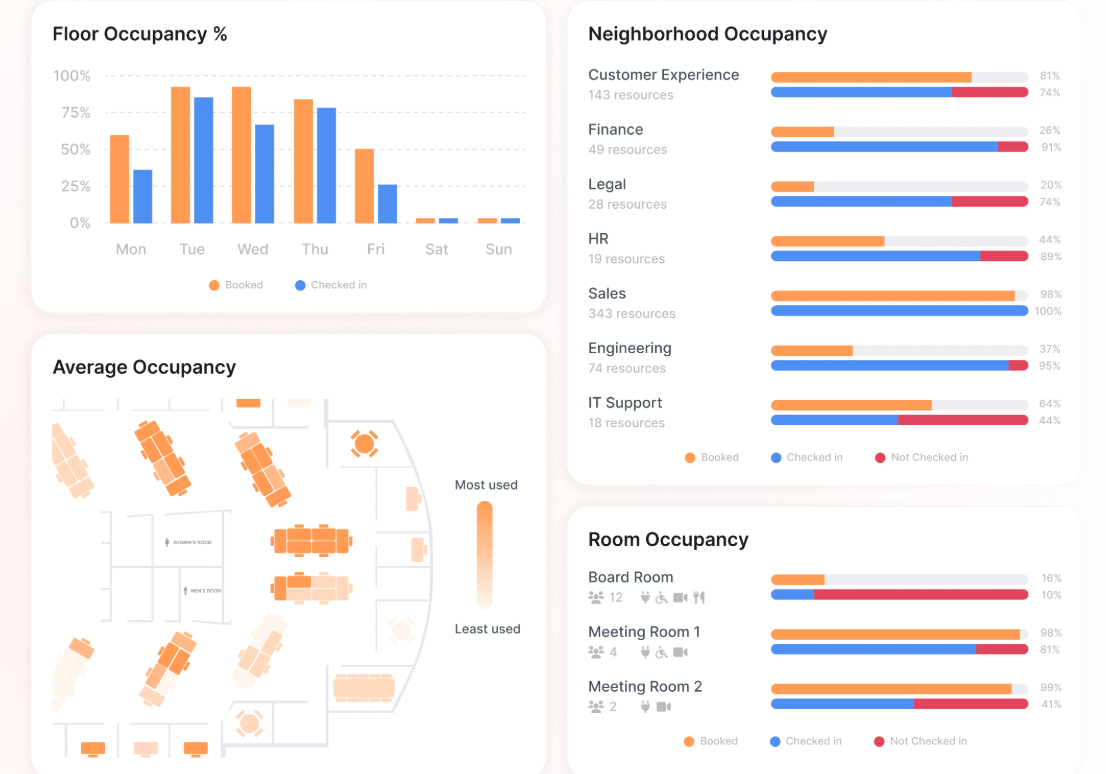
Kadence is a London-based hybrid workplace operations platform with 600+ customers across 40+ countries (Boeing, Ashurst, BDO), a $20M Series A led by High Alpha, and $15M revenue growing 138% year over year.
The original product, WorkOps, covers desk and room booking, visitor management, automated check-in, and team scheduling.
In April 2026 Kadence launched SpaceOps, a planning layer built on WorkOps signals: scenario modeling, dynamic stack planning, move management, and a conversational AI planning agent.
Selected features
- WorkOps: Desk and room booking, visitor management, automated check-in, and team scheduling — the operational layer 600+ customers use today.
- SpaceOps scenario modeling: Model headcount growth, policy shifts, and downsizing; forecast seat demand and cost per employee.
- Dynamic stack planning: Drag-and-drop layouts across floors with real-time cost and collaboration impacts.
- Move management: Automated allocations, dependency tracking, and approval workflows tied to updated floor layouts.
- AI Planning Agent: Conversational AI for plain-language stack planning, trained on Kadence WorkOps data.
- LiquidSpace partnership: Flex space booking integration for coworking-adjacent portfolios.
Best for
- Mid-market hybrid teams that want desk booking, room booking, move management, and scenario planning in one operational tool, especially in legal, finance, tech, and government.
The tradeoff
SpaceOps' planning is grounded in WorkOps signals: bookings, badge swipes, and check-ins, i.e. scheduling intent and entry logs, which doesn’t consistently reflect how people actually in their workspaces.
4. JLL (Workplace Strategy & Consulting)
JLL's workplace consulting practice is one of the largest CRE advisory groups globally, with senior strategists running occupancy studies, neighborhood design, change management, and post-occupancy evaluation.
Engagements are typically project-priced around a defined event — a lease decision, HQ redesign, or post-M&A consolidation — and deliver a board-ready recommendation grounded in pulse-study data. The practice bundles naturally into broader JLL transaction or FM relationships, which is often how CRE leaders land inside it. VergeSense is a JLL partner on shared engagements.
Selected features
- Workplace strategy and occupancy planning: Senior consultants in utilization studies, neighborhood design, and portfolio strategy.
- Transaction and project integration: Workplace decisions bundle into JLL's transaction, FM, and project-management services.
- Change-management depth: Established methodology for hybrid rollouts, RTO programs, and post-occupancy evaluation.
- IWMS implementation: JLL implements Eptura, Archibus, Serraview, and Planon — the systems VergeSense data flows into.
Best for
- CRE leaders who want a senior strategist interpreting portfolio data into a board-ready recommendation, or whose workplace decision sits inside a broader JLL transaction or FM relationship.
What VergeSense complements
JLL brings consulting depth, change management, and transaction services. VergeSense lets those teams start closer to the finish line. Predictive Planning automates the data wrangling that normally eats the first weeks of an engagement, unifying sensor, WiFi, badge, and booking data and running scenarios in hours instead of weeks. That frees JLL's experts to spend their time where it counts: on the strategic tradeoffs, not the spreadsheet prep.
5. CBRE (Workplace Consulting)
CBRE's workplace consulting practice is comparable in scale to JLL, running utilization studies, change-management programs, and space-planning workshops. It bundles into broader transaction, project, or FM contracts — a natural fit for organizations already inside a CBRE relationship.
VergeSense partners with CBRE on shared engagements: the platform provides the continuous data layer, CBRE strategists frame the portfolio decision on top.
Selected features
- Workplace strategy and change management. Workshops, persona work, and program rollouts alongside utilization studies.
- Transaction and FM integration: Workplace work nests inside transaction, project, or facilities engagements.
- Persona and neighborhood design: Mapping work modes to space types at the floor level.
- Post-occupancy evaluation: Measured verification after build-out.
Best for
- CRE leaders whose workplace decision is part of a larger CBRE transaction, project, or FM program — and who want one firm spanning the transaction, recommendation, and rollout.
What VergeSense complements
CBRE strategists do their best work when the underlying portfolio data is already continuous and decision-ready. VergeSense provides that layer, so the engagement moves past data collection and can focus on the strategic tradeoffs.
6. Cushman & Wakefield (Workplace Strategy)
Cushman & Wakefield rounds out the three largest CRE advisory firms, with particular depth in change management and post-occupancy evaluation. For organizations pairing a major workplace change with a build-out — new HQ, hybrid reset, post-M&A consolidation — that change capability is the differentiator.
VergeSense partners with Cushman on shared engagements: the platform provides the data, scenario modelling and predictive insights, the firm's strategists own the change story.
Selected features
- Change management: Structured stakeholder, persona, and rollout work alongside analytics.
- Post-occupancy evaluation: Measured verification of whether a design delivered against the hypothesis.
- Workplace strategy advisory: Utilization studies and space-planning workshops on par with the Big Three peers.
- Persona and neighborhood design: Mapping work modes to space types at the floor and team level.
Best for
- CRE leaders pairing a workplace decision with a meaningful change lift — new HQ, RTO reset, post-M&A integration, or programs that need structured POE.
What VergeSense complements
VergeSense gives Cushman strategists a live baseline to measure the build-out against, so POE answers whether the design worked, not just how it looked at one more point in time.
Key Features and Capabilities to Prioritize in Workplace Analytics
Whether you land on a platform, a consulting engagement, or both, the following five capabilities separate a decision that holds from one that ages out by the next lease cycle.
Continuous data vs point-in-time snapshot:
A pulse study captures six weeks. A platform captures trends every week. For decisions that have to hold across an M&A close, an RTO change, or a 2027 lease, continuous data is the difference between a recommendation that ages well and one that doesn't.
Persona-level outputs:
CRE, workplace, and facilities leaders ask different questions of the same portfolio. Prioritize tools whose outputs serve all three natively — scenario models for CRE, neighborhood data for workplace, operational data for facilities.
Integration with the existing stack:
The most actionable workplace data sits across Microsoft Places, ServiceNow, WiFi infrastructure, the BMS, badge swipes, and existing sensors. Tools that integrate cleanly across that stack produce faster time-to-value than a rip-and-replace.
Scenario modeling:
A dashboard tells you what happened. A scenario model tells you what will happen if you consolidate two floors, change neighborhood ratios, or absorb a 30% headcount increase. For decisions with eight- or nine-figure consequences, that modeling depth earns the platform its seat.
Coverage stack:
Portfolio decisions need portfolio-level data, but the highest-value spaces: boardrooms, focus rooms, and customer-facing neighborhoods still benefit from dedicated measurement. The right answer is sensor coverage for high-value spaces plus extracting value from your existing infrastructure for the rest.
How to Choose Between a Workplace Analytics Platform and a Consulting Engagement
Use the following questions to clarify whether your next lease, consolidation, or right-sizing call is better served by a platform, a consulting engagement, or both, starting with what you need to know internally before you ever talk to a vendor.
Questions to ask internally
- What decision am I making — a one-time lease event, or portfolio-wide rationalization that repeats?
- How often does my space mix, headcount, or in-office policy change?
- Who owns the data after the engagement ends — my team, or the firm?
- Do I need outputs for multiple personas (CRE, workplace, facilities) or a single deliverable?
- Will the recommendation hold through the next M&A close, RTO reset, or fiscal-year cycle?
Questions to ask vendors and consultants
- How is occupancy intelligence developed, what data is collected, and at what granularity?
- What's the refresh cadence between major reports?
- What access do I have to the raw data — during and after the engagement?
- How does the output integrate with my existing systems?
- What's the total cost of ownership over three years versus a single study?
- What happens when my portfolio changes mid-engagement?
Tired of paying for one-off studies that go stale before the next lease decision?
See how VergeSense gives CRE leaders continuous, decision-ready data on portfolio utilization, lease cost, and targeted space mix recommendations.
Book a Demo
FAQs About Workplace Analytics Platforms
Can a workplace analytics platform replace a consulting engagement?
For data collection and scenario modeling, yes — a platform like VergeSense replaces the measurement and modeling work an engagement would otherwise rebuild every time. For strategic interpretation, change management, and senior facilitation, consultants still earn their seat. Most CRE leaders adopt both: the platform provides continuous data and scenario modeling, the consulting engagement focuses on tradeoffs that need senior judgment.
How is platform data different from consulting study data?
A consulting study captures a defined window — typically four to twelve weeks — and presents a recommendation against that snapshot. Platform data is continuous and updates as the portfolio changes. The practical implication: a consulting recommendation is anchored to the portfolio that existed at fieldwork; a platform recommendation runs against the portfolio that exists today.
What does a workplace analytics platform cost vs a consulting engagement?
A consulting engagement is project-priced and sized to scope. A platform is annual subscription pricing, scoped to portfolio size and coverage stack. Over a three-year window, the better comparison is total cost of ownership — how many studies you'd otherwise commission, and what each costs to refresh. CRE leaders running multiple decisions in that window typically find the platform pays for itself by the second cycle.