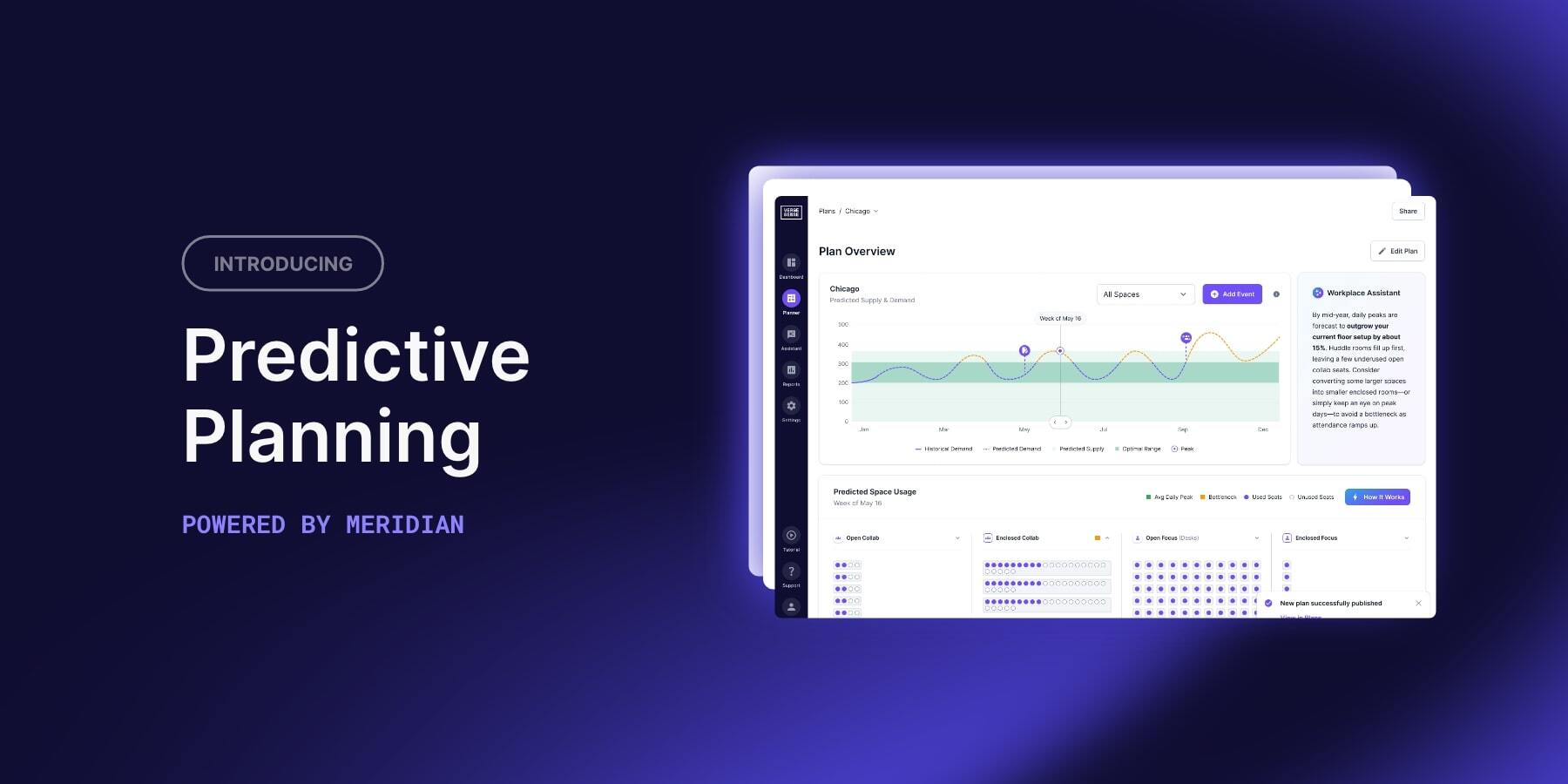




Plan office space based on how people will actually use it, not static assumptions
The Challenge
Workplace and real estate planning has long relied on:
- static utilization reports
- consultant benchmarks and ratios
- backward-looking data
But in hybrid environments, behavior shifts constantly. What worked last quarter may fail next month.
The real question teams need to answer is not what happened, but what will happen.
The Solution: Predictive Planning
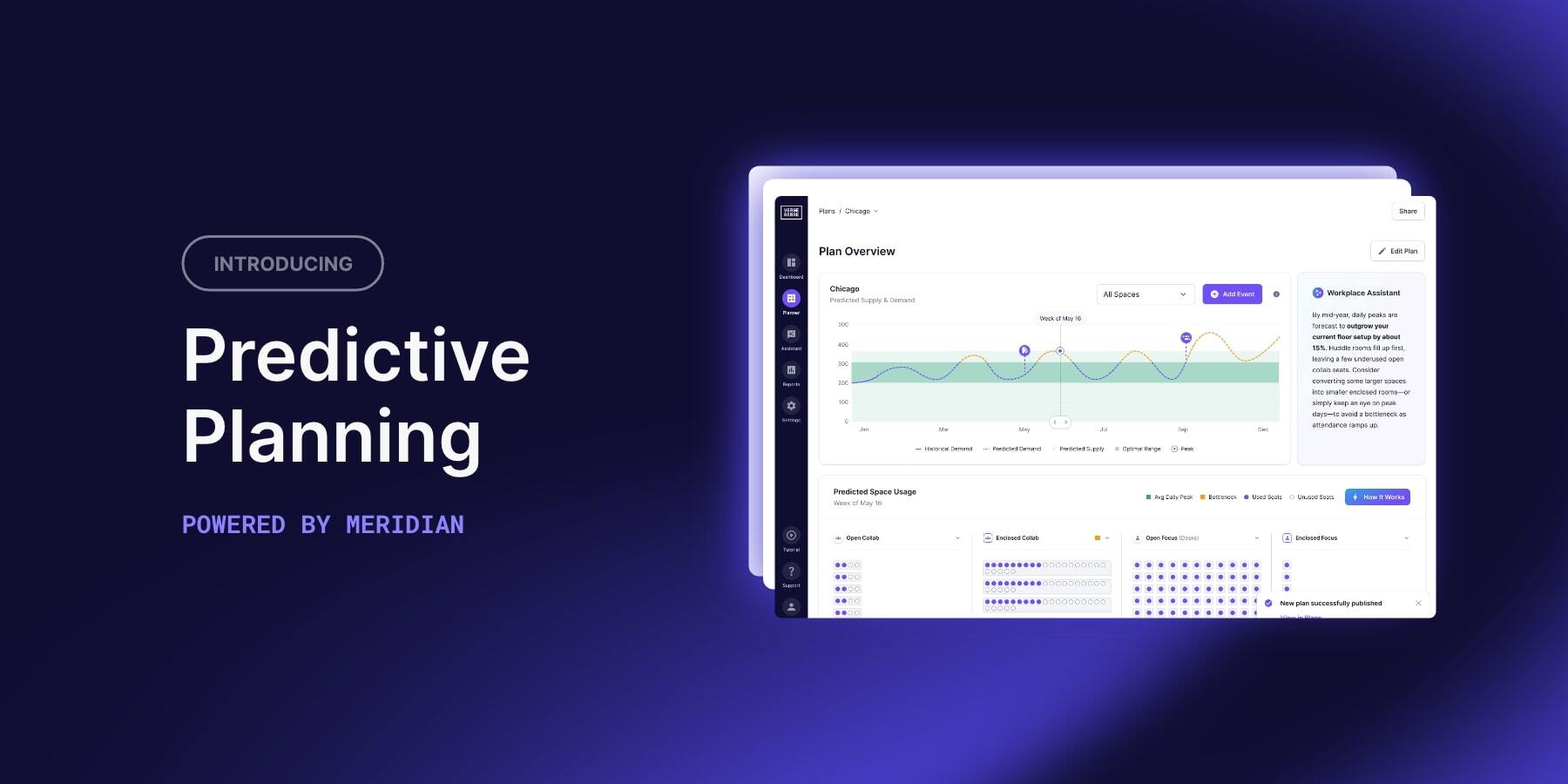
VergeSense Predictive Planning uses the Large Spatial Model (LSM) to simulate how people will interact with space before changes are made.
Instead of guessing, teams can model:
- different workforce scenarios
- design alternatives
- capacity thresholds
- demand vs. supply tradeoffs
All grounded in real-world behavioral data, not rules of thumb.
How It Works (At a Glance)
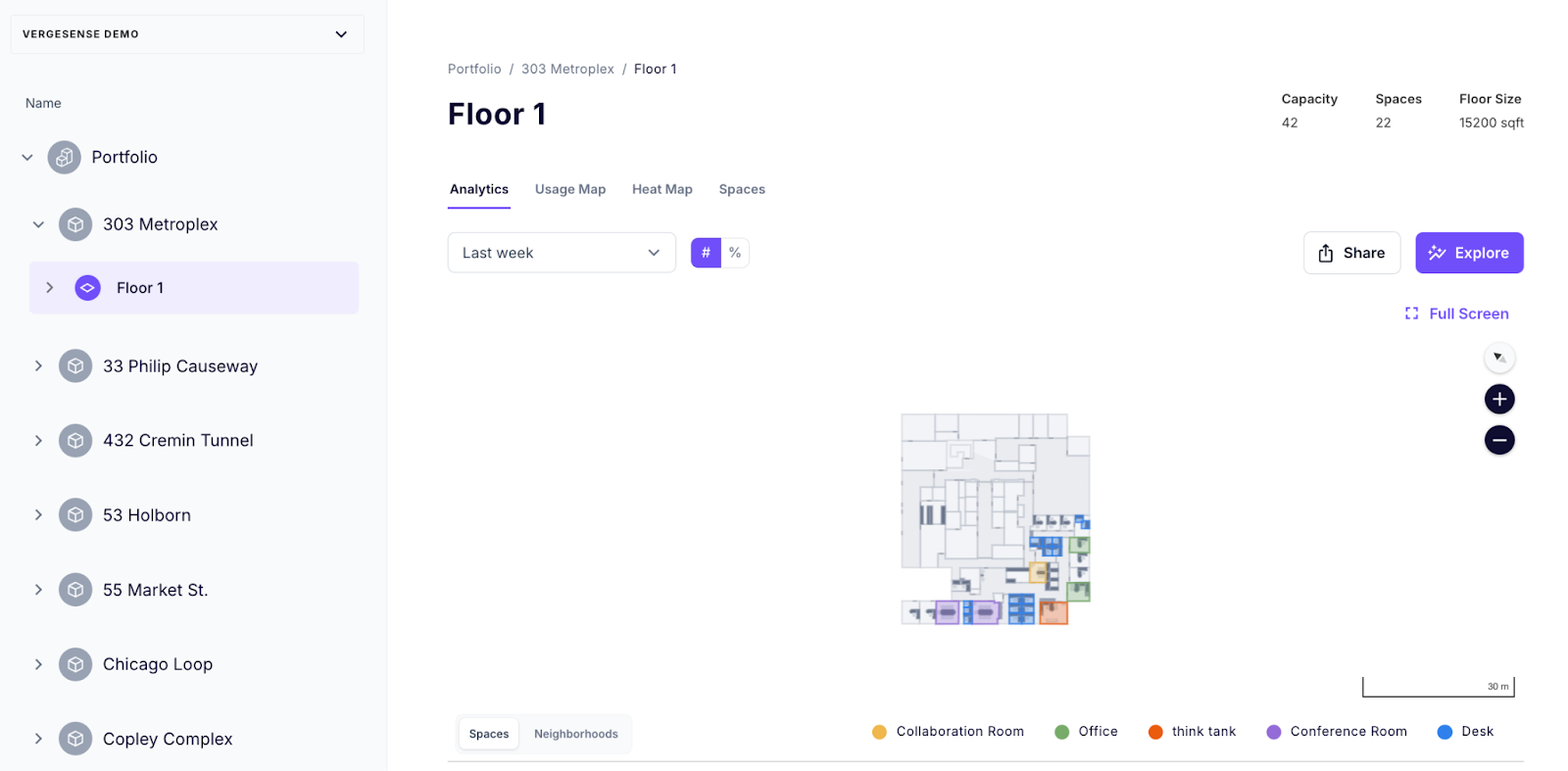
- Input your space + workforce context: Floor plans, space types, headcount, team mix, and work patterns.
- Generate a Usage Fingerprint: A behavioral profile that predicts:
-
- Where people go first
- What fills up next
- What runs out — and when
- Simulate thousands of realistic scenarios: Monte Carlo simulations turn probabilities into real-world outcomes.
- Compare what-if scenarios: Change the space or the people. Re-run the model. See the impact instantly.
It’s like measuring your office a thousand times — without installing a single sensor.
What Is a Usage Fingerprint?
A Usage Fingerprint is a behavioral model of how an office works.
Think of it as an office’s behavioral DNA.
It predicts:
- how different types of work (focus, collaboration, meetings) show up in space
- which rooms are preferred and claimed first
- how behavior changes as occupancy increases
Unlike static ratios, fingerprints reflect how people actually behave, not how space was intended to be used.
Why You Can Trust the Predictions
VergeSense’s Large Spatial Model is trained on:
- 8 years of data
- 200+ million square feet of offices
- real employee behavior at space-level granularity
Predictions are:
- Behavior-backed, not theoretical
- Probabilistic + deterministic, not simplistic averages
- Transparent, not a black box
You can trace outcomes back to real-world patterns and understand why the model predicts what it does.
What Teams Use Predictive Planning For
- Workforce scenario modeling (growth, hybrid shifts, peak days)
- Capacity & breakpoint prediction
- Right-sizing portfolios with confidence
- Design performance scoring before build-out
- Identifying hidden bottlenecks and wasted space
Who It’s For
- Corporate Real Estate & Workplace teams
- Strategy & Portfolio Planning leaders
- IWMS & Workplace Technology partners
- Design, architecture, and smart-building teams
Why It Matters
Most planning tools assume:
- Every seat is equal
- Every room is used as designed
- Behavior is static
Reality is different. Predictive Planning lets teams design and operate offices based on how people actually work, and how that behavior changes under real conditions.
Learn More
Explore how the Large Spatial Model and Usage Fingerprints work in detail.