



A hybrid work policy tells employees which days to come in. A hybrid workplace strategy determines how much space you actually need, where to invest, and what to cut. Most organizations have the first, but there is room for growth on the second.
Many organizations find that when they set a three-day-a-week requirement and then discover that Tuesday attendance looks nothing like Thursday, collaboration spaces sit empty on some floors while others are overbooked, and the data they need to make smarter decisions is already sitting in their badge systems, room-booking platforms, and occupancy sensors.
Below, you'll find what a hybrid workplace strategy requires, why most fall short without usage data, and how to build one that adapts as your workforce and portfolio change.
Ready to see how workplace leaders are approaching hybrid strategy?
See how real estate and workplace teams are using occupancy intelligence to reshape their hybrid strategies at the VergeSense Occupancy Intelligence Summit.
What Is a Hybrid Workplace Strategy?
A hybrid workplace strategy is a deliberate framework for aligning physical space, scheduling policies, and capital investment with how employees actually use the office. It answers the portfolio-level questions that a flexible-work policy doesn't touch: how many desks you need per floor, which neighborhoods to consolidate, and when a lease renewal is worth the cost.
Without that framework, most organizations default to ad-hoc flexibility. Everyone picks their own in-office days, facilities runs the same schedule regardless, and real estate decisions still rely on headcount projections that haven't been checked against actual attendance.
The result is predictable: space sits underused on slow days and overbooked on peak days, while budgets stay tied to square footage no one can prove is necessary.
A hybrid workplace strategy replaces those assumptions with measured inputs. It connects occupancy intelligence, booking patterns, and employee behavior into a planning layer that informs space allocation, lease decisions, and workplace design.
When the strategy is working, every square foot in your portfolio has a reason to exist, and you have the data to prove it.
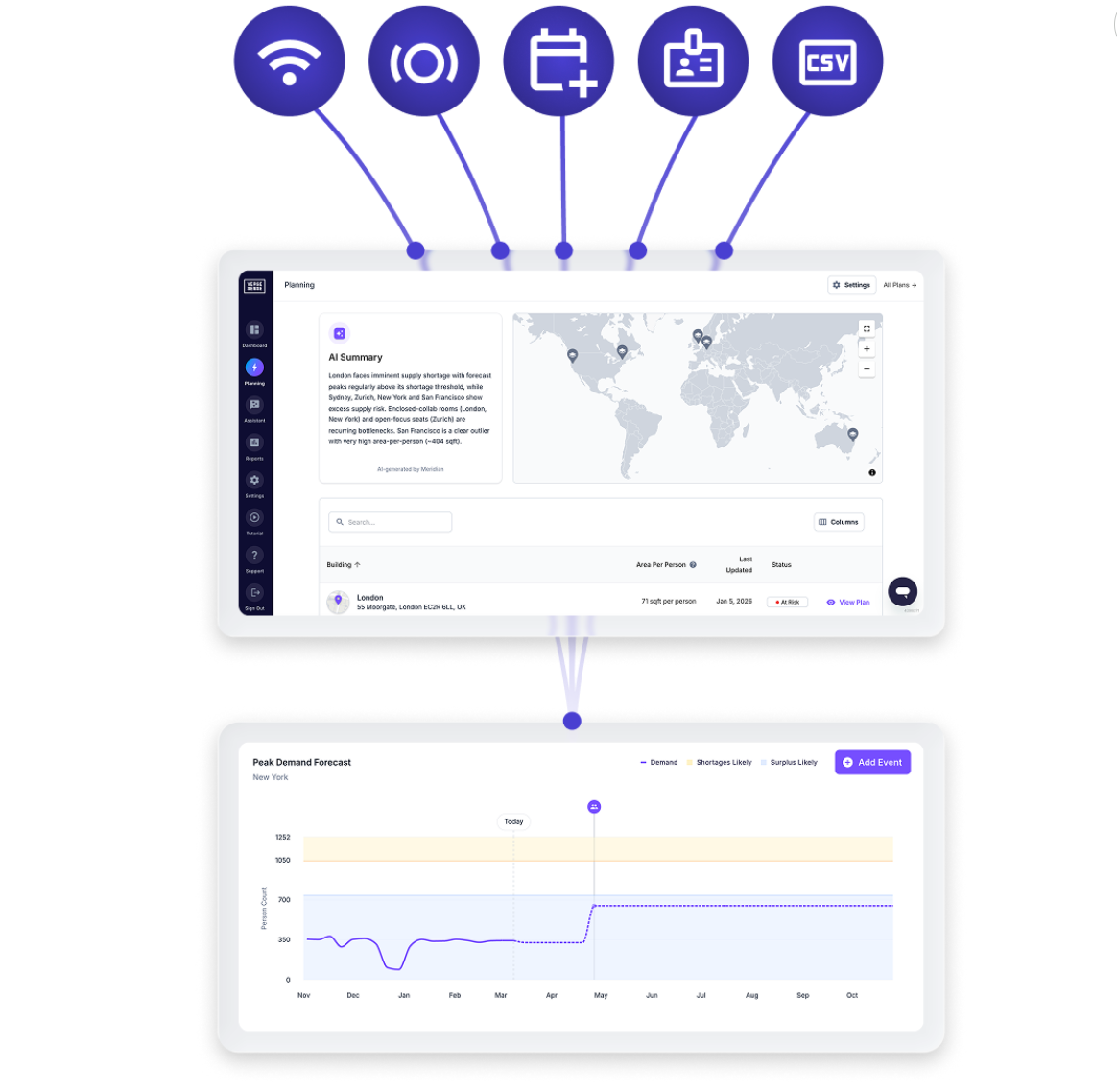
VergeSense’s Occupancy Intelligence platform brings all your data into a single platform.
Why Most Hybrid Workplace Strategies Fall Short
Even organizations that invest in a formal hybrid strategy often watch it break down within a few months. Two patterns account for most of the failures.
Policies Built on Assumptions Instead of Usage Data
Most hybrid strategies start with a scheduling policy: three days in office, team anchor days, rotating desk assignments. The problem is that the policy becomes the strategy, and no one measures whether the underlying assumptions hold.
Leadership might assume that Monday and Friday are low-traffic days, so they reduce cleaning and catering accordingly. But without continuous occupancy data, those assumptions go unchecked.
Badge swipes tell you who entered the building, not which floors or rooms they actually used. Room-booking systems show what was reserved, not what was attended.
The gap between the policy's assumptions and real utilization patterns grows quietly over months. By the time it's visible in complaints, space requests, or budget reviews, the misallocation has compounded across floors, buildings, and sometimes entire markets. What started as a minor planning miss becomes a portfolio-wide cost problem.
Misaligned Space Design and Employee Behavior
The second failure pattern is spatial. Organizations redesign offices for a hybrid workforce by adding more collaboration zones and fewer individual desks, based on the logic that hybrid employees come to the office primarily for in-person teamwork.
That logic holds in some buildings and fails in others. For example, Autodesk's workplace team discovered that employee needs varied significantly by location and team function.
A floor designed for open collaboration doesn't serve a team that comes in for focused heads-down work, and a neighborhood packed with phone booths doesn't help a team that needs large meeting rooms.
The fix requires continuous measurement of which space types are actually occupied, at what capacity, and on which days. Design decisions should follow observed behavior rather than predicted behavior, so that each redesign corrects for what the last one got wrong.
How to Build a Hybrid Workplace Strategy With Occupancy Data
Building a strategy that holds up over time requires three layers of occupancy insight, each one feeding the next.
Establish a Utilization Baseline Across Your Portfolio
Before you can right-size anything, you need to know what's actually happening in your spaces today. That means measuring utilization across every building, floor, and space type in your portfolio, not just the headquarters or the locations that raised a flag.
A utilization baseline draws from multiple data sources: badge access data, room-booking systems, WiFi connections, videoconferencing data, and occupancy sensors.
Each source captures a different dimension of use. Badge data shows building entry, WiFi approximates floor-level presence at roughly ~85% accuracy, and occupancy sensors measure room- and zone-level occupancy at ~95% accuracy.
The baseline answers the first question every workplace leader needs to resolve: what percentage of your space is actively used, and how does that number vary across your locations? Without it, every subsequent decision is a guess built on anecdotal feedback or outdated headcount ratios.
Identify Demand Patterns by Day, Floor, and Space Type
Once you have a baseline, the next step is understanding when and where demand concentrates. Hybrid workforces create highly uneven patterns: midweek peaks, quiet Mondays, and floor-by-floor variation that a building-level average obscures entirely.
These patterns emerge quickly with continuous measurement. You might find that enclosed collaboration spaces face a consistent shortage during midweek afternoons, while open focus areas run at high capacity only two days a week. These patterns are the foundation of smarter space allocation, because they reveal where supply and demand are mismatched at a granular level.
Understanding these rhythms lets you allocate resources deliberately rather than reactively. The point is matching supply to actual demand patterns, not filling every seat every day.
Align Space Supply to Measured Demand
With a baseline and demand patterns in hand, you can make informed decisions about how to right-size your portfolio. This is where a hybrid workplace strategy translates data into action: consolidating underused floors, redesigning neighborhoods to match actual collaboration needs, and adjusting lease commitments based on measured occupancy rather than projected headcount.
Right-sizing doesn't always mean shrinking. In some cases, the data reveals that a specific space type is consistently over capacity, and the right move is to expand or reconfigure rather than cut.
The VergeSense Occupancy Intelligence Index, drawing on data from 210+ enterprise customers across 50+ countries and 1,400+ sites, shows that average utilization hovers between 9% and 11%, while peak utilization reaches 52% to 60% midweek. That gap between average and peak is where most of the planning opportunity lives.
Aligning supply to demand is an ongoing process. As hybrid policies evolve and teams shift, the occupancy patterns that informed last quarter's decisions will shift too. A strategy built on continuous data can adapt quarter over quarter. One built on a point-in-time study can't keep pace.
How VergeSense Supports Hybrid Workplace Strategy
The strategy framework above, baseline measurement, pattern identification, and supply alignment, maps directly to VergeSense's core capabilities within Meridian, The Workplace AI Platform.
Occupancy Intelligence unifies data from badge systems, WiFi, room bookings, videoconferencing platforms, and VergeSense's own Infinity Area Sensors into a single measurement layer.
With ~95% accuracy at the area level compared to ~85% for WiFi-based systems at the floor level, sensor data fills the gaps that passive signals miss, including belongings-based passive occupancy that booking systems and badges can't detect.
Predictive Planning takes that measurement layer and turns it into scenario models. Workplace leaders can run scenarios for lease consolidation, neighborhood redesigns, and headcount changes, all grounded in 250M+ square feet of measured workplace data from the Large Spatial Model (LSM).
The impact shows up in real outcomes. A global consulting firm used VergeSense to analyze its conference room booking data at its Hudson Yards office against actual occupancy and discovered that 4,160 hours of booked meetings per month were going unattended.
Forty percent of the firm's 10,400 monthly booked hours were ghosted, meaning rooms sat reserved but empty. By surfacing that gap, the firm avoided approximately $50,000 per month in additional leasing costs it would have otherwise committed to solve what looked like a space shortage but was actually a visibility problem.
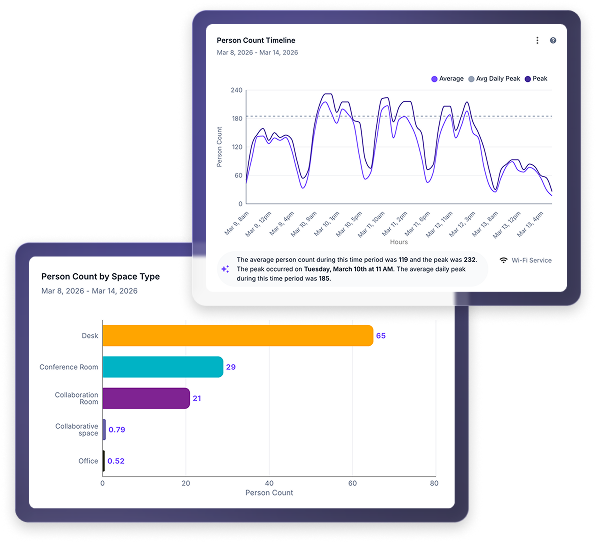
VergeSense’s Occupancy Intelligence solution shows real-time utilization data across meeting rooms, desks, and collaboration spaces.
Putting Your Hybrid Workplace Strategy Into Practice
Moving from a reactive hybrid policy to a measured strategy doesn't require a complete technology overhaul. It requires a commitment to making space decisions based on what you can observe rather than what you assume.
Start by auditing the data sources you already have. Badge systems, room-booking platforms, and WiFi logs are likely collecting information that no one is connecting to space planning decisions today. Layering occupancy sensors on top of those existing signals gives you the accuracy and granularity needed to move from building-level averages to floor-by-floor, room-by-room insight.
From there, establish a regular cadence for reviewing the data. Monthly utilization reviews catch shifts early, whether that's a floor trending toward underuse after a team reorganization or a collaboration zone that's consistently over capacity on anchor days. This cadence keeps the strategy responsive rather than static.
Then make the data operational. The strongest hybrid strategies connect occupancy intelligence directly to the decisions that cost the most: lease renewals, build-outs, and neighborhood configurations. When those decisions are grounded in continuous measurement rather than quarterly surveys or annual studies, you can adjust faster and spend less to get the workplace right.
Hear directly from the teams making hybrid strategy work.
Workplace and real estate leaders share their frameworks, data, and outcomes at the VergeSense Occupancy Intelligence Summit.
FAQ About Hybrid Workplace Strategy
How Do You Measure the Success of a Hybrid Workplace Strategy?
Track utilization rates across space types, compare actual occupancy against your portfolio's designed capacity, and monitor whether the gap between supply and demand narrows over time. Successful strategies also reduce the frequency of reactive space requests and improve employee satisfaction with available workspaces.
How Often Should Organizations Revisit Their Hybrid Workplace Strategy?
Review your strategy quarterly at minimum. Occupancy patterns shift with seasonal hiring cycles, policy changes, and team reorganizations. Continuous occupancy data lets you spot those shifts early rather than waiting for an annual planning cycle to surface problems that have already compounded.
How Does a Hybrid Workplace Strategy Affect Real Estate Costs?
A data-driven hybrid strategy typically reduces real estate costs by identifying underused space that can be consolidated, subleased, or returned at lease renewal. It also prevents over-investment in build-outs by validating demand with occupancy data before committing capital to expansion.

.jpg)