


Your employees tell you two contradictory things. On some days the office feels empty enough to echo, and on others nobody can find a free room. Surveys won't resolve the contradiction, because surveys can't tell you which neighborhoods employees actually gravitate toward, which rooms sit booked-but-empty, or which amenities quietly justify the commute.
The data says this tension is now the steady state of hybrid work. Across 2025, our research shows peak capacity usage ran between 52% and 60% while average usage held flat at 9–11%. Same people, same portfolio, tighter midweek windows that strain some spaces while leaving others untouched.
Hybrid workplace solutions exist to close that gap between what employees experience and what workplace teams can see.
But "hybrid workplace solution" is a label that covers very different tools. Some measure how space is actually used today. Some forecast what you'll need next. Others run the day-to-day of booking a desk or signing in a visitor.
This guide compares six of the tools workplace experience teams evaluate most often:
- VergeSense
- Eptura
- XY Sense
- Robin
- OfficeSpace
- Envoy
For each, you'll see how it measures space, how far its analytics and planning reach, and which team it's built for, so you can match the right mix to where hybrid friction shows up first in your portfolio.
Before you redesign a floor or add an amenity, you want proof it'll actually get used.
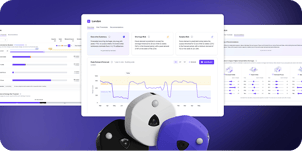
VergeSense pairs occupancy intelligence with Predictive Planning, so you can validate amenity and neighborhood investments against real demand and model policy or headcount changes before they hit the floor.
Get a Demo →
At a Glance: Comparing Hybrid Workplace Solutions
Use the table below to see how the best six tools compare on focus, capability, and fit:
|
Tool |
Best For |
Core Approach |
Data Inputs |
Analytics & Planning Depth |
Best-Fit Buyer |
|
VergeSense |
Measuring utilization and planning future demand |
Occupancy intelligence + AI predictive planning |
Sensors, WiFi, badge, booking data |
Deep: forecasting, scenario modeling, ROI outputs |
Enterprise workplace experience and CRE teams |
|
Eptura |
One vendor across workplace operations |
IWMS and workplace operations suite |
Booking, badge, third-party sensor feeds |
Moderate: dashboards, manual scenario planning |
FM-led teams consolidating point tools |
|
XY Sense |
Sensor-based utilization measurement |
Wired sensor hardware + dashboards |
Proprietary sensors |
Descriptive: live views, heatmaps, reports |
Teams focused on real-time space utilization monitoring |
|
Robin |
Employee booking experience |
Desk and room booking platform |
Booking and check-in data |
Light: booking analytics, usage trends |
Teams fixing booking and wayfinding friction |
|
OfficeSpace |
Move management and floor plan administration |
Space management + stack planning |
Floor plans, booking, presence signals |
Moderate: rules-based stack and scenario plans |
Teams managing frequent moves and restacks |
|
Envoy |
Visitor flow and front-door experience |
Visitor management + workplace app |
Visitor, booking, delivery data |
Light: workplace dashboards |
Offices prioritizing the visitor experience |
Best Hybrid Workplace Solutions in 2026
The list below spans the real categories on the market: occupancy intelligence and predictive planning platforms, IWMS and workplace operations suites, sensor-led utilization platforms, desk and room booking platforms, and visitor and workplace experience apps.
The biggest difference between them is whether they help you measure what's happening, plan what's next, or operate day-to-day.
1. VergeSense
VergeSense is the workplace AI platform that helps enterprise real estate and workplace teams stop making million-dollar decisions based on assumptions. It measures how space is actually used through its own sensors, WiFi, badge, and booking data, then layers on AI forecasting so teams can model lease exits, headcount shifts, and policy changes before committing to them.
The platform pairs that measurement layer with Predictive Planning, powered by the Large Spatial Model, a proprietary AI model trained on 8 years of real occupancy behavior across 250M+ sq ft. It's a fit for teams whose first problem is making defensible space decisions, not just seeing what happened historically.
Selected features
- Predictive Planning: model any portfolio scenario, from lease exits to RTO policy changes, in minutes rather than waiting months for a consultant study, with forecasts grounded in 250M+ sq ft of real behavioral data
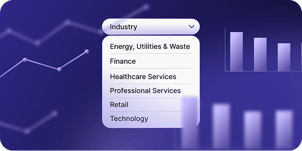
- Probabilistic forecasting, not single-point guesses: the Large Spatial Model runs 1,000+ simulations per scenario and forecasts how a space will be used, using behavioral benchmarks calibrated to industry and building type
- Active and passive occupancy detection via the Infinity Area Sensor: a wireless, battery-powered sensor that detects occupancy with 95%+ accuracy, even so a desk with a bag on it doesn't read as available
- Unified Occupancy Intelligence: sensor, WiFi, badge, and booking data combined in one platform, so every team works from the same numbers
- Integrations across the workplace stack: Logitech videoconferencing technology, Microsoft Places, ServiceNow Workplace Service Delivery, Juniper Mist, Cisco Meraki, and dozens more
- Granularity from portfolio to zone: portfolio, floor, neighborhood, and zone-level views, so amenity and design decisions have evidence behind them
Best for
- Real estate teams right-sizing portfolios interested in modeling the impact of policy or headcount changes before committing capital
- Workplace teams validating design and neighborhood investments against how employees actually use space
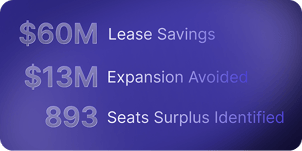
$13M a year in expansion costs: A real-life example
At its San Francisco headquarters, a biotechnology company used VergeSense to test how well its unassigned-seating policy was actually working.
VergeSense data showed that much of the space reading as "occupied" was being held passively by bags, coats, and laptops rather than people.
By adding dedicated areas for personal belongings, the team freed up usable workspace and avoided an estimated $13M a year in expansion costs.
Surveys and badge swipes won't tell you which neighborhoods employees actually choose — or which rooms sit booked and empty.
VergeSense measures real usage down to the neighborhood and space-type level, so you can see where people gravitate and where space quietly goes to waste.
Get a Demo →
2. Eptura
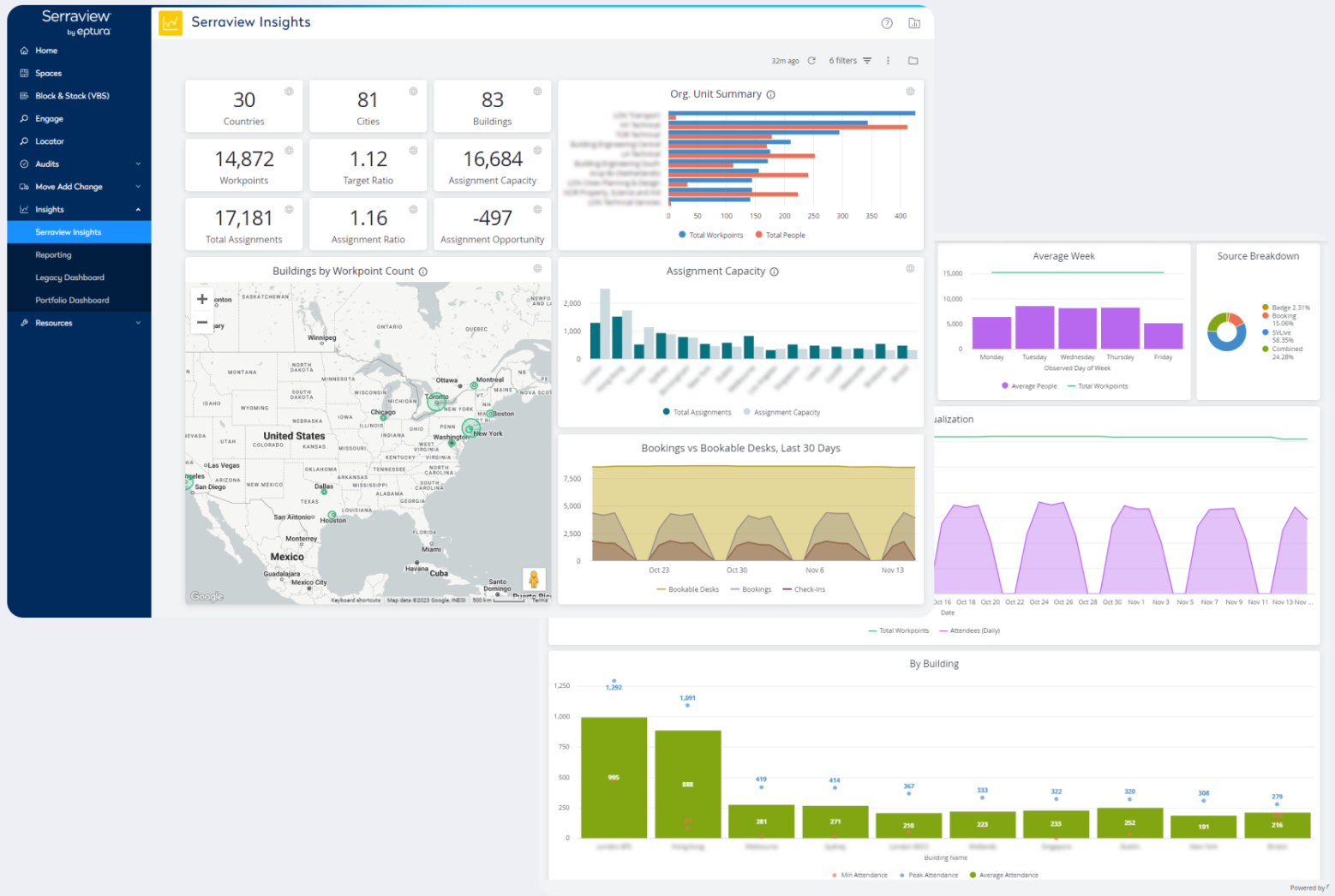
Eptura is a broad workplace operations and IWMS suite formed from the merger of nine worktech companies, including Archibus, Condeco, iOffice, and Serraview.
It combines desk and room booking, visitor management, asset and maintenance tracking, and space planning under one roof, and was named a Leader in the 2026 Gartner Magic Quadrant for Workplace Experience Applications.
You should consider shortlisting Eptura if you want one vendor across many workplace operations functions rather than maximum depth in any single layer.
Selected features
- Desk and room booking via Eptura Engage: hybrid scheduling, team bookings, and event management built on the Condeco heritage
- Visitor management: check-in, security, and compliance workflows from the Proxyclick lineage
- Asset and maintenance management: work orders and preventive maintenance through the platform's asset modules
- Space planning in Serraview: visual block-and-stack, scenario comparison, and move management for floor plan changes
- Reporting dashboards: consolidated occupancy, real estate, and asset data with connections to Power BI, Tableau, and Looker
Best for
- Teams consolidating multiple workplace point tools under a single vendor
- FM-led buying committees that prioritize operational breadth
- Enterprises with classic IWMS use cases: lease administration, maintenance, moves, and bookings in one system
What VergeSense complements
VergeSense integrates directly with Eptura's Serraview via its Occupancy Sensor API, and many enterprises run both. VergeSense supplies the measured occupancy data and predictive planning layer, while Eptura handles floor plan management, bookings, and move execution.
3. XY Sense
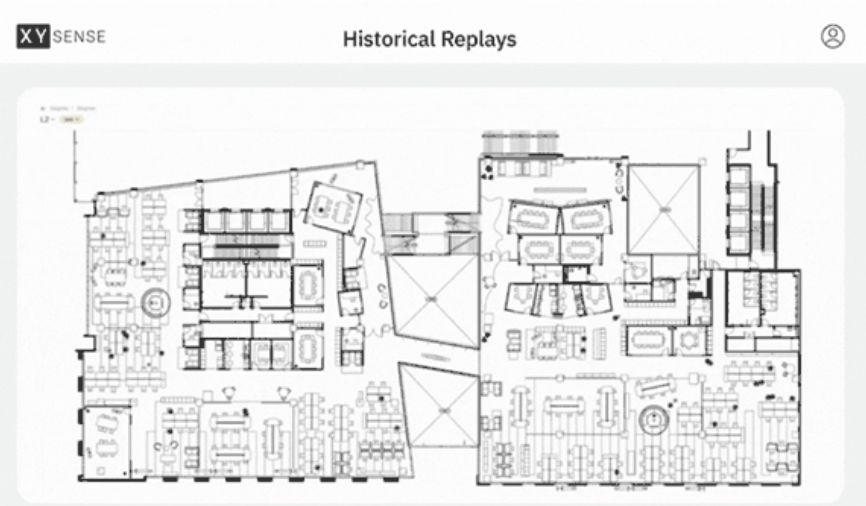
XY Sense is a sensor-led utilization platform from Australia that pairs wired, ceiling-mounted occupancy sensors with real-time dashboards.
Its Area Pro sensor, launched in March 2026, covers up to 3,000 sq ft per device with on-device AI processing, and the platform offers live floor views, heatmaps, and desk and meeting room analytics. It has its strongest footprint in APAC and EMEA, and suits teams whose first priority is real-time visibility into how spaces are used.
Selected features
- Wide-coverage wired sensors: Area Pro covers up to 3,000 sq ft per sensor, reducing device counts in open areas
- Real-time dashboards: live floor views, heatmaps, and replays with frequent update intervals
- Desk and meeting room analytics: utilization reporting at the space level
- Privacy-first detection: anonymous coordinate data rather than images
- Self-service commissioning tools: simplified setup and recommissioning for in-house teams
Best for
- Teams that want sensor-based utilization measurement with real-time monitoring
- Organizations in APAC and EMEA where XY Sense's deployment footprint is strongest
- New-build projects where wired PoE infrastructure is planned from the start
The tradeoff
XY Sense's platform is descriptive: it shows what's happening now and what happened before, but offers no predictive planning, scenario modeling, or demand forecasting layer. Its wired sensors also detect people but not passive occupancy, so a desk claimed by belongings reads as empty.
4. Robin
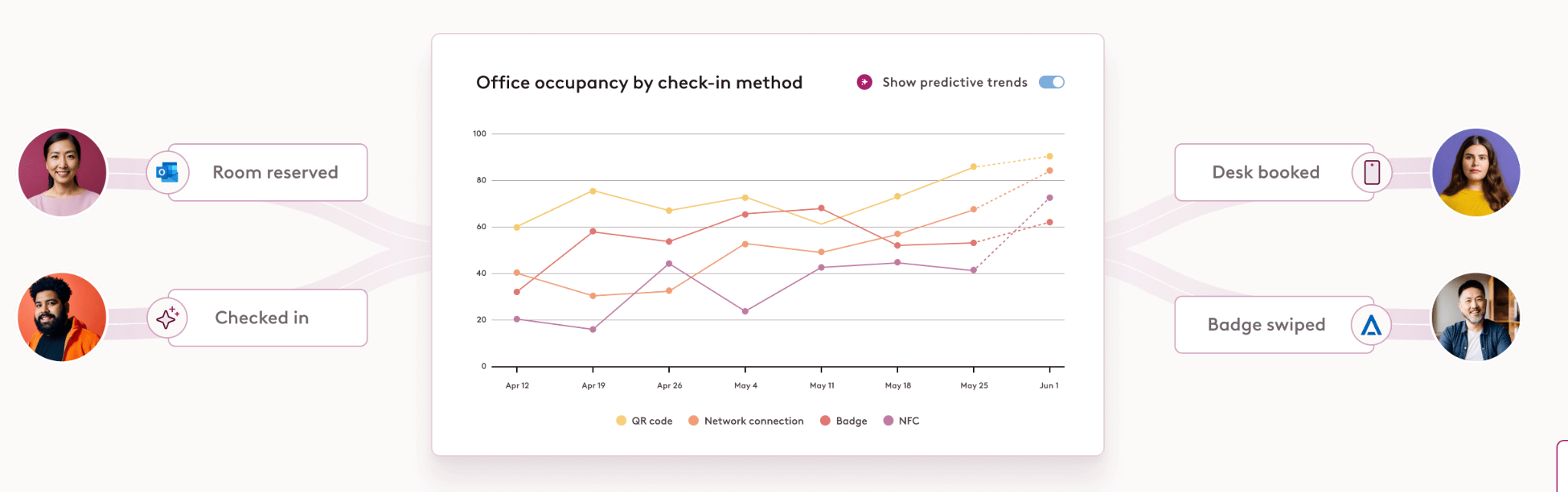
Robin is a desk and room booking platform with employee-facing apps for finding teammates, reserving spaces, and managing hybrid schedules.
Employees can book desks and rooms from web and mobile apps or interactive office maps, see which colleagues plan to be in, and coordinate office days inside the calendar tools they already use. It's a strong fit for workplace teams whose first problem is the booking experience rather than utilization measurement.
Selected features
- Desk booking: hot desks, assigned seating, and amenity-based search across interactive maps
- Room booking: scheduling with room displays showing real-time availability and check-in
- Hybrid scheduling: employees set in-office days and coordinate around team patterns
- Teammate finding: see who's planning to be in and where they're sitting
- Calendar integrations: works inside Outlook and Google Calendar, with Slack and Teams support
- Teams prioritizing the employee experience around booking and wayfinding
- Companies whose hybrid friction shows up first as "can't find a desk" rather than "don't know if space is right-sized"
What VergeSense complements
Robin is one of VergeSense's native booking integrations. Booking data from Robin can feed the VergeSense platform, where it's reconciled against measured occupancy, so teams can see the gap between what was reserved and what was actually used. VergeSense’s space booking automation tool can also allow automatic check-in and room release in Robin to free up more available space.
5. OfficeSpace
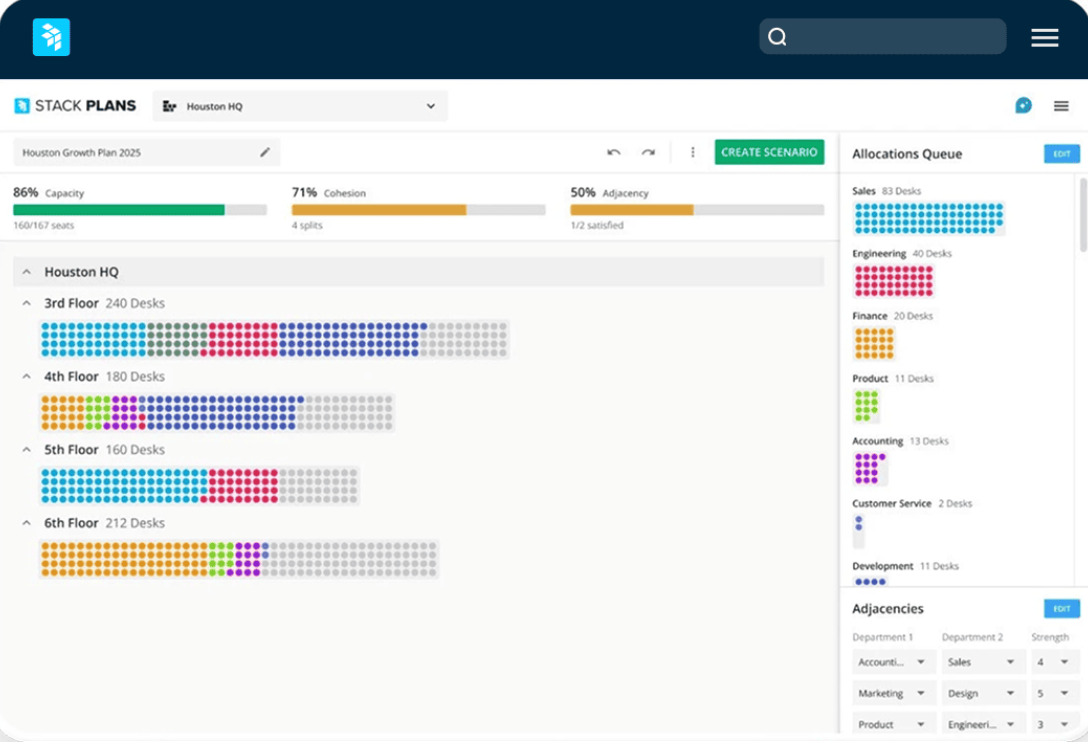
OfficeSpace is a space management and move planning platform backed by a $150M investment from Vista Equity Partners. Its core strengths are stack planning, move management, and floor plan visualization, augmented by the Dojo AI acquisition in 2025 and the AI Canvas platform that auto-generates stack plans and adjacency recommendations.
It's a strong option for teams whose lead use case is move management and floor plan administration rather than continuous utilization measurement.
Selected features
- Stack planning: auto-generated stack plans, restacks, and adjacency recommendations via Dojo AI
- Move management: workflows that take a planned restack through to executed moves
- Floor plan visualization: interactive plans and visual portfolio inventory
- Booking modules: desk and room reservations with wayfinding for employees
- Reporting: presence and utilization dashboards drawing on booking and third-party data feeds
Best for
- Workplace teams managing frequent moves, restacks, and floor plan changes
- CRE teams that need a visual inventory of the portfolio's floors and seats
The tradeoff
OfficeSpace's planning engine is design-oriented: it optimizes where teams fit based on rules, adjacencies, and constraints rather than simulating how people actually behave in space. It also doesn't generate its own occupancy data, relying on third-party sensor feeds and the customer's historical records for its forecasting.
6. Envoy
Envoy is a workplace experience platform with visitor management at its core, expanded over time into desk booking, room booking, and deliveries. Its visitor product handles pre-registration, custom sign-in flows, badge printing, and audit-ready records across thousands of office locations, with a single workplace app tying the modules together.
It's suitable if your primary workplace problem is the front-door experience and a lightweight employee booking system.
Selected features
- Visitor management: pre-registration, kiosks, host notifications, badge printing, and compliance records
- Desk booking: hourly, daily, or weekly reservations with flexible desk schedules by day and time
- Room booking: conference room scheduling with availability displays
- Deliveries: automated package scanning, routing, and employee notifications
- Workplace app: one mobile surface for visitors, bookings, and announcements
Best for
- Teams whose top hybrid friction is visitor flow and the front-door experience
- Smaller offices that want one app covering both visitors and employee bookings
The tradeoff
Envoy's analytics center on bookings, check-ins, and visitor traffic rather than measured occupancy, which leaves it light on utilization measurement compared to occupancy intelligence platforms. Teams making space and portfolio decisions will need a dedicated measurement and planning layer alongside it.
Key Features and Capabilities to Prioritize
The entries above differ less in their feature lists than in their foundations. These are the capability categories worth weighting most heavily as a workplace experience leader.
Accurate occupancy data, not booking or badge proxies.
Booking data records intent, and badge data records entry; neither tells you whether the room stayed occupied or the desk went unused. By measuring active occupancy (people present) alongside passive occupancy (belongings like bags and laptops claiming a space), you have a signal that doesn't overcount ghosted reservations or mistake a held desk for an empty one.
Neighborhood, zone, and space-type measurement granularity.
Floor totals can look healthy while a specific neighborhood is over capacity every midweek peak. Design and amenity decisions need evidence at the level where the decision happens, which means zone and space-type data, not just building averages.
Predictive and scenario-modeling depth.
Measuring the present is the entry requirement; the higher-value capability is testing policy and headcount shifts before they hit the floor. Platforms with a forecasting layer let you model a three-day policy or a 20% headcount change and see the demand impact in advance.
Employee-facing surfaces.
Real-time availability, wayfinding, and assistant-style interfaces are what reduce midweek friction for the people actually in the building. A solution that only serves the workplace team leaves the employee experience problem unsolved.
Integrations with the existing stack.
Your occupancy layer should plug into Microsoft Places, ServiceNow Workplace Service Delivery, calendar systems, and building management systems rather than forcing a rip-and-replace. The fewer parallel systems of record, the more trustworthy the numbers.
Privacy and trust.
Anonymized counting with no personally identifiable information is the baseline, but employee trust also depends on what you can show people: clear signage, plain-language policy, and a data model that measures spaces rather than surveilling individuals.
How to Choose Hybrid Workplace Solutions for Your Workplace Experience Team
The right shortlist depends on where hybrid friction shows up first in your organization, and on which decisions you need the data to change. Use the questions below to narrow the field before any vendor conversation starts.
Questions to Ask Internally
- Where does hybrid friction show up first: booking, ghosted rooms, peak-day crowding, or amenity utilization?
- Are we trying to measure current usage, plan future demand, or operate the day-to-day, or all three?
- What granularity do we need: portfolio, building, floor, neighborhood, room, or desk?
- Whose decisions need to change: workplace experience, CRE, FM, IT, or leadership?
- What's our data source today (badge, booking, survey, walkthroughs), and how confident are we in it?
- How will employees experience this, and could the data-collection model feel like surveillance?
- What does success look like 12 months out, and which metric tells us we got there?
Questions to Ask Vendors
- How is occupancy actually measured, and what is the accuracy in real deployments?
- What data sources beyond your own product can the platform ingest?
- Can the platform forecast future demand and model policy or headcount scenarios?
- What granularity does the platform support, end to end?
- Which integrations are live today with Microsoft Places, ServiceNow, calendar, badge, and BMS systems?
- How is privacy designed in, and what can we show employees to build trust?
- What does deployment look like, and what is realistic time-to-value at our portfolio size?
Wherever hybrid friction shows up first, the fix starts with knowing what's actually happening in your space.
VergeSense brings accurate occupancy measurement and predictive planning into one platform, so your team plans from real behavior instead of best guesses, and can prove the impact of every change.
Get a Demo →
FAQs About Hybrid Workplace Solutions
What Counts as a Hybrid Workplace Solution?
Any tool that helps an organization run an office where attendance varies by day and team. The category spans occupancy intelligence and predictive planning platforms, IWMS and workplace operations suites, sensor-led utilization platforms, desk and room booking systems, and visitor and workplace experience apps. Most enterprises combine two or three layers rather than expecting one tool to do everything.
How Are These Different From Badge or Booking Data?
Badge data records who entered a building, and booking data records what people intended to reserve. Neither measures what happened inside: whether the booked room sat empty, or whether an unbooked neighborhood filled up anyway. Occupancy intelligence platforms measure actual usage at the space level, then can reconcile badge and booking feeds against it for a complete picture.
Do Workplace Experience Teams Need Sensors?
Not for every site. Sensors deliver the most accurate space-level measurement, including passive occupancy detection, but platforms like VergeSense can also use WiFi-based occupancy and benchmarks derived from 250M+ square feet of measured spaces to cover sites where sensor deployment isn't practical. The right answer is usually a layered stack matched to each site's decision needs.
What's the Difference Between Workplace Analytics and Predictive Planning?
Workplace analytics describes the past and present: utilization rates, peak days, popular space types. Predictive planning forecasts the future: how demand shifts under a new attendance policy, where a floor will hit its breaking point, and what a headcount change does to space needs. Analytics tells you what happened; predictive planning tells you what to do next.
How Should a Workplace Experience Team Prioritize Among These Tools?
Start with where friction shows up first and which decision is most expensive to get wrong. If employees can't find desks, fix booking. If you don't know whether space is right-sized, invest in measurement and planning before anything else, because every downstream decision depends on whether the underlying data reflects real behavior.

.jpg)