

Ready to Get a Good Look at Your Occupancy Trends?
Already measuring? See what’s next.
NEW REPORT: The Self-Adapting Workplace, from VergeSense & WORKTECH Academy Download Now →
Badge, WiFi, room booking, video conferencing, and sensor data all in one platform. Unify the signals you already have, and add sensors only where they answer a question nothing else can.
Meridian measures how every space is actually used, across every signal you already have, so the number you carry into a lease, design, or budget conversation holds up under scrutiny.
See where you're over- and under-utilized across every building, floor, and neighborhood, down to the individual desk.
Right-size Your Portfolio →Know which space types are saturated and which sit empty, so a redesign starts from measured behavior instead of a floor plan someone drew three years ago.
Design Better Offices →Trigger cleaning, HVAC, and security based on actual occupancy. Cut costs while maintaining experience.
Automate Your Operations →.png)
POWERED BY THE MERIDIAN PLATFORM
Start with what you already have from badge data, booking systems, WiFi, video conferencing systems, and more. Add sensors where you need space-level precision.
Every source flows into a single analytics layer in the Meridian Platform. The more signals you connect, the sharper your baseline becomes.
Feed clean, unified occupancy data directly into Predictive Planning, so your forecasts and scenario models are grounded in how people use your space.
Ready to go further? See how Predictive Planning uses this data to forecast demand and model scenarios.
Start with the signals you already own. Add VergeSense sensors only where you need space-level precision that nothing else can give you.
The signal most teams already trust. Meridian ingests badge data for building and floor level attendance, then the Large Spatial Model fills in the gaps.
Leverage your existing infrastructure for building/floor-level people count, up to 85% accuracy. No new hardware, no installation.
Room cameras you've already deployed become an occupancy signal. Get people count and true meeting attendance in every equipped room, including the meetings that get booked and never happen.
Compare what was reserved against what was actually used, so you can see where your booking policy is working and where it's creating phantom demand.

95%+ accurate people count for your conference rooms, collab spaces, desks, and other individual spaces. 10-year battery life, passive + active occupancy, people count, wired or wireless connectivity.
95%+ accurate people count for building and floor level occupancy trends.
Already invested in occupancy sensors from another vendor? Bring that data into Meridian instead of replacing it, and unify it with everything else in one measurement layer.
Measure real usage at the desk, room, and neighborhood level, with visibility into both active occupancy (people present) and passive occupancy (belongings without people) where Infinity Area sensors are installed.
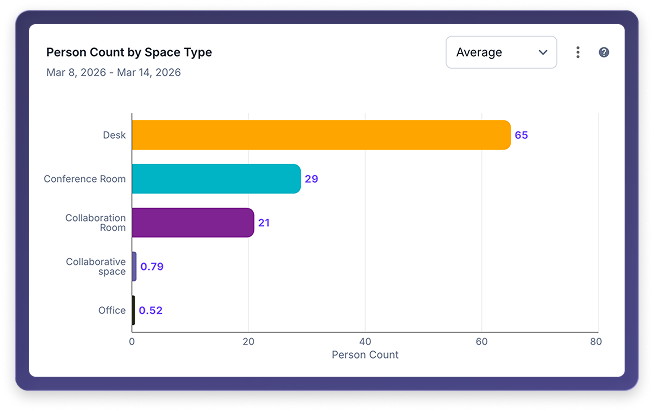
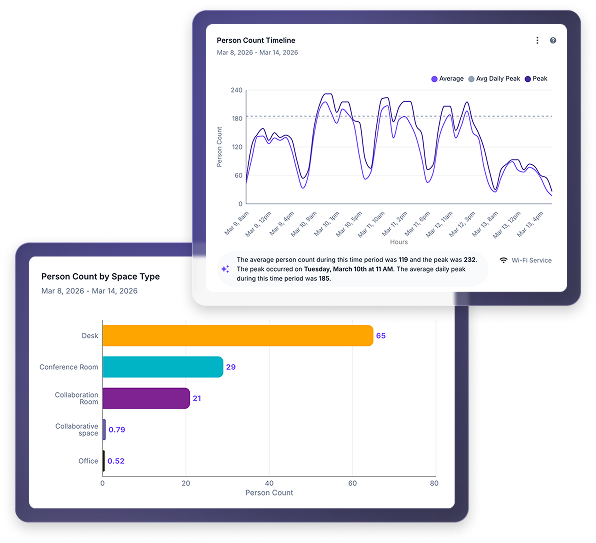
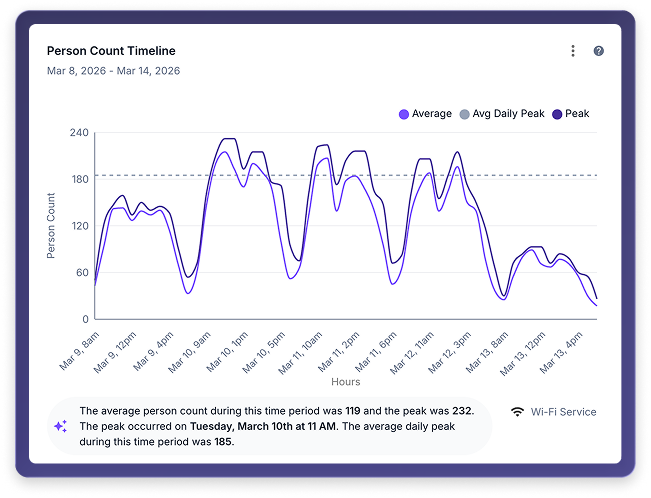
Track building-level occupancy over time, compare peak against average utilization, and see how every region, site, and space type stacks up.
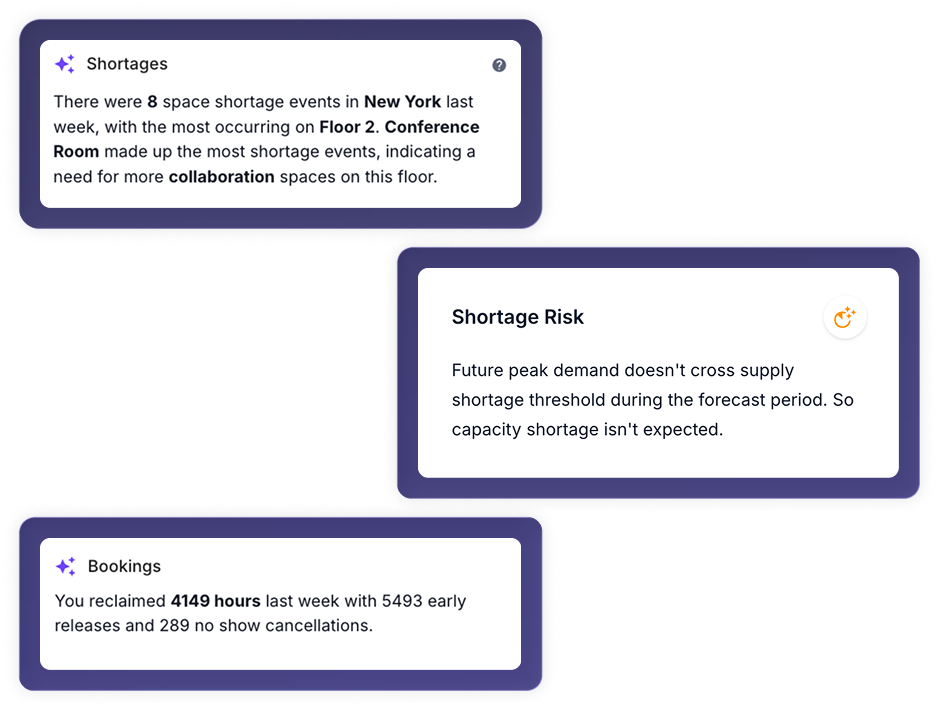
Meridian flags attendance shifts, space shortages, and booking waste as they emerge, so you find out from the platform rather than from a complaint.
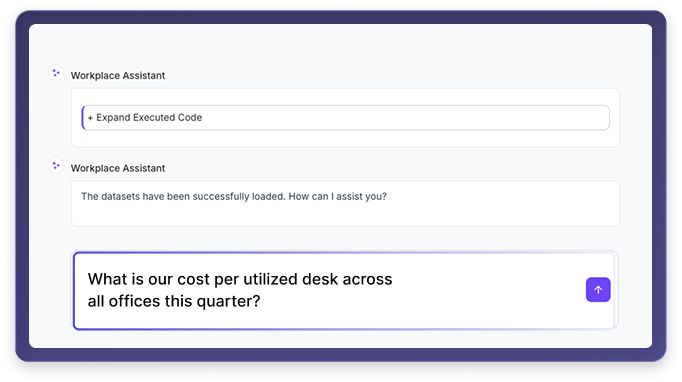
Use natural-language AI to query your occupancy data in seconds, “Which floor had the lowest utilization last quarter?” or “What are our peak days in Austin?”without building manual reports
Export a portfolio read that holds up in a board deck, a lease negotiation, or a budget review, without rebuilding it by hand every quarter.
A global consulting firm suspected meeting rooms weren't being used as booked, but had no data to prove it. Leadership was evaluating leasing an additional floor at an estimated $600K annually to solve what felt like a space shortage.
VergeSense compared booking data against actual sensor-verified occupancy, revealing that 40% of monthly booking hours were ghosted. Rather than expanding, the firm automated room release and used space-type data to install 50 phone booths where demand actually was.
4,160 hours of ghosted meetings eliminated every month. $600K in annual lease costs avoided. No additional square footage required.
The space shortage wasn't real. The data made that clear in minutes, not months.
50+ pre-built integrations to connect to your stack. Open APIs and webhooks for custom workflows.

Occupancy intelligence is the practice of collecting, unifying, and analyzing data about how workplace spaces are actually being used to make confident real estate and workplace decisions. It goes beyond simple headcounts by incorporating person count, active occupancy, and passive occupancy into a single platform, giving leaders the insights needed to optimize portfolios, redesign spaces, and automate operations.
Occupancy measures whether a space is in use and how many people are present at a given time. Utilization measures how effectively a space is being used relative to its capacity and intended purpose over time. For example, a 10-person conference room used by 2 people is occupied, but poorly utilized. VergeSense captures both to give you a complete picture of space performance.
Active occupancy is when a person is physically present in a space. Passive occupancy is when a space is claimed by personal objects, like a laptop, bag, or jacket, but the person has temporarily left. VergeSense is the only platform that detects passive occupancy. Without passive occupancy data, you're making decisions based on half the picture.
Badge data tells you who entered a building. It does not tell you what they used once they were inside. Badge swipes measure attendance at the entry point, so they cannot show which floors filled up, which meeting rooms sat empty, or which desks were claimed by belongings and never actually used. A team relying on badge data alone typically knows its buildings are underused but cannot say which spaces to give back. VergeSense resolves what badge data cannot see.
Occupancy Intelligence in the Meridian platform measures space use directly, at the desk, room, and floor level. It captures person count, active occupancy, and passive occupancy, the space people claim without booking it. It also ingests badge data alongside WiFi, room booking, video conferencing, and sensor signals, so attendance and space use reconcile into one number rather than two competing ones.
Infinity is VergeSense's most advanced area sensor, featuring a 10-year battery life, wire-free installation with magnetic snap-on mounting, and a carbon footprint 25x lower than competing solutions. It measures occupancy with 95% accuracy and uses advanced AI to detect both people and objects like monitors, chairs, and laptops. Infinity receives over-the-air AI updates so it gets smarter over time, and its data feeds directly into the Meridian Platform.
The Meridian Platform provides dashboards and analytics that show peak person count, capacity usage, and occupancy trends over time at the portfolio, building, floor, and individual space levels. You can view data by space type, day of week, and time period. Floor plan visualizations let you see neighborhood-level usage patterns, and the platform highlights space shortages, availability trends, and efficiency metrics at a glance.
Yes. Workplace Assistant is VergeSense's AI-powered tool that lets you ask questions about your occupancy data in plain language and receive instant, data-driven answers. Instead of weeks of manual analysis, you can get insights about space trends, optimization opportunities, and portfolio performance within minutes. Workplace Assistant operates with enterprise-grade security, accessing only data you explicitly provide in each session.
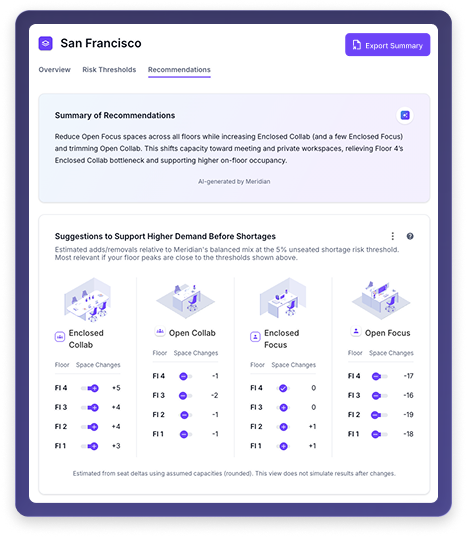
The Meridian Platform offers built-in analytics dashboards covering occupancy trends, capacity usage, space shortages, and efficiency metrics. Workplace Assistant can generate AI-powered analysis and personalized recommendations. The platform integrates with over 50 workplace applications, and Predictive Planning produces CFO-ready reports with cost savings, payback timelines, and ROI quantification for scenario comparisons.
Occupancy Intelligence tells you what happened: a single, trusted picture of how every space has actually been used, from portfolio down to the individual desk. Predictive Planning tells you what's next. Powered by the Large Spatial Model, trained on 250M+ sq ft of real workplace behavior, it takes those historical and current occupancy signals and forecasts forward, so you can model scenarios like lease exits, headcount changes, or restacks and see the financial and experience impact in hours, not months, before you commit budget.
Already measuring? See what’s next.