


the ai behind the meridian platform
The VergeSense
Large Spatial Model
Forecast workplace demand from a floor plan alone, calibrated on 250M+ square feet of real occupancy behavior.
Model a lease exit, a redesign, or a policy change in minutes instead of waiting months for a study.
What the Large Spatial Model Predicts
Our focus is how people interact with workplace environments. The LSM models four dimensions of that interaction, each one tied to a planning decision your team is already trying to make.
Which spaces are underused or overloaded
Utilization patterns and capacity mismatches surface where you're wasting space and where you're creating bottlenecks, floor by floor and space type by space type.
How new work patterns change behavior
Hybrid schedules, policy changes, team growth. The LSM models how behavior shifts when context changes, so your plans don't break when reality does.
Where people choose to gather
Collaboration clustering and social hotspots, so you can design for how teams actually convene rather than how you assumed they would.
How they move through layouts
Circulation and wayfinding behavior reveal which layouts create flow and which create friction, before you build.
How the Large Spatial Model Works
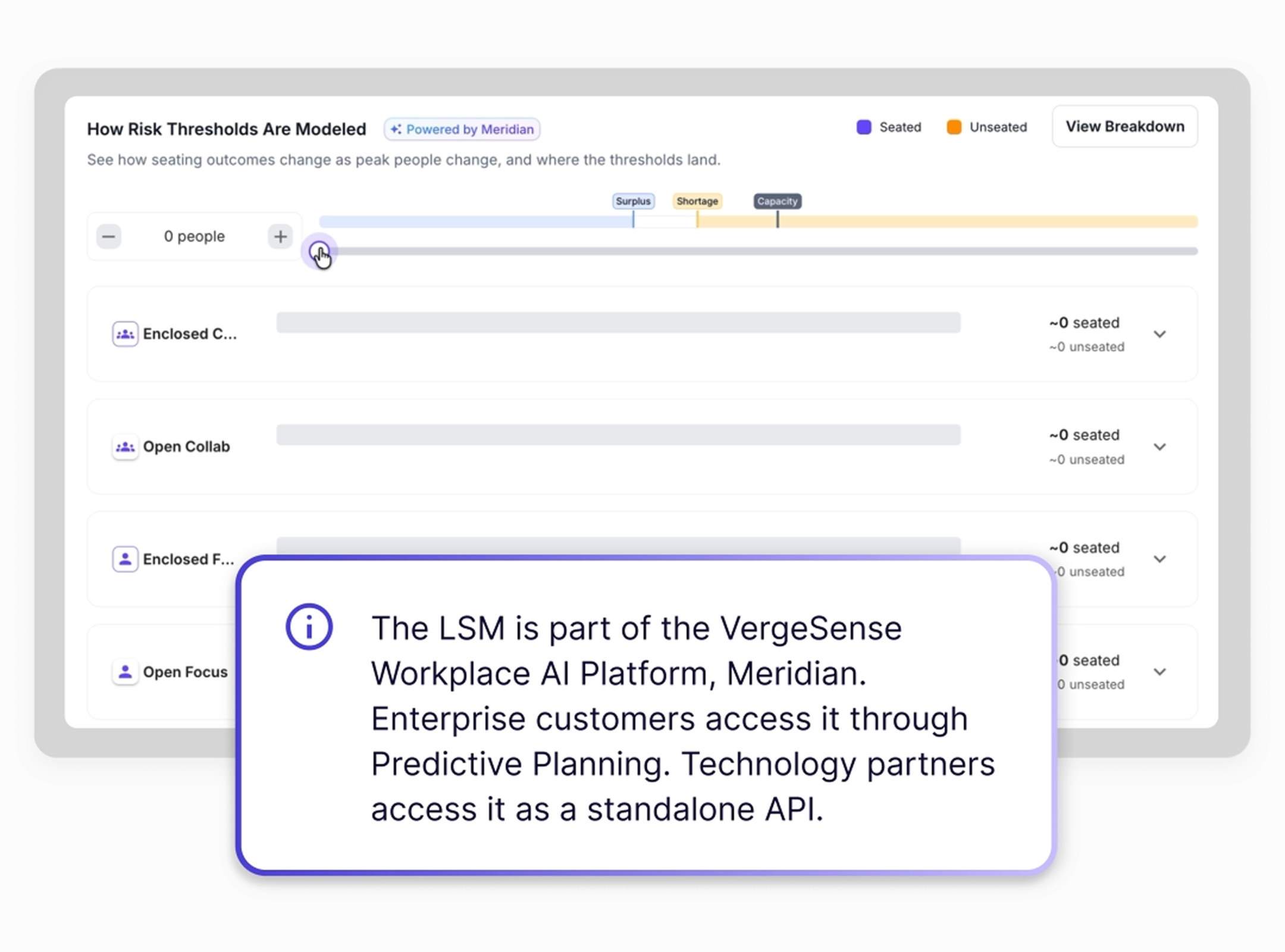
Given a space and the people who use it, the LSM predicts how those people will use that space.
Here's how.

Space + People In
The LSM takes two inputs: your floor plan (space types, capacities, layout) and your workforce context (industry, team mix, work patterns). It models the interaction between them.

Usage Fingerprint Out
The model generates a Usage Fingerprint, a behavioral profile that predicts how employees will actually use a specific office. Think of it as your office's behavioral DNA.
Forecast Outcomes
The LSM runs thousands of Monte Carlo simulations, like replaying the same day 1,000 times, to show you the full range of realistic outcomes. Where will rooms saturate? Which space types bottleneck first? At what occupancy does experience degrade?

Compare Scenarios
Change the space or the people, re-run the model, and see the impact instantly. What if you consolidate two floors? What if peak attendance doubles? Every scenario reflects real behavioral dynamics.
Ground Truth from Data, Not Assumptions
Most spatial models start from geometry and layer in a best guess for behavior on top. VergeSense started with a different
approach: we observed people-space interactions in office environments over years, then used that real data to train a
foundation model that predicts how people will use space.
Square Feet Analyzed
Real occupancy data from global workplaces.
Floor Plans Used for Training
Diverse layouts across industries and regions.
Years of Behavioral Data
The longest-running workplace behavior dataset in the industry.
Start with a Floorplan. Get Sharper as You Add Data.
Most teams need an answer before they can justify a sensor deployment. The LSM gives you a forecast on day one, then anchors to your own signals as they come online.
Modeled Precision
Just a floor plan. No sensors, no existing data required.
Forecasts built on behavioral benchmarks from 250M+ sq ft of workplace data, calibrated to your industry and building type. Enough to pressure-test a lease, design or headcount change before you make a decision.
Measured Precision
Occupancy signals you probably already have. Badge, WiFi, room booking, video conferencing, or VergeSense sensors.
Forecasts generated directly from your own workplace behavior, calibrated to your buildings rather than your industry. Enough to defend a number that carries real budget.
No sensors? No problem.
The Large Spatial Model can predict occupancy patterns for spaces you're not measuring yet, using behavioral benchmarks calibrated to your industry, building type, and work patterns.
From Forecast to Decision
The Large Spatial Model is the engine behind the Meridian Platform that helps enterprise real estate and workplace teams forecast demand, model scenarios, and make portfolio decisions before committing capital.
Right-Size Your Portfolio
Model consolidation, expansion, or hybrid policies with predicted outcomes to optimize your real estate footprint.
Design for How People Actually Work
Test proposed layouts and multi-floor stack plans against predicted occupancy patterns before construction starts.
Plan Team Moves Before You Make Them
Model team allocations across floors. Test reorg scenarios before disrupting employees.
Large Spatial Model API for Technology Partners
The Large Spatial Model is available to technology partners via API, bringing spatial intelligence directly into the platforms your customers already use. Through a simple integration, partners can embed predictive capabilities without building behavioral models from scratch.
IWMS & Planning Platforms
Design & Space Planning Tools
Workplace Experience Apps
Smart Building & BMS Systems
Request
POST /predict/normalized_space_type_usage
{ "person_count": 100, "spaces": [
{
"id": "312",
"name": "Conference Room 312", "capacity": 6,
"normalized_space_type": "enclosed_collab" }
]
Predicts how people will distribute across your spaces given a target headcount.
Response
{
"data": [
{
"id": "predict-nst-312",
"type": "normalized_space_type_usage_prediction",
"attributes": {
"person_distributions": [
{ "normalized_space_type": "enclosed_collab",
"avg_seated": 20.1,
"avg_unseated": 0
} ],
"seat_distributions": [
{
"normalized_space_type": "enclosed_collab",
"avg_used": 10,
"avg_wasted_layout": 8, "avg_wasted_room_size": 2
}
]
}
Returns seat usage patterns and person distributions by space type.
POST | v1 | Forecast | Demand
Predict daily and weekly office attendance over the next 12
months based on your workplace policies, historical patterns,
and real-world conditions.
Input
Office details:
Location, assigned headcount, space configuration
In-office policy:
Required days, hybrid schedules, flexibility parameters
Historical data:
Actual attendance patterns (or expected adherence %), peak occupancy (or expected conversion rate)
Employee sentiment:
LLM-style textual context about what you're hearing from your workforce
Output
Daily forecasts:
Expected headcount for each business day over 12 months
Weekly patterns:
Aggregated trends showing typical office density by week
Context aware predictions:
LSM factors in weather data, commute conditions, holidays, and employee sentiment alongside your inputs and our
The LSM architecture is extensible. We're partnering with companies that have unique building system datasets to
create custom multi-modal variants, expanding from people-space interactions to comprehensive building
intelligence. Use cases like Predictive BMS Controls are early examples of partner-enabled applications.
Frequently Asked Questions
What is the VergeSense Large Spatial Model?
The VergeSense Large Spatial Model (LSM) is a proprietary AI foundational model purpose-built to predict how humans use physical space. Trained on 8 years of real-world occupancy behavior across 250M+ square feet of workplaces, spanning industries, geographies, and space types, it's the only spatial AI model of its kind. The LSM powers VergeSense Predictive Planning for enterprise customers and is available via API for technology partners.
What is a Usage Fingerprint?
A Usage Fingerprint is a compact behavioral profile that predicts how employees will interact with a particular office. Think of it as an office's behavioral DNA. It captures four signals: how people spread across space types, how rooms are actually used relative to capacity, how behavior changes under pressure, and which spaces get claimed first. Unlike static planning ratios, Usage Fingerprints reflect real behavioral patterns that shift as occupancy changes.
How does the Large Spatial Model work?
The LSM takes two inputs, space context (your floor plan, space types, layout) and behavior context (industry, team mix, work patterns,) and predicts how those people will interact with that space. It generates a Usage Fingerprint, then runs Monte Carlo simulations (1,000+ runs) to translate behavioral probabilities into a range of realistic, floor-level outcomes. This makes it possible to quantify questions like: How often will we run out of meeting rooms? Which space types bottleneck first? At what occupancy does user experience degrade?
What is Monte Carlo simulation and why does VergeSense use it?
Monte Carlo simulation is a method that generates many plausible scenarios by sampling from predicted probability distributions. VergeSense uses it because workplace outcomes aren't deterministic, meaning the same headcount can produce different experiences depending on meeting sizes, team behavior, and space preferences. By running 1,000+ simulations, the LSM shows the full range of realistic outcomes, not just a single "breakpoint" number. Think of it as replaying the same day 1,000 times to see what would realistically happen.
Does the Large Spatial Model require occupancy sensors?
No. The LSM can generate forecasts from a floor plan alone, using behavioral benchmarks from its 250M+ sq ft training dataset calibrated to your industry and building type. This is called "modeled precision." When VergeSense sensor data or WiFi data is available, the model shifts to "measured precision," generating Usage Fingerprints directly from your workplace's actual behavior for higher fidelity.
How is the LSM different from a large language model (LLM)?
Large language models are trained on text from the internet. They can summarize a report but cannot predict how consolidating a floor will affect employee experience, because they've never learned how humans behave in physical space. The LSM is trained on spatial behavioral data — real occupancy patterns from millions of square feet of offices. It predicts the interaction between people and space, which requires understanding probability, physical constraints, and behavioral dynamics that text models can't capture.
What can technology partners build with the LSM API?
Partners can embed spatial intelligence directly into the platforms their customers already use. IWMS and planning platforms can add scenario modeling and breakpoint forecasting. Workplace experience apps can offer predictive busyness signals. Smart building systems can optimize HVAC and cleaning based on predicted demand. Design tools can score layout performance before construction. The API provides behavioral distributions, simulation snapshots, or derived planning metrics depending on integration needs.
How does the Large Spatial Model power Predictive Planning?
Predictive Planning is VergeSense's customer-facing product built on the LSM, available via the Meridian Platform. It allows enterprise real estate and workplace teams to forecast space demand, run what-if scenarios, identify breakpoints, and quantify ROI, in hours instead of the months a consultant study would take. Every forecast, scenario comparison, and risk assessment in Predictive Planning is generated by the LSM's behavioral modeling and Monte Carlo simulation engine.
What data was the Large Spatial Model trained on?
The LSM was trained on 8 years of anonymized workplace occupancy data collected by VergeSense sensors across 250M+ square feet of offices in 50+ countries. The training set includes 5,000+ diverse floorplans across industries and regions. This covers how people actually use individual spaces (desks, meeting rooms, focus areas, collaboration zones), how behavior changes across days, seasons, and occupancy levels, and how usage varies by industry, region, and space design. No personally identifiable information is used.
Is the Large Spatial Model API available now?
Yes. The LSM API is available now for technology partners. Through a simple integration, partners can bring spatial intelligence into the platforms their customers already trust. Contact VergeSense to discuss your use case and get API access. For full technical details, visit vergesense.ai.
Predict How Your Spaces Will Be Used
Before You Commit
Whether you're planning a portfolio consolidation, testing a floor redesign, or building spatial
intelligence into your platform, the Large Spatial Model is the foundation.
See Predictive Planning in Action
Get a personalized walkthrough and see how the LSM models your specific portfolio.
Bring Spatial Intelligence to Your Platform
Embed predictive capabilities into the tools your customers already use.