


From How Space Is Used to How It Is Experienced: Workplace Experience Data Comes to Meridian


VergeSense is the industry leader in providing enterprises with a true understanding of their occupancy and how their offices are actually being used.
Most enterprises track how their offices are occupied. Far fewer know how well that space supports the people using it.
That gap matters when you're planning a consolidation, a redesign or a change to in-office policy. Knowing which spaces are busy tells you part of the story. Knowing which ones help people do their best work tells you the rest.
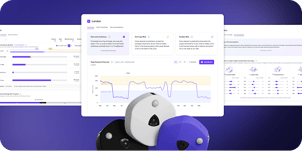
That's why we're expanding Meridian, our Workplace AI Platform, to integrate workplace experience data. For the first time, you can analyze experience and survey data alongside occupancy and planning data in one platform, and get one view of how your workplaces are used and how they are experienced.
Why experience and occupancy data belong together
Legacy experience surveys are slow to run, one-size-fits-all, and disconnected from what happens on the floor. As a result, experience and occupancy data live in separate reports, owned by separate teams.
That leaves real estate and workplace leaders stitching the picture together by hand, or making decisions with only half of it. Occupancy data shows how space is used. Experience data shows how well it works. You need both to make portfolio and workplace decisions with the full picture.
What you can do with experience data in Meridian
Meridian closes that gap. You can bring in the experience surveys you already run, or measure experience directly with VergeSense, and see the results alongside your occupancy data and planning forecasts in the same platform.
The result pairs quantitative evidence of how space is used with qualitative insight into how well it works. That combination has not existed in a single platform before. With it, you can:
- See not only which spaces are busy, but which ones help people do their best work
- Use both signals when planning a consolidation, a redesign or a change to in-office policy
- Forecast a change, measure how people use and experience it, and feed both back into the next plan
Smarter recommendations from the Large Spatial Model
The Large Spatial Model, trained on workplace behavior across more than 250 million square feet, powers Meridian's forecasting and Predictive Planning capabilities. Each new data source expands what the model can learn and makes the platform more capable.
With experience data, the model can account for how space performs for people as well as how often it is used. That means the recommendations you get reflect both efficiency and effectiveness.
Built on planning results occupiers already trust
Experience data strengthens Predictive Planning, the Meridian capability that lets you test lease, design, headcount and policy changes before you commit to decisions. Here's what occupiers have done with it recently:
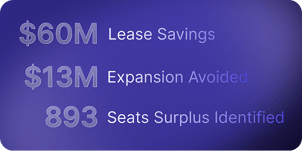
- Deferring a $10M+ build-out: A global professional services firm was preparing to build out shell floors based on projected headcount growth. Three months of data showed workstations were less than half full even on the busiest days, giving the firm the evidence to defer the build-out and let real demand set the timing.
- Absorbing higher attendance with no new space: A large US insurance company expected a space shortage as it raised in-office attendance. Meridian showed desks were never the constraint; enclosed rooms were. Converting 25 to 30 desks into collaboration rooms allowed the floor to absorb the increase without additional space.
- Avoiding £1M+ in capital expense: A global technology company facing a lease event planned to rebuild its office with the same layout and desk count. Meridian showed fewer than half the desks were in use even on the busiest days, and fitting out to actual demand revealed more than £1M in avoidable capital expense.
Each of these decisions started with how space was used. With experience data in Meridian, the next ones can also account for how well that space works for the people in it.
Led by Workplace Science leaders from Leesman
The offering is led by two of the industry's best known workplace experience thought leaders, who join us from Leesman. Peggie Rothe is our VP of Workplace Science, and Kyle de Bruin is our GM of Workplace Science.
During their years at Leesman, Peggie and Kyle helped build one of the world's largest workplace experience databases, covering more than 1.6 million employees across 10,000+ workplaces in 124 countries. They now bring that knowledge to VergeSense to connect how workplaces are designed and used with how well they support the people in them.
"Knowing how space is used was never the whole answer. By bringing experience data into Meridian, we're giving occupiers the full picture, so they can make decisions that are right for both their businesses and their people."
- Dan Ryan, CEO & Co-founder, VergeSense
Part of one platform for every workplace signal
Workplace experience is the latest layer in Meridian, which is now the connective layer for workplace data. It brings together sources that have historically lived in separate systems. This year alone, we expanded Meridian to include:
- Occupancy data from video conferencing systems, through our membership in the Logitech Collaboration Program
- Third-party sensor data, so you can put existing sensor investments to work alongside VergeSense sensors
- Workplace and booking data from Microsoft Places, through an expanded integration
- AI-generated test fits, through a partnership with laiout that turns Predictive Planning forecasts into floor plan designs
- Integrated workplace management data, through a partnership with Spacewell
Experience data adds what no sensor, booking system or floor plan can capture on its own: how people feel about the spaces they use.
A long-term partner for your workplace decisions
VergeSense reached profitability this quarter, achieving positive EBITDA in our fiscal third quarter, which ended October 31, 2026.* For the 200+ enterprise occupiers we serve across 50+ countries, that means a durable, long-term partner for your most consequential real estate and workplace decisions.
We're reinvesting that growth into the platform, starting with workplace experience measurement and followed by agentic AI capabilities that move you from insight to action.
Get early access
Workplace experience in Meridian is available now to a select group of early-access customers. If you want experience data in front of you for your next lease, redesign or policy decision, request early access.
*Based on unaudited results.