




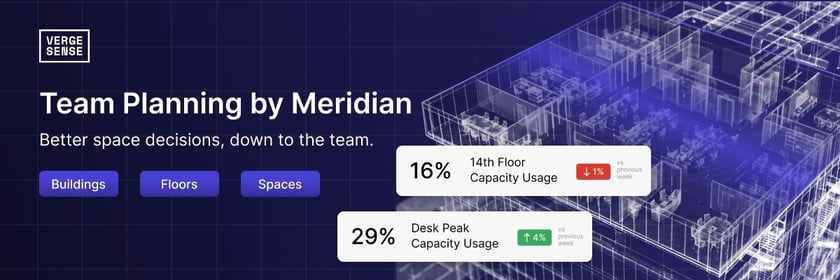

Meridian now models demand at the team level, so your planning starts from how teams actually use space instead of one blended number.
We spend a lot of time with occupancy planners, and the job almost always comes back to the same set of decisions: how do you right-size the space you already have, plan for the headcount that's coming, design a floor people want to use, and stand behind the call before anyone moves?
In Predictive Planning, VergeSense customers already answer that question. They model scenarios, forecast demand a year out, see the health of their space, and get recommendations on what to do about it.
But until now, demand has been described one way: a single building-wide headcount. A plan covered a building, and you gave it one population, with no way to break it down by the teams inside. And that one number can't tell you which team is shaping your busiest days, which group barely comes in, or whose growth is about to break a floor. A building can look perfectly sized on average while the teams inside it tell a completely different story.

From the building down to the teams inside it
With the new People tab, you can define the teams that make up a building and model demand for each one. Every team carries its own inputs: its headcount, how reliably people show up, and when they tend to arrive and how long they stay.
From that, Meridian predicts each team's daily demand profile and its average weekly peak, then rolls it all up into an all-teams view that shows total headcount, and demand across every team.
Every team's forecast starts grounded in the Large Spatial Model, trained on 250M+ sq ft of real workplace behavior, so you get a credible demand profile from a floor plan alone, before you add any data of your own. If you do have badge data, you can upload it with a team identifier to calibrate a team's forecast with your own signal and sharpen it further.
Where this is going
Seeing demand at the team level is the foundation. Next, you will be able to assign teams to the spaces they occupy and see supply and demand together: exactly where a team is short, and where it is sitting on more room than it needs, before anyone commits to a move. From there, the goal is to give planners not just the gaps but clear options for closing them, the kind you can put in front of a room full of stakeholders and defend with the reasoning behind each one.
See it for yourself
Team-level planning is live in Meridian now. If you want to see what your building looks like once that one big number breaks apart into the teams behind it, talk to your VergeSense team member.


.jpg)