

How to Cut Office Lease Costs with Confidence


VergeSense is the industry leader in providing enterprises with a true understanding of their occupancy and how their offices are actually being used.
Every CRE leader is getting the same mandate: cut lease costs. And the logic seems simple. If space is underutilized, reduce it.
But most organizations are running into the same paradox: the data shows excess capacity, yet the office still feels full. Meeting rooms are impossible to find. Collaboration spaces are overbooked. Teams compete for the same resources while desks sit empty.
The numbers confirm this disconnect. According to VergeSense data, nearly 30% of booked rooms go unused every single day. Companies targeting 65% utilization are landing somewhere between 38% and 54%. The gap between what the data says and what employees experience is real, and it's where lease decisions go wrong.
As Diane Wu, Workplace Strategy Governance Data Manager at a global life sciences company, shared at the 2nd Occupancy Intelligence Summit:
“When we looked at the data, it was quite interesting to see that there was less than two hours a day that each of these conference rooms were being utilized. So it begs the question, do we really need three of them?”
Her team used that insight to consolidate three underperforming conference rooms into one, reclaiming significant square footage for a lobby redesign that better represented the company's brand and scale. No space was eliminated without the data to back it up.
This is the challenge many organizations face. What feels like a space shortage is often a mismatch between perception and reality. The question becomes not just how to reduce lease costs, but how to do it without introducing new friction into the workplace.
Why Reducing Office Lease Costs Is More Complex Than It Seems
For years, real estate decisions followed a predictable model: headcount drove demand, demand drove space, and space was planned accordingly. That model no longer holds.
Today's workplace is shaped by hybrid schedules, shifting attendance patterns, and a broader range of work happening in the office. Employees are no longer showing up in consistent, predictable ways. Demand concentrates around certain days, certain teams, and certain types of spaces.
Yet 74% of organizations are collecting utilization data while only about 7% feel like experts in actually applying it. The data exists. The confidence to act on it does not.
Most teams are still relying on the same tools they've used for years: badge data, employee surveys, spreadsheets, and external benchmarks layered together until a decision emerges. This approach can produce answers, but it comes at a cost. The process takes weeks or months. The inputs are fragmented across different systems. And by the time a decision is finalized, the underlying data may already be outdated.
This is the core tension. Lease decisions are not easily reversible. They lock organizations into a fixed supply of space, often for five to ten years or more, while demand continues to evolve. Even small miscalculations can have significant financial and operational consequences.
The Real Risk: Cutting Too Much
Despite these shifts, many organizations are still relying on the same tools and processes they have used for years.
Badge data is pulled and analyzed. Surveys are used to understand employee preferences. Spreadsheets are built to test different scenarios. External benchmarks and consultant recommendations are layered in. And eventually, a decision is made.
This approach can produce answers, but it often comes at a cost.
The process is slow, requiring weeks or months of iteration. The inputs are fragmented, pulling from different systems and assumptions. And by the time a decision is finalized, the underlying data may already be outdated.
More importantly, these methods are all rooted in the past. They show you what already happened, but don’t give you much clarity on what your space actually needs to support going forward.
That creates a fundamental gap at the exact moment when precision matters most.
Lease decisions are not easily reversible. They lock organizations into a fixed supply of space, often for five to ten years or more, while demand continues to evolve. And because leases are typically structured in large blocks, such as full floors or buildings, even small miscalculations can have significant financial and operational consequences.
The Real Risk: Cutting Office Space Too Aggressively (or Not Enough)
One of the most common pitfalls in lease cost reduction is assuming that underutilized space can simply be removed without consequence.
In reality, the constraint is rarely total square footage. It is whether the right types of space are available when employees need them.
A workplace may appear under capacity overall, but still struggle to support peak demand. Meeting rooms fill up early in the day. Small collaboration spaces are consistently overbooked. Teams compete for the same resources, even while desks remain empty.
This is where the concept of true capacity becomes critical.
A floor may be designed to support a certain number of people based on seat counts. But the point at which the workplace actually stops functioning effectively often occurs much earlier, when key spaces run out and employees can no longer do the work they came in to do.
Without a clear understanding of that threshold, it becomes difficult to know how far you can reduce office space costs without creating downstream issues.
How to Reduce Office Lease Costs Using Scenario Planning
To make better lease decisions, organizations need to move beyond static snapshots and start evaluating how their space performs under different conditions.
The question is no longer just what utilization looks like today. It is how the workplace will respond to change.
Even without advanced modeling tools, there are practical ways to start building a more forward-looking view.
1. Look at Peaks, Not Just Averages
Average utilization rarely tells the full story. Most workplaces feel strained during specific windows, typically midweek mornings, even if overall occupancy appears low.
Instead of asking “How full is the office?” ask:
- When does the office feel the most constrained?
- Which days consistently create pressure?
- At what point do employees start struggling to find space?
Understanding these peak moments gives you a much clearer sense of how much space you actually need to support.
2. Identify Where Friction Shows Up First
Space constraints are rarely evenly distributed.
You may have plenty of desks available, but still run into issues if:
- Meeting rooms are consistently booked
- Small collaboration spaces are hard to find
- Phone booths or focus areas fill up early
Before reducing space, map where demand exceeds supply first.
Those friction points often define your true capacity more than overall square footage.
3. Segment Demand by Team or Work Pattern
Not all employees use the office the same way.
Some teams may come in consistently. Others cluster on certain days. Some rely heavily on collaboration space, while others need focus time.
If you treat demand as a single number, you risk oversimplifying the problem.
Instead, break it down:
- Which teams drive peak days?
- Which teams require more shared space versus individual desks?
- Are certain groups creating localized pressure in specific areas?
This helps avoid broad cuts that disproportionately impact specific teams.
4. Pressure-Test Simple Scenarios
You do not need a complex model to start thinking in scenarios.
Even lightweight questions can surface risk:
- What happens if attendance increases by 10 percent on peak days?
- What happens if one more team shifts to overlapping in-office days?
- What happens if you remove one floor or reduce desk count by 15 percent?
If the answer is unclear, that uncertainty is a signal that more analysis is needed before making a change.
5. Validate Assumptions with Multiple Inputs
No single data source tells the full story.
- Badge data can show entry patterns
- Surveys can reveal preferences
- Booking data can highlight intent
- Observations from workplace teams can uncover friction points
Occupancy data adds a critical layer, showing not just presence, but how space is actually being used, including when spaces are occupied with objects without a person physically present
Individually, each is incomplete. Together, they can provide directional confidence.
As Nireas Kolestsos, IoT Specialist, Digital CX and Mobility at Roche, shared at the 2nd Occupancy Intelligence Summit:
“We’re not only collecting person counts, but also passive data… so we can see if a room is occupied passively and not actively.”
This type of layered insight is critical. It moves organizations beyond surface-level signals and toward a more accurate understanding of how space is actually being used.
The goal is not perfect precision. It is enough clarity to avoid making a decision based on a single, potentially misleading signal.
A Smarter Way to Right-Size Office Space: Predictive Planning
A more effective approach is now emerging, one that treats workplace planning as a forward-looking modeling problem rather than a retrospective analysis exercise.
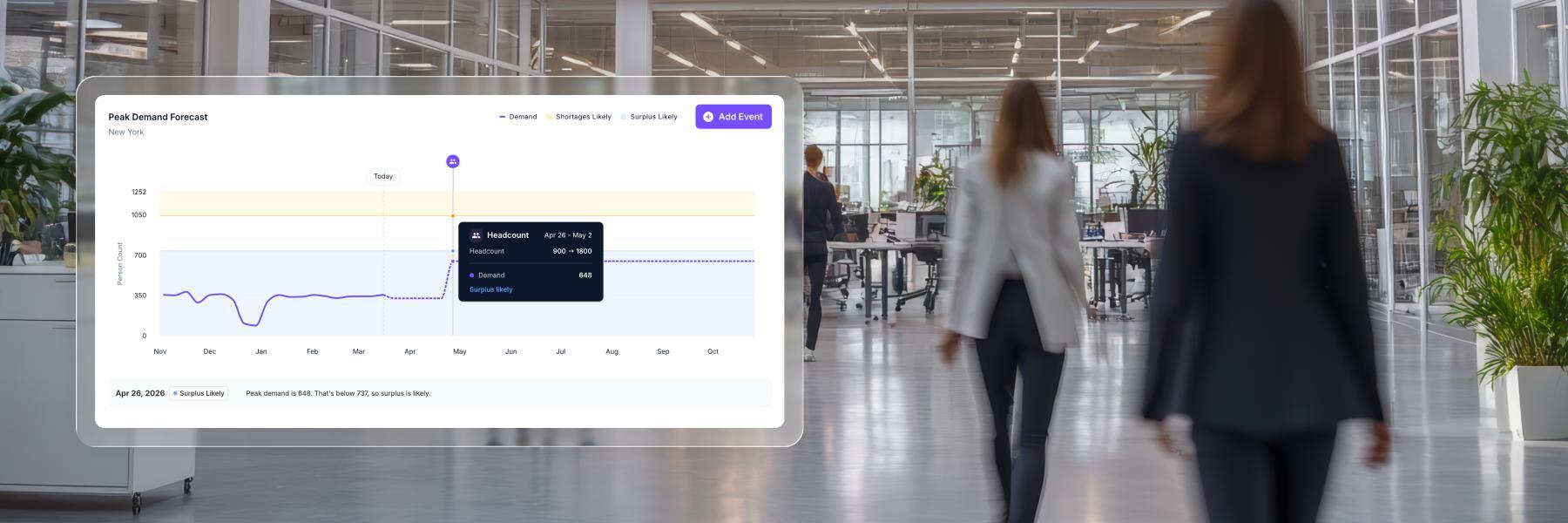
VergeSense Predictive Planning helps organizations understand how people will actually use space before changes are made.
Instead of relying on static ratios or historical averages, it models the interaction between workforce behavior, workplace design, and attendance patterns. This makes it possible to simulate how an office will perform under different scenarios, and to do so quickly enough to support real decision-making timelines.
With this approach, teams can:
- Test different lease reduction strategies
- Forecast future space demand
- Identify when space will reach its limits
- Compare options before committing to long-term leases
What was once a slow, manual process becomes a dynamic, iterative one.
The Bottom Line
Reducing lease costs is no longer just a matter of identifying underutilized space.
It requires a deeper understanding of how demand and supply come together in the workplace, how those dynamics shift over time, and where the real constraints exist beneath the surface.
The organizations that succeed will not be the ones that simply cut the most space. They will be the ones that approach these decisions with the most clarity.
Because in today’s workplace, the goal is not just to reduce costs.
It is to reduce costs with confidence.
Interested in learning how predictive planning can help you align supply, demand, and experience across your portfolio?
Connect with a VergeSense specialist to explore how data-driven workplace strategy can help you plan smarter in 2026 and beyond.
FAQ: Reducing Office Lease Costs
How can companies reduce office lease costs?
Companies can reduce office lease costs by analyzing utilization data, identifying underused space, and right-sizing their portfolio. More advanced teams use scenario modeling and predictive planning to forecast future demand and avoid overcorrecting.
How do you know if you have too much office space?
Signs include low utilization rates, underused desks, and large areas of space that remain empty even during peak days. However, it is important to evaluate whether certain space types are still in high demand before reducing overall square footage.
What is right-sizing in real estate?
Right-sizing is the process of aligning office space supply with actual employee demand. This includes adjusting square footage, rebalancing space types, and ensuring the workplace supports both efficiency and employee experience.
Why is it risky to cut office space too quickly?
Reducing space too aggressively can lead to overcrowding, lack of meeting rooms, and poor employee experience. Without modeling future demand, organizations risk making decisions that are difficult to reverse.