


Office space is one of your highest fixed costs, and most organizations are making decisions about it with incomplete data. Booking systems tell you what was reserved, but won’t tell you which floors are consistently underutilized, where you are about to hit capacity, or whether your space mix matches how teams actually work.
Choosing the right platform to support your space planning decisions comes down to a handful of decisions most buyers get wrong: prioritizing dashboards over predictive capabilities, underestimating data accuracy requirements, or picking a solution that can't scale across a multi-building portfolio.
This guide covers:
- What separates enterprise-grade platforms from basic reporting tools
- Key features and capabilities to evaluate before committing to a vendor
- Data accuracy, integration depth, and implementation requirements
- A comparison of leading solutions across the criteria that matter most
Trying to right-size your portfolio without reliable data?
VergeSense gives real estate leaders the predictive intelligence to model any scenario and make portfolio decisions in minutes, not months — backed by 200M+ sq ft of real occupancy behavior.
What Is Workplace Analytics Software and How Does It Work?
Workplace analytics software collects and analyzes data from sensors, booking systems, Wi-Fi networks, and badge readers, turning raw occupancy signals into insights that inform real estate and facilities decisions.
Where basic reporting tools show you historical utilization, enterprise-grade platforms answer the questions that drive portfolio strategy, such as:
- Which neighborhoods hit capacity at peak hours but sit empty by mid-afternoon?
- Are your collaboration spaces sized for how teams actually work?
- Where should you add desks versus meeting rooms before your next lease negotiation?
The best platforms forecast capacity constraints, model scenarios for different space configurations, and quantify the ROI of specific changes before you commit capital.
Key Features and Capabilities of Workplace Analytics Software
Workplace analytics platforms vary widely in what they can actually do. Before evaluating vendors, it helps to know which capability categories matter most for enterprise real estate decision-making.
- Predictive capacity planning and scenario modeling use AI trained on large occupancy datasets to forecast future demand and model "what-if" scenarios. This moves your team from reactive space management to proactive portfolio strategy.
- Real-time occupancy tracking and utilization analytics deliver live visibility into desk occupancy by hour, meeting room no-shows, and peak versus average demand by neighborhood.
- Multi-source data integration means not forcing a choice between sensor data, badge swipes, Wi-Fi signals, and booking systems. VergeSense, for example, offers native integrations with 50+ workplace systems, combining them into a single analytics layer.
- AI-powered recommendations turn utilization data into a decision queue rather than a dashboard you have to interpret yourself. Instead of reading charts, your team can see which floors to consolidate, where capacity breakpoints are emerging, and what the ROI looks like.
Leading workplace analytics platforms bring sensor data, insights from other workplace systems, and predictive planning into a single layer. The occupancy data behind real-time dashboards is the same data driving scenario models and portfolio recommendations.
How To Choose the Right Workplace Analytics Software
Organizations optimizing space mix need different capabilities than those forecasting capacity for headcount growth or building a business case for portfolio consolidation.
Once you've defined your primary use case, evaluate vendors across predictive planning, data quality, integration depth, sensor technology, measurement accuracy, and implementation requirements.
Predictive Planning Capabilities
Your tool selection should be able to give you confident answers to a wide range of “what-if” questions. Look for four core functions that translate workplace data into confident decisions about capacity, space mix, and portfolio right-sizing:
- Scenario modeling: Test "what-if" questions before committing capital or signing leases. For example, model the impact of converting 20% of open desks to collaboration zones, or forecast how a shift in attendance policy would change capacity needs across five buildings.
- Capacity analysis: Go beyond current headcount to forecast future needs based on hiring plans, team growth, and historical attendance patterns, identifying when and where you'll hit utilization breakpoints.
- Demand forecasting: Use historical occupancy trends and booking behavior to predict space needs weeks or months ahead.
- Employee risk modeling: Identify which teams, floors, or neighborhoods are most vulnerable to space shortages before booking conflicts become a recurring problem.
Real-Time Data and Analytics
Predictive analytics moves workplace analytics from historical reporting to proactive decisions. The practical applications include:
- Peak occupancy alerts: Notify facilities teams when neighborhoods approach capacity limits
- Live availability updates: Show which desks, rooms, and collaboration spaces are open right now
- Space booking automation: Flags no-show meetings within minutes and automatically releases rooms back into inventory
When evaluating solutions, ask two questions: what's the data refresh interval, and what's the measurement accuracy at that speed?
Platforms that update every 15-30 minutes are suitable for trend analysis but too slow for automatic room release or wayfinding. Those that refresh every 30-60 seconds enable real-time availability displays and automated booking workflows.
Accuracy matters as much as speed. Motion-based sensors can show a room as occupied for hours after a brief entry, inflating utilization metrics and triggering false capacity alerts.
Integration Capabilities and Ecosystem Compatibility
Your workplace analytics platform needs to connect with the systems you already use to manage space, employees, and operations. Before committing, verify that integrations are truly native rather than requiring middleware or custom development.
At a minimum, look for native integrations across three areas:
- Calendar and booking systems: Microsoft Outlook, Google Workspace, and leading space booking platforms
- Badge and access control: Entry and exit data that complements sensor occupancy readings
- IWMS and building management: Connects utilization data to your broader real estate and facilities infrastructure
VergeSense, for example, offers native integrations with 50+ workplace systems, combining sensor occupancy with calendar, badge, and lease records in a single analytics layer.
Sensor Technology and Data Collection Methods
The occupancy data collection method your platform relies on determines how accurate your utilization baseline is and how much you can trust the informed decisions you make from it. The three main sources each come with different tradeoffs:
- Sensors: The highest accuracy for passive space utilization measurement. For example, VergeSense's Infinity Area Sensor uses depth-sensing and machine learning to detect both active occupancy and passive signals like personal belongings, capturing utilization that booking systems and badge data miss entirely.
- Wi-Fi data: Provides building, floor, and neighborhood-level people counts with around 85% accuracy; a cost-effective way to extend coverage across a portfolio. It’s best as a complement to sensors, as it can't distinguish between spaces at the desk or room level.
- Badge and booking data: Captures entry and exit events and reservation patterns, but tells you nothing about which floors or desks employees actually use once inside. Ghost meetings and no-shows create systematic gaps in utilization reporting.
For enterprise real estate decisions, the platforms that deliver the most defensible data combine sensor-based detection with Wi-Fi, badge signals, and behavioral benchmarks, rather than relying on any single source.
Data Accuracy and Measurement Methodology
Bad occupancy data produces bad real estate decisions. The measurement methodology your platform uses determines how much you can trust your utilization baseline, and everything built on top of it.
- Motion-based detection: Triggers on movement, then times out after 15-30 minutes of inactivity. This systematically undercounts occupancy whenever someone sits still during a video call or works quietly in a focus room.
- Passive occupancy sensing: Detects presence rather than movement. VergeSense's Infinity Area Sensor uses depth-sensing and machine learning to identify occupancy based on visual signatures, not motion triggers, delivering accuracy above 95%.
- Aggregated data sources: Combining Wi-Fi, badge, and booking data improves coverage but introduces its own error rates. Wi-Fi can overcount devices, badge data misses desk-level behavior, and booking data reflects reservations rather than actual use.
When your utilization baseline has a 15-20% error due to motion timeouts or proxy data, every forecast and ROI calculation inherits that uncertainty.
Implementation Timeline and Support Requirements
Deploying workplace analytics software across an enterprise portfolio requires coordination across IT, facilities, real estate, and procurement. Most enterprise implementations follow three phases:
- Pilot deployment: 4-8 weeks to validate sensor accuracy, integration connections, and data quality before broader rollout
- Portfolio rollout: 3-6 months for most enterprise deployments, scaling to 6-9 months for global portfolios
- Ongoing optimization: Regular calibration of utilization thresholds and space mix assumptions as attendance patterns change
Rollout speed depends on standardized building infrastructure, pre-negotiated IT security approvals, and clear data governance policies. Training requirements are often underestimated: plan for onboarding across real estate, facilities, and finance teams since each audience uses the platform differently.
At scale, verify support for regional data residency requirements, role-based access controls, and API access for your existing IWMS.
Benefits and ROI of Implementing Workplace Analytics Software
When you identify consistently underutilized floors or neighborhoods, you can consolidate space, renegotiate leases, or sublease excess square footage. The 9th Edition of the Workplace Occupancy & Utilization Index includes benchmark data to help you model realistic scenarios for your own portfolio.
Beyond reducing total square footage, workplace analytics tools help you optimize your existing space mix to better support how your teams work:
- Converting underused private offices into collaboration zones where demand is higher
- Adding focus rooms where peak demand creates booking conflicts
- Reallocating meeting rooms based on actual occupancy rather than reservation patterns
For example, instead of debating whether 40% desk utilization is good enough, VergeSense's 200M+ square feet of benchmark data and Large Spatial Model allow you to play out scenarios based on proven outcomes.
Notable Workplace Analytics Software Solutions
The workplace analytics software market includes platforms with very different approaches to sensor technology, data accuracy, and predictive capabilities. The five solutions below cover the range most enterprise real estate and facilities teams will encounter during an all-in-one platform evaluation.
1. VergeSense
VergeSense combines AI-powered Predictive Planning with Occupancy Intelligence to help enterprises forecast space demand, model portfolio scenarios, and make confident real estate decisions. The platform unifies sensor, Wi-Fi, badge, and booking data into a single analytics layer.
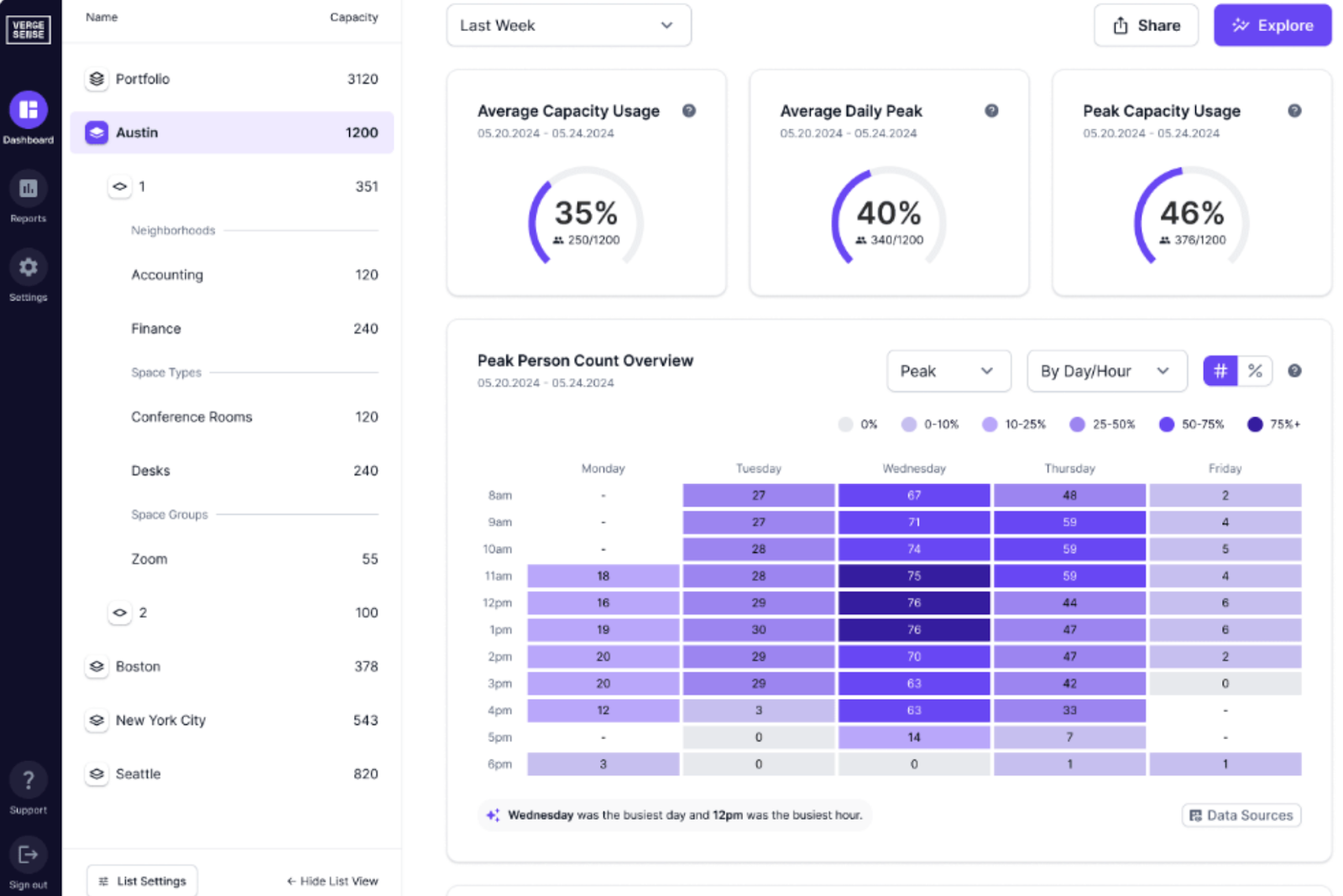
- Predictive scenario modeling: Model space mix, headcount, and policy scenarios to identify right-sizing opportunities before committing capital
- Powered by the Large Spatial Model: AI trained on 8+ years of occupancy data delivers demand forecasting, capacity analysis, and automated portfolio recommendations
- Infinity Area Sensor: Depth-sensing detection with on-device processing, 10-year battery life, and wired/wireless options. No video streaming, and no personal data sent to the cloud.
- Signs of Life™ passive occupancy detection: Captures active presence and passive indicators like personal items and laptops for accurate desk and room utilization measurement
- Space booking automation: Automatically releases no-show meeting rooms and updates live availability across 50+ workplace platforms
- Portfolio-wide benchmark comparisons: Compare your utilization metrics against industry peers using 200M+ sq. ft. of data — the largest single real-world workplace dataset
- Unified data layer: Consolidates sensor data, booking systems, badge access, and WiFi analytics into a single source of truth
- Native integrations with 50+ workplace systems: Connects to Microsoft 365, Google Workspace, ServiceNow, Archibus, and leading space booking platforms
Best for: Enterprise real estate and workplace teams managing multi-building portfolios who need predictive planning, AI-powered scenario modeling, and high-accuracy occupancy data to justify consolidation, lease decisions, and space mix optimization.
See how VergeSense unifies occupancy intelligence and predictive planning for confident real estate decisions
Request a demo
2. Density
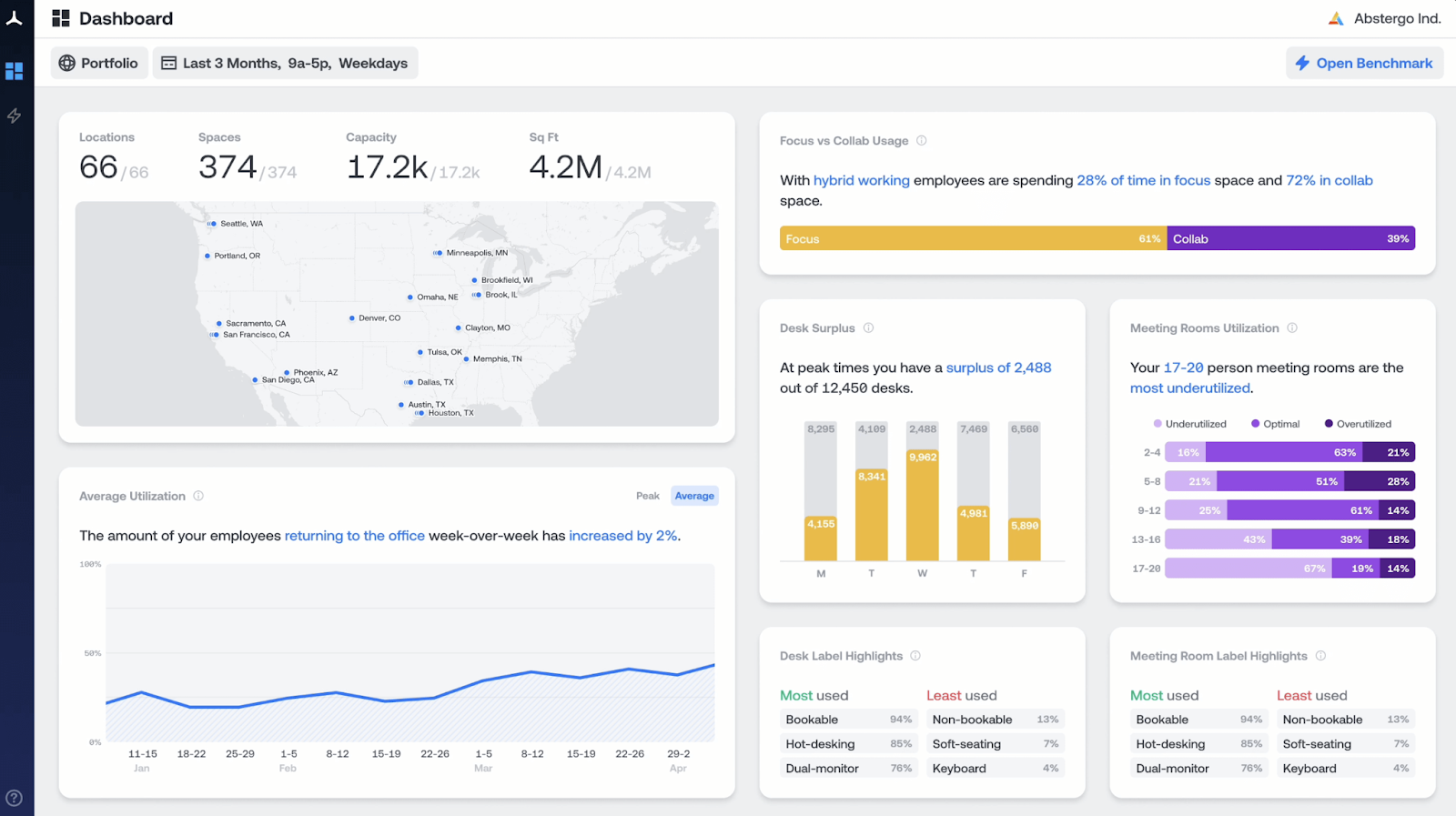
Density is a sensor-based occupancy analytics platform focused on real-time people counting and space utilization tracking for offices and commercial environments. It combines proprietary radar sensors with cloud analytics to help real estate and facilities teams measure actual space usage.
- Real-time occupancy sensors (Waffle): Self-installable, wired plug-in radar sensors anonymously count people in meeting rooms, phone booths, and flex spaces
- Atlas analytics dashboard: Tracks utilization metrics, including peak usage, critical mass, and operating hours, to identify underutilized spaces
- Live wayfinding and space availability: Real-time maps show available spaces with auto room release for no-show meetings
- Anonymous people counting: On-device machine learning processes data over standard PoE+ infrastructure without storing personal information
- RESTful API integrations: Connects with leading workplace experience and booking platforms for data flow into existing facilities management systems
Best for: Organizations prioritizing rapid deployment and real-time occupancy visibility, particularly those seeking self-installable sensors for meeting rooms and flex spaces.
3. XY Sense
XY Sense is a workplace intelligence platform combining privacy-first sensor technology with AI-powered analytics to help real estate and facilities teams measure desk and room utilization and make data-driven space planning decisions.
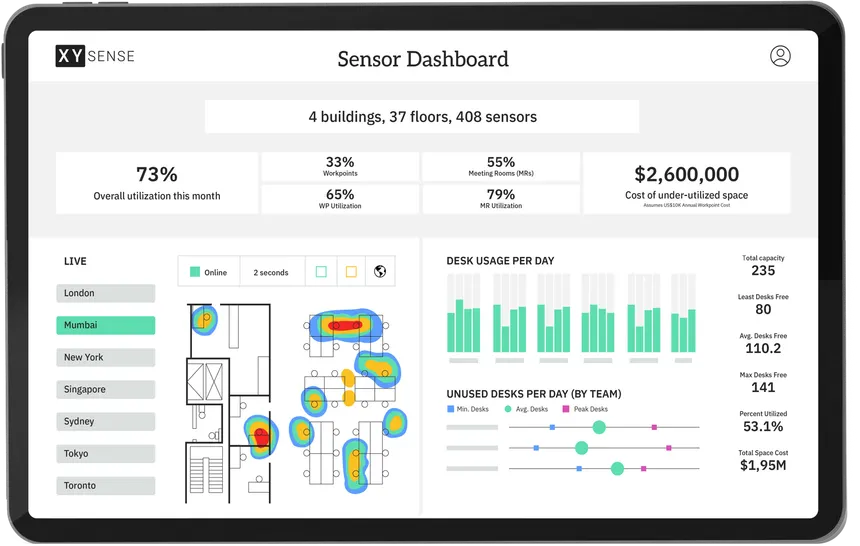
- XY Sense Insights Platform: Central analytics dashboard providing live and historical views of desk utilization, meeting room occupancy, and portfolio-wide trends with cost benchmarking tools
- High-precision area sensors: Machine learning-powered sensors with 1-foot accuracy track individual desk usage and movement patterns every 2 seconds
- Historical occupancy playback: Reviews movement and utilization patterns over time to support workspace redesign and expansion planning
- Privacy-first data collection: On-device processing captures granular occupancy metrics from global portfolios down to individual desks without storing personal data
- Portfolio-level benchmarking: Compares utilization rates and costs across multiple locations to identify optimization opportunities and standardize space planning decisions
Best for: Facilities teams requiring granular desk-level utilization data and movement analytics to support activity-based workplace design, particularly in environments transitioning from assigned seating to flexible arrangements. Pricing requires direct vendor contact.
4. OfficeSpace
OfficeSpace is a workplace management platform combining desk and room booking, space planning, and utilization analytics to help real estate and facilities teams manage hybrid work environment strategies and quantify real estate spend.
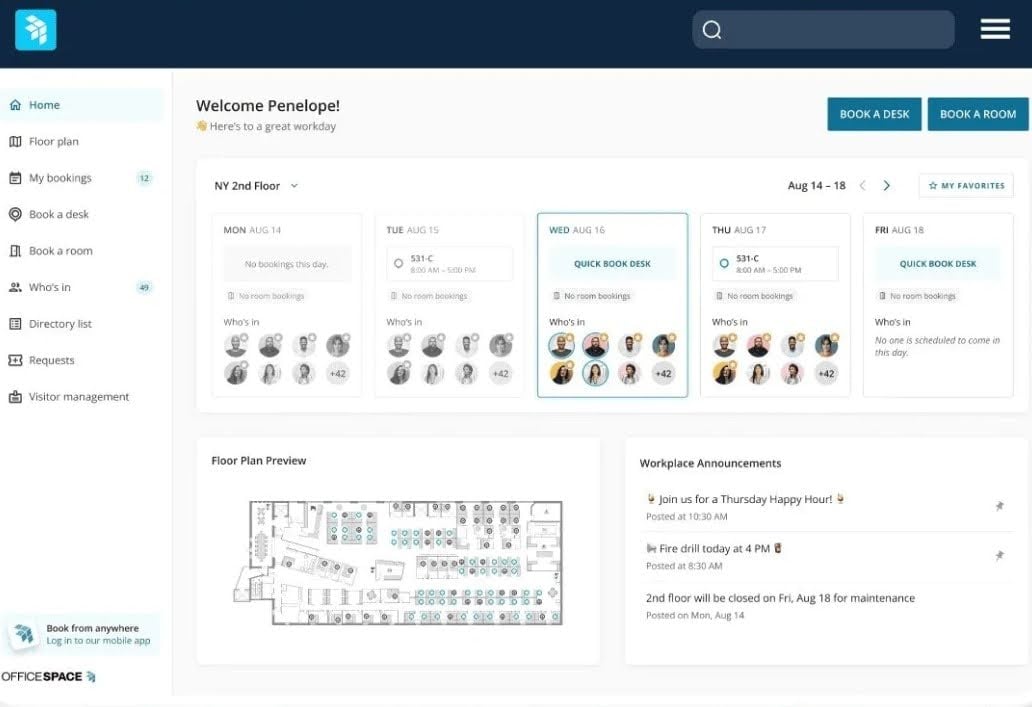
- Workplace intelligence analytics: Real-time dashboards, heat maps, and utilization reports pull data from Wi-Fi, badge systems, and sensors to surface occupancy patterns across your portfolio
- Cost analysis and forecasting: Expense breakdowns per seat, employee, or square foot, combined with hiring-based forecasting, help finance stakeholders model budget scenarios
- Desk and room booking trends: Tracks booking patterns against actual usage to surface no-show rates and low-utilization assets
- Space planning and move management: Visual floor plan tools support scenario modeling for reconfigurations before committing to physical changes
- Integration with workplace systems: Connects with calendar platforms, access control systems, and other workplace tools to unify booking, occupancy, and operational data
Best for: Mid-market to enterprise organizations managing hybrid workplace policies who need a combined booking and analytics platform, particularly teams prioritizing cost transparency and ROI reporting to finance stakeholders. Pricing requires direct vendor contact.
5. Eptura
Eptura is an Integrated Workplace Management System (IWMS) platform combining workplace management, space planning, and occupancy analytics to help large enterprises measure utilization, manage hybrid work, and improve real estate ROI across complex multi-site portfolios.
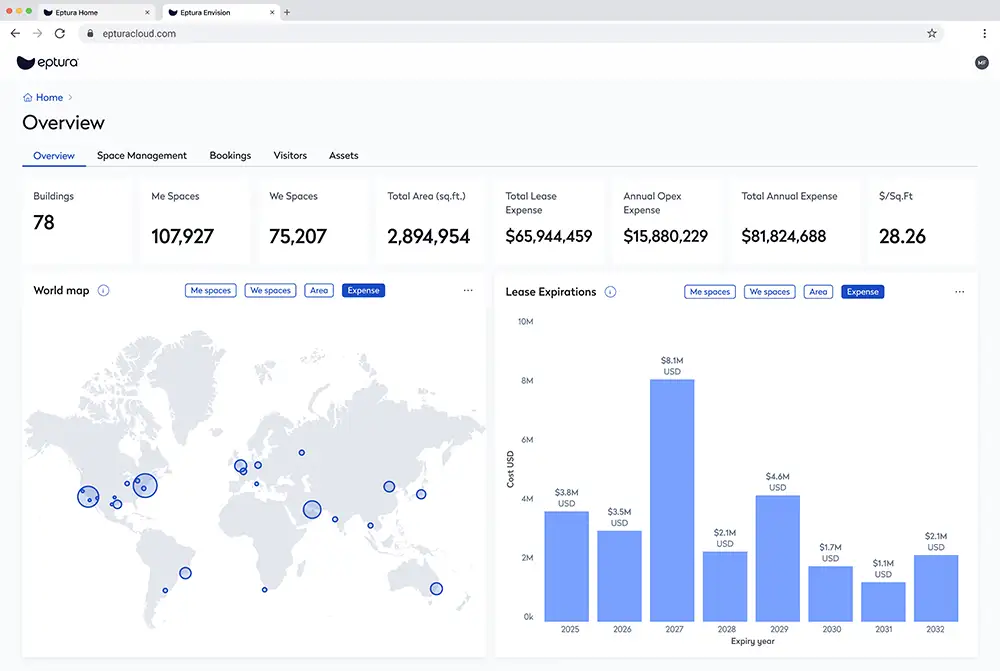
- Workplace analytics dashboards: Built-in dashboards and Power BI integration monitor real-time occupancy, peak usage, no-shows, and utilization trends for space optimization
- Real-time space booking and availability: Visibility into desk, room, and neighborhood availability with team booking capabilities and capacity limit enforcement
- Utilization reporting and insights: Generates reports on attendance patterns versus bookings and historical trends to identify high-demand areas and forecast space needs
- Integration ecosystem: Supports Outlook, Google Calendar, Power BI, Tableau, Looker, and Serraview for space planning, alongside sensor integrations for occupancy data
- Multi-site scalability: Designed for enterprise deployments across multiple buildings and regions, with role-based access controls and data governance tools for global portfolios
Best for: Large enterprises managing complex multi-site portfolios who need comprehensive workplace management beyond analytics alone, particularly organizations requiring unified visitor management, booking, and utilization measurement. Pricing requires custom quotes from sales.
Choosing the Best Workplace Analytics Software for Your Organization
The right platform unifies your data sources, delivers actionable insights rather than historical reports, and scales with your real estate strategy. This gives you clear benchmarks to track at 90 days, six months, and one year across utilization rates, cost savings, and decision speed.
Enterprise real estate teams need to be able to turn occupancy data into portfolio decisions, fast. VergeSense is the only platform that brings occupancy intelligence and AI-powered predictive planning together in one system, powered by the Large Spatial Model trained on 200M+ sq ft of real workplace behavior.
The result is scenario modeling in minutes, not months, with CFO-ready outputs grounded in how space is actually used.
Ready to see what your portfolio looks like with accurate occupancy data behind every decision?
VergeSense helps workplace and real estate leaders measure space usage, understand demand, and make confident portfolio decisions.