






How To Implement an Office Sensor Network for Measurable ROI
Your CFO wants to know how much space you actually need. Your facilities team is fielding complaints about rooms that are always booked but half-empty. And leadership is pushing for a consolidation decision before your lease expires in eight months.
The data you have (badge swipes, calendar holds, a headcount spreadsheet) doesn't answer any of those questions with enough confidence to act on.
That's the problem an office sensor network is designed to solve. Not just by adding sensors to rooms, but by connecting occupancy data, environmental monitoring, and building systems into a single analytics layer that gives you continuous, portfolio-wide visibility into how space is actually being used.
This guide covers how to plan, deploy, and measure ROI from an office sensor network, from sensor selection and integration to the business case metrics that hold up in a CFO review.
Unsure if an office sensor network is right for your portfolio?
See how VergeSense turns occupancy data from sensors, WiFi, and bookings into a single, accurate picture of space demand across your entire portfolio.
What Is an Office Sensor Network and How Does It Transform Workplace Management?
An office sensor network is a coordinated system of devices: occupancy sensors, environmental monitors, badge readers, and booking integrations. Together, they give you a continuous, accurate picture of how your space is actually being used across every floor, building, and market in your portfolio.
The emphasis is on "coordinated" and "continuous." Most workplace teams already have fragments of this data. The network turns fragments into a single source of truth. The payoff arrives when you connect that data to scenario modeling and demand forecasting.
For example: a financial services firm with 12 locations might find that collaboration spaces designed for groups are routinely occupied by one or two people, while employees looking for actual meeting space can't find a room. That gap could cost millions in wasted real estate and create daily friction across multiple teams.
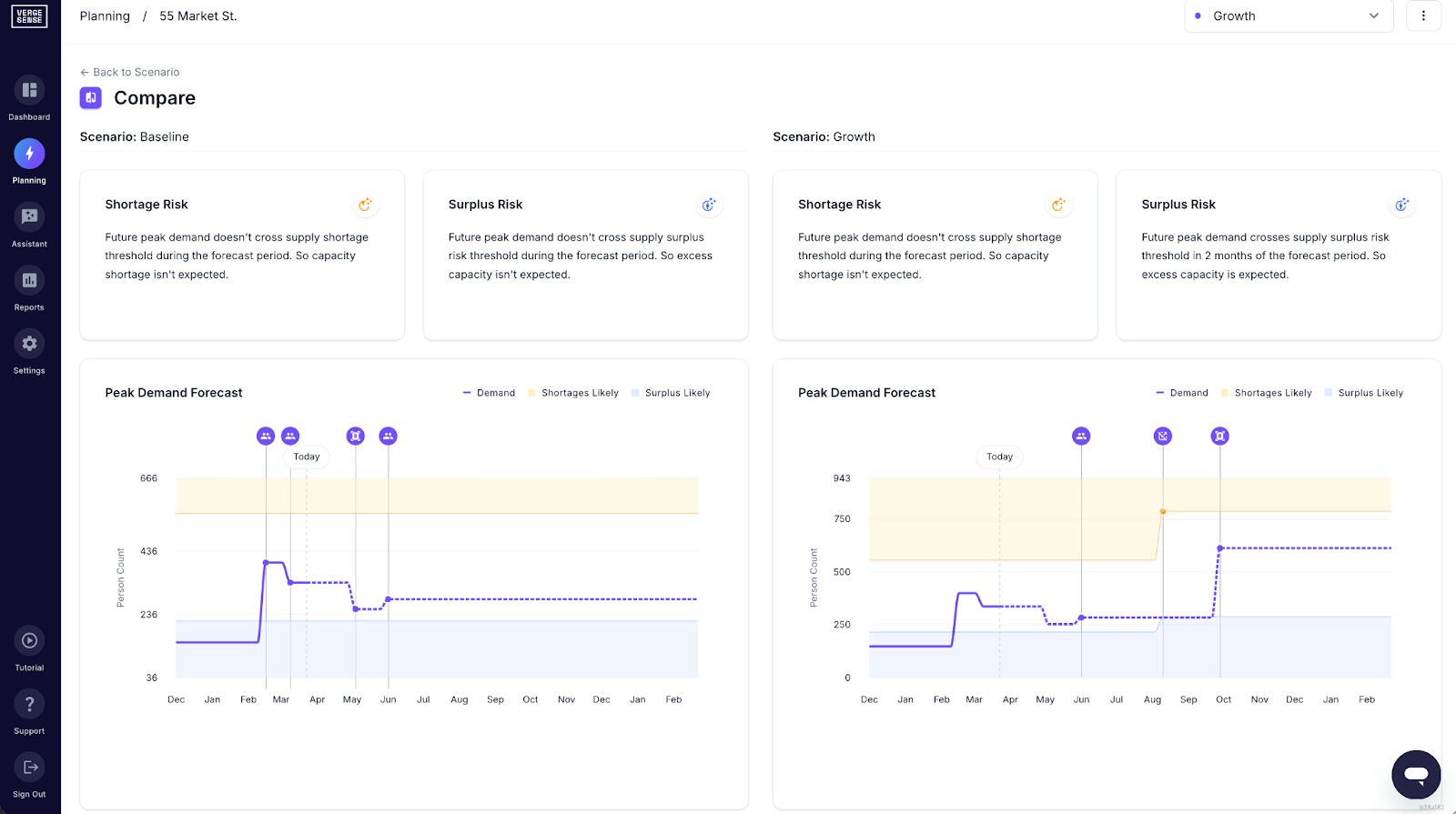
A sensor network helps address that issue, but the real value comes from what happens next. Connected to a workplace AI platform, that occupancy data feeds scenario modeling and demand forecasting, so when you walk into a lease renewal or a consolidation discussion, you can confidently present a defensible business case.
Essential Types of Office Sensors for Comprehensive Workplace Monitoring
Here’s what a well-designed office sensor network should include so you can make the best-informed workplace decisions, and what each category does for facility managers and workplace teams.
Occupancy and Space Utilization Sensors
Occupancy sensors are the foundation of workplace intelligence. Modern devices measure more than motion. They provide people counting, dwell time, and usage patterns across workstations, meeting rooms, and floors.
That data answers the questions that drive right-sizing decisions: which conference rooms sit empty at peak hours, where collaboration zones are actually being used, and where capacity bottlenecks are pushing teams into overflow space.
For example, VergeSense's Infinity Area Sensor detects passive occupancy by identifying spaces claimed by bags, jackets, or laptops—not just people actively seated. It requires no badge swipes, desk bookings, or behavior changes from employees.
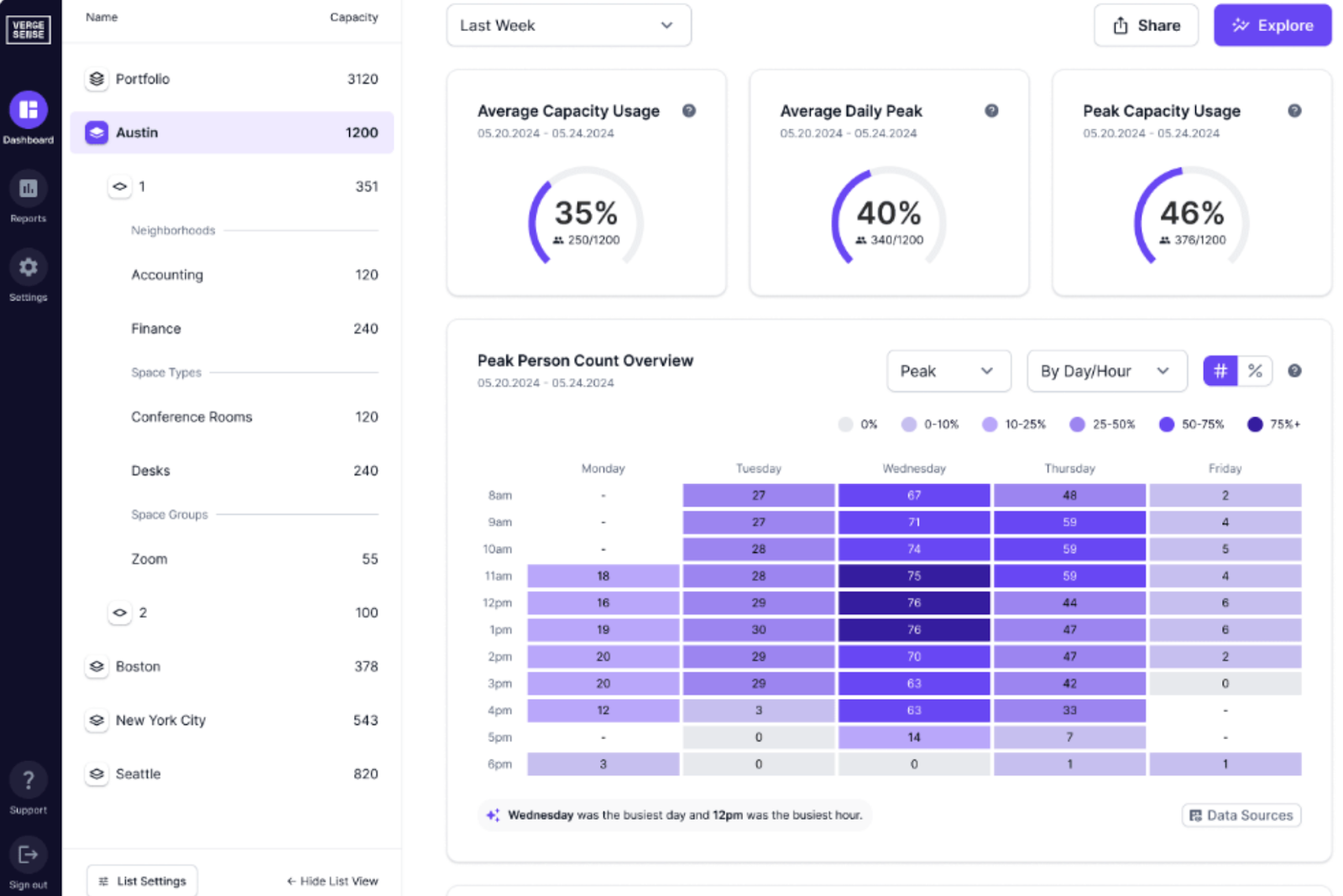
Instead of guessing whether a 12-person conference room should become two focus rooms, you see occupancy curves: peak counts, average capacity usage, and usage by time of day.
Environmental Quality and Operational Sensors
Beyond occupancy, a sensor network should monitor the conditions that affect employee well-being and facilities costs.
Temperature, humidity, air quality (CO2, VOCs), light levels, and noise sensors give you visibility into what people actually experience across your portfolio.
This data surfaces comfort issues before they become complaints. It also gives facilities teams what they need to run HVAC systems and ventilation based on actual demand rather than fixed schedules.
The result is lower energy consumption, fewer service tickets, and proof that spaces meet indoor air quality standards.
Integration-Ready Sensors for Unified Analytics
The value of a sensor network comes from how the data connects, not just what individual devices measure.
Integration-ready sensors are built for enterprise technology stacks, feeding real-time data into unified analytics platforms rather than operating as standalone devices.
When evaluating sensors, prioritize open APIs, Ethernet and wireless connectivity, pre-built connectors, and long battery life. Battery-powered sensors that run for months without replacement reduce installation disruption and simplify ongoing maintenance as your workplace design strategy evolves.
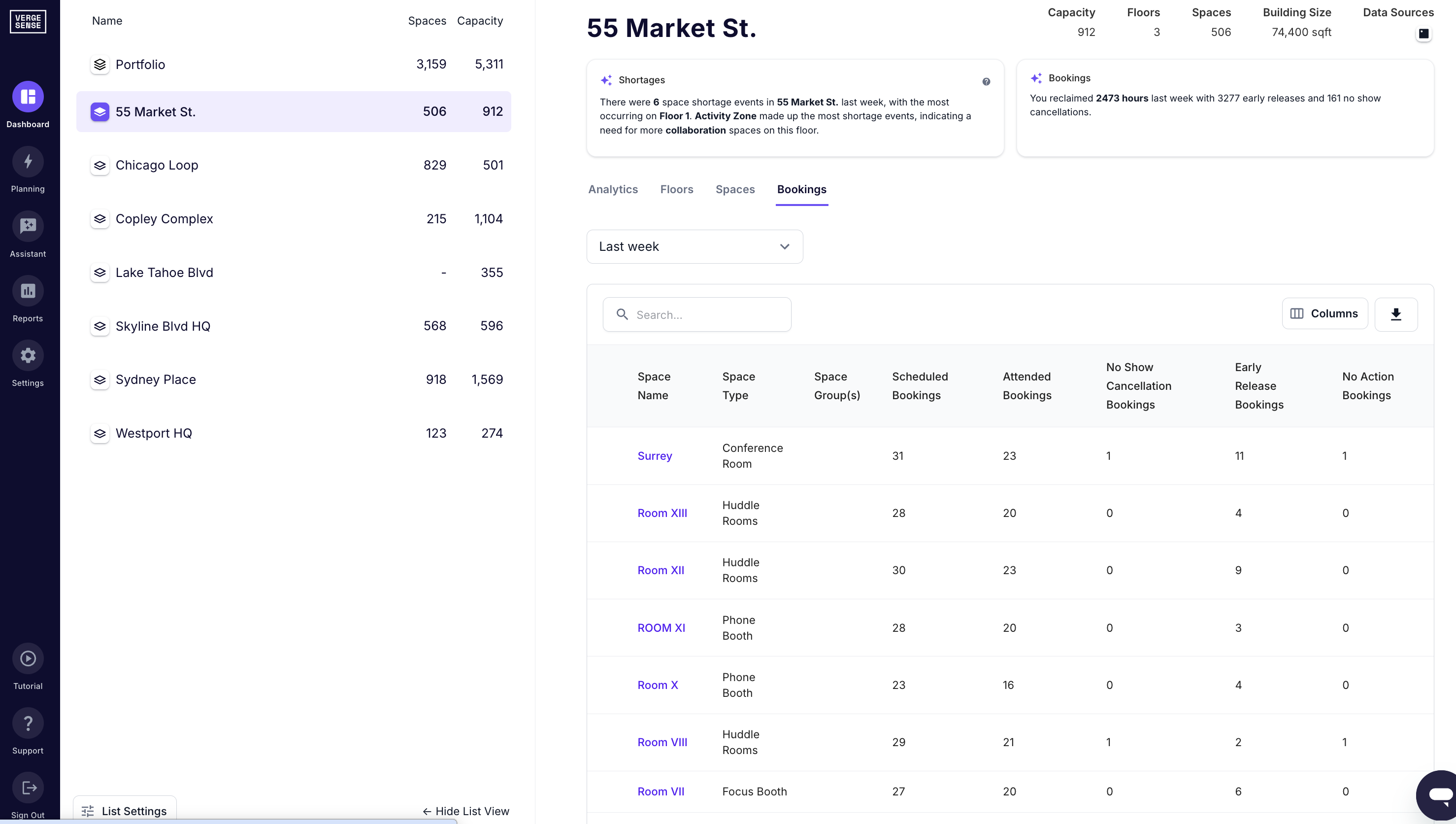
VergeSense, for example, pulls together data from occupancy sensors, booking calendars, and Wi-Fi signals into a single dashboard, letting you:
- See demand patterns across buildings
- Flag neighborhoods that are consistently overbooked or underused
- Identify where your portfolio has room to consolidate
How To Implement an Office Sensor Network: Planning and Deployment Strategy
A successful deployment is about building measurement infrastructure that scales across your portfolio. The following three steps cover what to do before sensors go up, how to evaluate hardware and platforms, and what to expect during installation and rollout.
1. Conducting Pre-Installation Assessment and Requirements Planning
Start with a space audit that documents every area you plan to monitor, categorizing spaces by type, current capacity, booking patterns, and utilization observations from facilities teams.
Define your use cases and success metrics. Are you trying to:
- Identify underutilized conference rooms to convert into focus spaces?
- Validate whether your desk-sharing ratio matches actual demand?
- Optimize cleaning schedules based on real-time occupancy?
From there, map your integration requirements across existing systems: your building management system, HVAC controls, room booking platforms, badge access, and workplace analytics tools.
2. Selecting Compatible Hardware and Integration Platforms
Evaluate sensor hardware against three criteria: measurement accuracy for your use cases (occupancy sensors should distinguish one person from five, not just detect motion), power and connectivity requirements, and integration architecture.
Your selected platform should:
- Aggregate multiple sensor types into a single dashboard and collect data from all your sources
- Connect via API to building management systems and IWMS
- Support consistent data models across buildings
- Enable scenario modeling before you commit capital to a project
3. Managing Installation, Testing, and System Optimization
Enterprise deployments typically follow a phased approach: pilot on one or two floors, validate data quality and integration workflows, then roll out across remaining buildings. Expect two to four weeks for the pilot, one to two weeks for testing and calibration, and four to 12 weeks for full deployment, depending on portfolio size.
Spot-check sensor counts against manual observations during peak and off-peak periods. Accuracy should consistently exceed 95%. Plan for ongoing optimization in the first 30 to 60 days to catch any placement issues, then move to quarterly data quality reviews from there.
Measuring ROI and Performance Impact of Office Sensor Networks
Building a business case means connecting office occupancy data to financial outcomes your CFO will recognize. This section covers the three areas where sensor networks deliver measurable returns, and the metrics to track once you’re deployed.
- Real estate cost savings deliver the most immediate impact. One biotechnology company avoided $13M in annual expansion costs after VergeSense data revealed that spaces at its San Francisco headquarters weren't truly underused. They were passively occupied by bags and personal items rather than employees.
- Operational efficiency shows up in facilities budgets when sensor data feeds into BMS (building management systems), shifting cleaning and HVAC schedules from fixed routines to demand-based automation.
- Employee experience improvements are harder to quantify but increasingly important for retention. Accurate room availability, better space mix decisions, and capacity management that prevents overcrowding all contribute to workplace satisfaction.
Once deployed, track these metrics to understand the impact of your sensor network over time:
- Cost per square foot before and after optimization
- Percentage of underutilized space identified and recaptured
- Operational cost reductions in facilities services
- Employee satisfaction scores tied to space availability and comfort
The business case strengthens further when you connect sensor data to predictive planning, forecasting future space needs, and modeling scenarios before committing to lease renewals or expansions.
Benefits of Wireless Sensors
Wireless sensors give workplace leaders the flexibility to measure and optimize operations across a portfolio without rewiring buildings. The sections below cover installation impact, sustainable space management, and how occupancy data connects to the building systems you already run.
You Can Add Them To Established Offices With Minimal Disruption
Battery-powered sensors mount in minutes using adhesive backing or ceiling clips, with no electricians, permits, or disruption to occupied spaces. Most enterprise deployments complete floor-by-floor rollouts during normal business hours, with sensors live within days.
For facilities teams, that speed translates directly to faster time-to-insight. You're collecting occupancy data within weeks of identifying a capacity question, not waiting months for construction windows or budget cycles. That matters when you're evaluating:
- Lease renewals
- Post-merger consolidations
- Shifting work patterns that affect your real estate footprint
Sustainable Space Optimization Without Construction
When utilization data shows you're carrying more space than your workforce needs, traditional space reduction means buildout costs and months of disruption. An office sensor network changes that.
You optimize through data-driven reallocation: converting underused conference wings into collaboration zones, consolidating teams onto fewer floors, or subleasing buildings based on verified occupancy patterns. This approach also reduces your carbon footprint by eliminating the carbon impact of avoided construction.
The impact adds up quickly at portfolio scale. For example, when a global food manufacturer faced a CFO-driven cost-savings mandate, VergeSense data revealed their Chicago HQ was running at just 5% average capacity.
That gave them the confidence to reduce their operating footprint by 75% by exiting and subleasing space they could prove they didn't need, avoiding $715K in annual occupancy costs.
Connect Occupancy Data With Building and Workplace Systems
The operational value of an office sensor network grows when occupancy data flows into the systems that run your building:
- Building management systems: A conference floor running at 10% average capacity doesn't need full HVAC conditioning all day. Demand-based scheduling means you're only conditioning space when people are actually in it.
- Room and desk booking systems: When sensors detect a reserved room is still empty 15 minutes after the scheduled start time, the space releases back into inventory automatically, eliminating phantom bookings. This also supports hot desking and flexible seating strategies.
- Cleaning and maintenance workflows: A global financial services firm integrated VergeSense with its building operations platform to align cleaning schedules with actual occupancy, eliminating cleaning of unused spaces entirely. The result was a 50% reduction in cleaning costs, totaling $2M in annual savings.
Building Your Office Sensor Network Strategy for Long-Term Success
A sensor network is most valuable as a framework for continuous space management, not a one-time deployment. Start with high-priority buildings or floors where you have the most pressing capacity questions, then expand systematically.
As you grow the network, establish clear governance: who reviews utilization dashboards, what thresholds trigger a space redesign conversation, and how occupancy data feeds into annual real estate planning.
That's where the sensor network becomes a planning system rather than just a reporting tool. In the case of VergeSense, you can connect occupancy data to scenario modeling and demand forecasting, so the thresholds you set in governance trigger something actionable: whether that's a space redesign, a capacity forecast, or a consolidation that defers a lease renewal.
How much do you trust your occupancy data?
See how VergeSense customers use Predictive Planning to reduce costs, improve the workplace experience, and build a defensible business case.
FAQs About Office Sensor Networks
What types of sensors are used in an office sensor network?
Most workplace occupancy sensors fall into three categories. Occupancy sensors measure people counting, dwell time, and space usage patterns. Environmental sensors track temperature, air quality, and humidity. Integration-ready solutions connect with your existing workplace technology stack.
VergeSense's Infinity Area Sensor goes beyond basic motion detection to capture granular utilization data without requiring badge swipes or employee interaction.
How do office sensor networks improve workplace management?
An office sensor network gives you continuous visibility into how spaces are actually used: peak occupancy times, utilization rates, and demand patterns across floors and buildings. That data drives decisions about space mix, cleaning schedules, and HVAC optimization. The result is measurable cost savings from carrying less space than you need.
Are office sensor networks difficult to install?
Wireless sensors require no construction, cabling, or IT infrastructure changes. They mount using adhesive backing or ceiling clips and connect via existing Wi-Fi. For enterprise deployments, expect a phased rollout covering assessment, installation, and testing. Most organizations have their network fully operational within 4 to 8 weeks from kickoff.
How do companies measure the ROI of an office sensor network?
ROI typically comes from three areas: real estate cost savings from reclaiming underutilized space, energy efficiency gains from demand-based cleaning and HVAC schedules, and employee experience improvements tied to space availability.
VergeSense customers track square footage per employee, utilization rates by space type, and cost-effective space metrics like cost per usable desk to build the business case.