



Workplace Trends 2026: Peaks, Shortages, and Strategy
According to VergeSense's Occupancy Intelligence Index, average capacity usage across enterprise portfolios sits around 10%. That means most enterprise spaces sit empty most of the time. Organizations are paying for space that isn't earning its keep.
But cutting space isn't straightforward, because peak demand is concentrated. Specific spaces like enclosed collaboration rooms and focus areas run short midweek and mid-day, even when the floor looks quiet overall.
That tension between chronic underuse and concentrated peak demand is at the heart of workplace strategy in 2026. The question is no longer "Do we have enough space?" It's "How do we right-size for real demand without creating crunch at the moments that matter most?"
In this overview of workplace performance in 2026, we'll use our research across 200 million square feet of real workplace behavior and 250,000+ spaces to break down:
- Four practical lessons for space planning and workplace strategy
- How North America, APAC, and EMEA differ in peak intensity and utilization
- Why predictive planning is replacing hindsight reporting in space strategy
- How space design creates friction even when overall occupancy looks fine
Ready to see where your workplace stands?
Learn how these patterns show up across regions, industries, and space types, and what they mean for your portfolio decisions — with our latest report.
Explore the 9th Edition of the Workplace Occupancy & Utilization Index
What Workplace Trends Are Shaping Offices In 2026?
The patterns that define workplace performance in 2026 aren't new, but they're becoming harder to ignore as real estate pressure mounts.
Compounding that pressure is the fact that peaks are predictable in their timing but unpredictable in their intensity, and space types that look fine on a utilization report can still fail employees during the hours they need them most.
The organizations that manage this well aren't the ones with the most space, but the ones that understand where and when demand concentrates.
At-A-Glance: What The Data Says
Here's what emerges from the 8th edition Index data:
- Averages stay relatively low (9–11%), but peak capacity usage rises to 52–60%, and average daily peaks hit 19–23%. The office is shaped by surges in demand, not a steady average.
- Shortages (hours when a space type is 80%+ occupied) are the practical "office feels full" trigger. When the right space becomes harder to find, friction shows up before the utilization numbers catch up.
- Shortages follow a consistent rhythm: they peak midweek and mid-day, with the sharpest pressure between 10 a.m. and 3 p.m. and especially high strain around 2 p.m.
Not all "busy" is the same. Some space types stay highly occupied without frequent shortages, while others experience shortages despite low average occupancy. Utilization alone misses the problem.
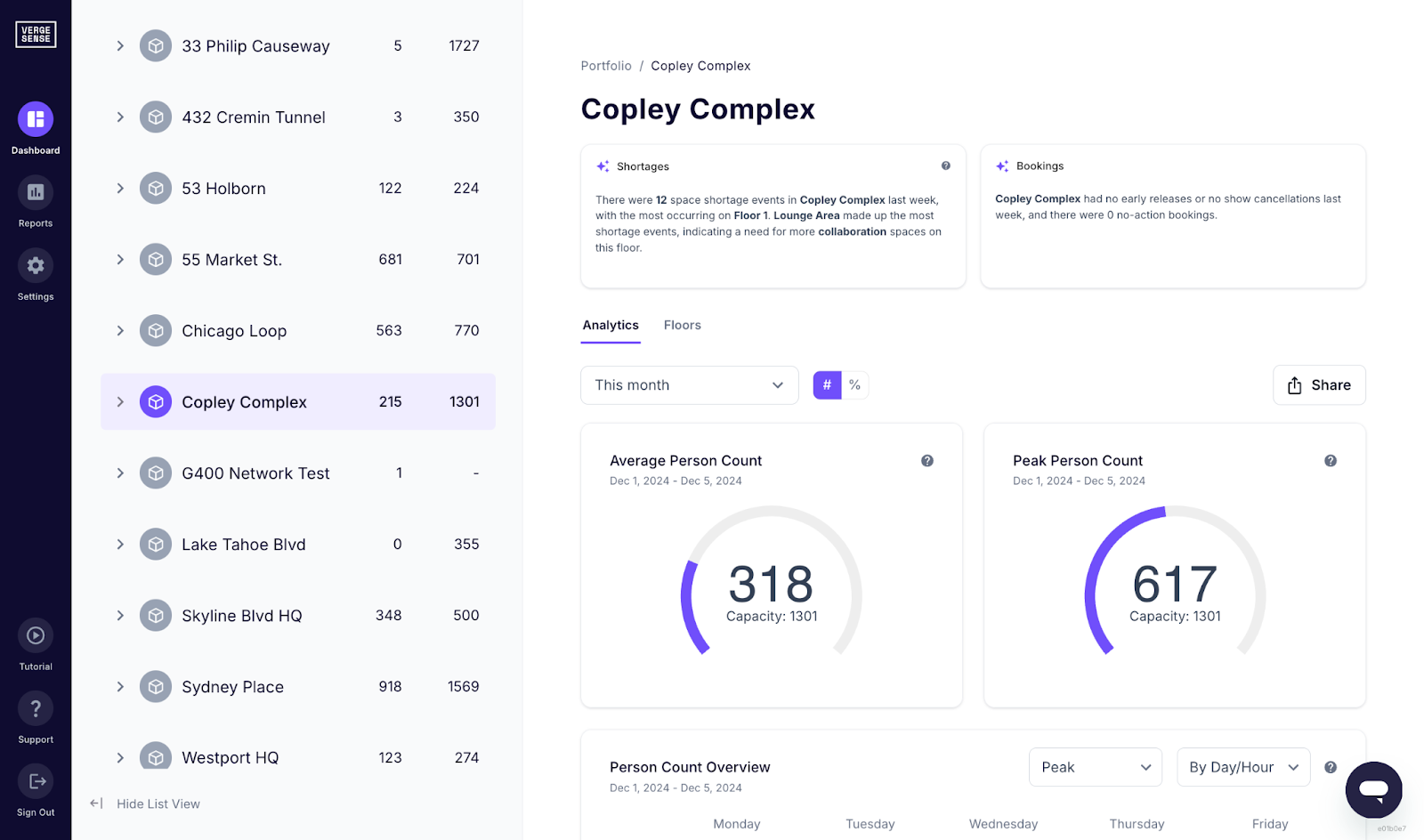
North American Workplace Trends: Lower Regional Peaks, Same Need to Plan for Surges
AMER maintains the lowest average daily peak of any global region, ranging roughly 15–20%. That figure can make North American portfolios look comfortably underutilized, but it obscures what's happening during peak windows.
Even at a 15–20% average daily peak, specific hours push certain space types to capacity. Midweek, between 10 a.m. and 3 p.m., is when pressure concentrates. That's the experience employees are actually having when they come in.
North American workplace strategy needs to account for those windows rather than planning around monthly averages, which smooth out the moments that matter most.
APAC Workplace Trends: Higher Peaks and Late-Day Pressure Windows
APAC shows the highest average daily peak of any region, ranging 22–29%, a meaningfully higher baseline than AMER or EMEA. But the more distinctive pattern is timing.
The 7th edition data shows a sharp afternoon shortage spike between 2–3 p.m., where APAC experiences an average shortage rate of 11% in enclosed collaboration and focus spaces. That late-day pressure window doesn't appear with the same intensity in other regions.
For APAC space planning, that means two things: sizing for higher overall peak intensity, and modeling specifically for the 2–3 p.m. window rather than treating the day as uniform.
EMEA Workplace Trends: Variable Peaks + Universal Midday Shortage Window
EMEA sits between AMER and APAC in peak intensity, with average daily peaks ranging 18–25% across the region. That spread reflects genuine variation in how offices are used across Europe, the Middle East, and Africa. Markets at the lower end of the range face different planning challenges than those at the upper end.
What EMEA shares with every other region is the midday shortage window. Between 10 a.m. and 3 p.m., shortage events concentrate in enclosed collaboration and focus spaces regardless of where a specific market falls within the regional range.
That timing pattern is consistent even when intensity varies, which means space strategy should be built around that shared pressure window first, then calibrated for local demand levels, whether that means adjusting desk ratios, space mix, or neighborhood sizing.
Technology and AI Workplace Trends: From Hindsight Reporting to Forward-Looking Planning
Most space planning still works backwards. Utilization reports describe what happened last month. Badge data confirms who came in. Booking logs show what was reserved.
None of it tells you where friction will concentrate next week or whether a proposed layout change will make things better or worse.
The shift toward predictive planning is already underway. Occupancy data is increasingly being used not just to report on past usage but to model future demand, identifying where friction will concentrate before it shows up in employee complaints or utilization reports.
That’s the direction workplace technology is moving, from dashboards that describe the past to tools that model what’s coming, including:
- Which space types will be in demand
- Where layouts won’t match actual behavior
- Which areas risk bottlenecks
This visibility lets you intervene before friction degrades experience. That capability matters most during periods of change: office redesigns, headcount shifts, return-to-office policy updates, or seasonal demand swings.
Predictive Tools That Model Friction Before It Happens
Scenario modeling, where you test proposed changes against real occupancy patterns before implementing or proposing them, is the practical application of predictive planning.
Instead of discovering that a reconfiguration created new bottlenecks after the fact, you can identify the problem in the model and adjust before anything is built.
For example, VergeSense's Predictive Planning lets you test how a proposed floor plan change will perform under real attendance patterns. You can compare scenarios side by side, like reducing desk density on a low-attendance floor or converting open collaboration space into enclosed focus rooms, before committing to any physical changes.
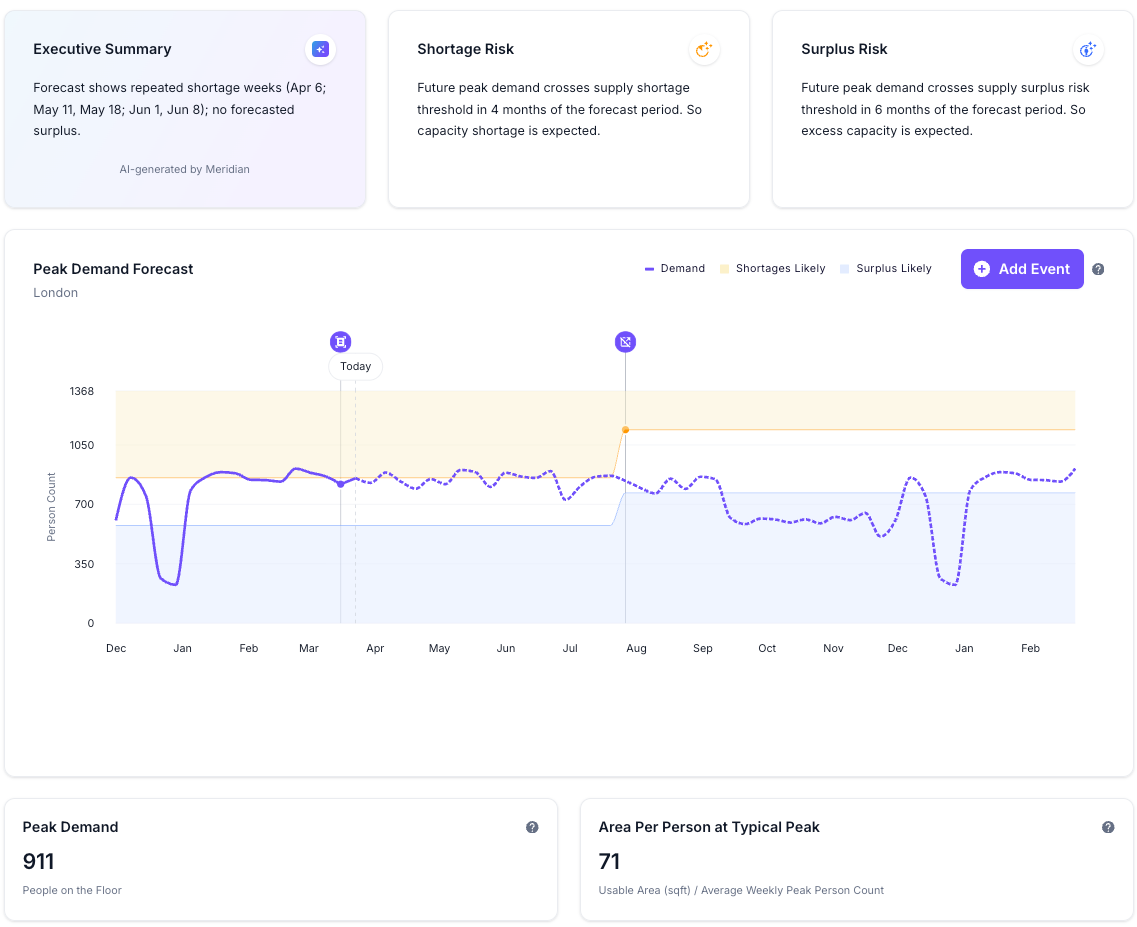
Occupancy Intelligence Platforms
The measurement gap matters as much as the planning gap. Badge data tells you who entered the building. Booking systems tell you what was reserved. Neither tells you whether a desk was actually used, or whether it was simply claimed by a bag while its owner spent the day in meetings.
This distinction between active and passive occupancy is where modern occupancy intelligence platforms go beyond traditional data sources.
Active occupancy means a person is present and using the space. Passive occupancy means the space is claimed but not in use, such as a desk blocked by personal belongings or a room that is booked but empty. Both states affect availability. Only one reflects genuine demand.
Tracking both gives a materially different picture of how space is actually performing and where the real constraints are.
Space Design Trends: The Office Feels Full Before It Is
When employees say the office feels crowded or hard to work in, they're usually describing a shortage of the right kind of space at the right time, not an overall capacity problem. That distinction matters for how you respond to it.
Two factors drive it:
- How consistently space types are defined and measured across a portfolio
- Whether the mix of spaces actually matches how employees use them
Dynamic Workplaces
One structural challenge in space design is inconsistent classification. Space types vary widely from organization to organization. One team’s “huddle room” is another’s “small meeting space,” making cross-portfolio benchmarking unreliable and the patterns that should inform design decisions harder to read.
Standardizing how space types are defined is what makes shortage signals comparable across locations and over time. When you're looking at enclosed collaboration shortage rates across a portfolio, you need confidence that you're measuring equivalent spaces. Without that consistency, the numbers can point in the wrong direction.
Individual vs. Collaborative
The relationship between utilization and shortage isn't linear. Between 10 a.m. and 3 p.m., the mismatch between space type supply and actual demand becomes most visible.
Open collaboration spaces (like meeting rooms and team areas) can show low average occupied capacity yet generate high shortage rates. They're rarely full on average, but when demand spikes, they run out fast.
Meanwhile, open focus spaces (individual desks and workstations) show the opposite pattern: high occupancy throughout the day, but lower shortage rates because supply is better matched to demand.
A portfolio heavy on open focus and light on enclosed collaboration will hit shortage conditions during midweek peak hours, even when overall utilization numbers look reasonable. This means employees can't find the spaces they need when most people are in the office.
Employee Experience Workplace Trends: Friction Concentrates in Specific Moments
Averages obscure the moments when the workplace actually breaks. Sharp spikes, tight windows, and space-type constraints create friction that employees feel intensely, even when overall utilization looks fine. The office experience is defined by its worst moments, not its average state.
Shortages are the turning point. When a space type hits 80%+ occupancy, meetings get delayed, and the office feels full even when it's not. That's a shortage event, and though it doesn't show up in average utilization, it can be an issue for employees that gets reported.
Focus, Privacy, and Control
Not all shortage friction lands the same way. When an open collaboration space runs short, employees can usually find somewhere else to land. When enclosed focus rooms run short, there's no real substitute. Concentrated work and private conversations don't transfer easily to a busy open floor.
The data bears this out. Enclosed focus rooms average 77% occupied capacity despite making up just 8% of total floorspace.
They're running close to their limits most of the time, which means when demand spikes, employees feel it immediately. That's typically when the office stops feeling like it's worth the commute.
Measuring Workplace Experience Through Space Usage
A space that's heavily used but rarely in shortage is performing well. A space that's lightly used but frequently in shortage has a supply problem that average metrics will never surface.
Pairing usage patterns with shortage signals gives a more accurate picture of where experience is holding up and where it’s breaking down. This is the difference between managing space reactively and understanding it well enough to get ahead of the problems.
Key Workplace Trends: Lessons for Workplace Leaders
Here are the four practical lessons for space planning and workplace strategy in 2026, designed to help business leaders and HR leaders drive positive workforce trends:
- Plan around peaks, not averages. A 9–11% average capacity usage figure gives little guidance for Tuesday at 2 p.m., when enclosed collaboration rooms are running short. The peak numbers, and when they hit, are what your space strategy needs to be built around.
- Track shortage rates alongside utilization. A space can look fine in a monthly report while failing employees for two hours every Wednesday. Shortage signals reveal where the workplace is actually breaking down.
- Standardize how you classify space. Cross-portfolio benchmarking only works if you're comparing equivalent space types. Without consistent definitions, the patterns that should inform design decisions stay hidden.
- Move from reporting to modeling. Historical data tells you what happened. The organizations getting ahead of friction are the ones using occupancy data to model what’s likely to happen next, before a redesign, a lease renewal, or a policy change forces the issue.
The 2025 Occupancy Intelligence Index puts all of this data in one place: regional breakdowns, industry-specific rhythms, space-type shortage patterns, and the benchmarks you need for confident portfolio decisions.
For our very latest findings:
Download the 9th Edition of the Workplace Occupancy & Utilization Index to see where your workplace stands and what to do about it.