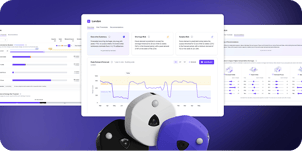

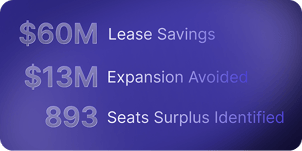



CRE and workplace teams are under pressure to right-size portfolios, defend lease decisions, and model hybrid policy changes that can stand up to a finance review. are increasingly turning to a new wave of AI-driven planning tools. VergeSense and Trebellar both target that buyer, but they're built on fundamentally different foundations.
VergeSense combines occupancy measurement with Predictive Planning in one platform, giving teams the data and decision layer needed to optimize their portfolios. Forecasts run on the Large Spatial Model, a foundational AI model trained on more than 200 million square feet of behavioral data across 200+ enterprises.
Trebellar is an emerging AI analytics and planning tool for corporate real estate teams. It focuses on scenario modeling and decision support, with AI models that train per customer on whatever data the customer can supply from existing systems.
VergeSense vs Trebellar at a glance:
|
VergeSense |
Trebellar |
|
|
Data collection |
Purpose-built sensors + WiFi, badge, booking integrations |
Customer-supplied data from existing systems |
|
AI model |
Large Spatial Model trained on 200M+ sq ft across 200+ enterprises |
Per-customer ML models trained only on your data |
|
Post-implementation |
Sensors validate outcomes after changes |
Requires separate instrumentation and data feeds |
|
Time to first plan |
Weeks, with any data inputs you have |
Dependent on your existing data infrastructure |
Ready to see how AI-powered planning drives better space decisions?
See how VergeSense combines occupancy intelligence with predictive planning.
Get a Demo →
Understanding VergeSense and Trebellar: Platform Foundations
VergeSense and Trebellar take different starting points to space planning. Here's how each platform is built and what that means for your team.
VergeSense: Occupancy Intelligence and Predictive Planning
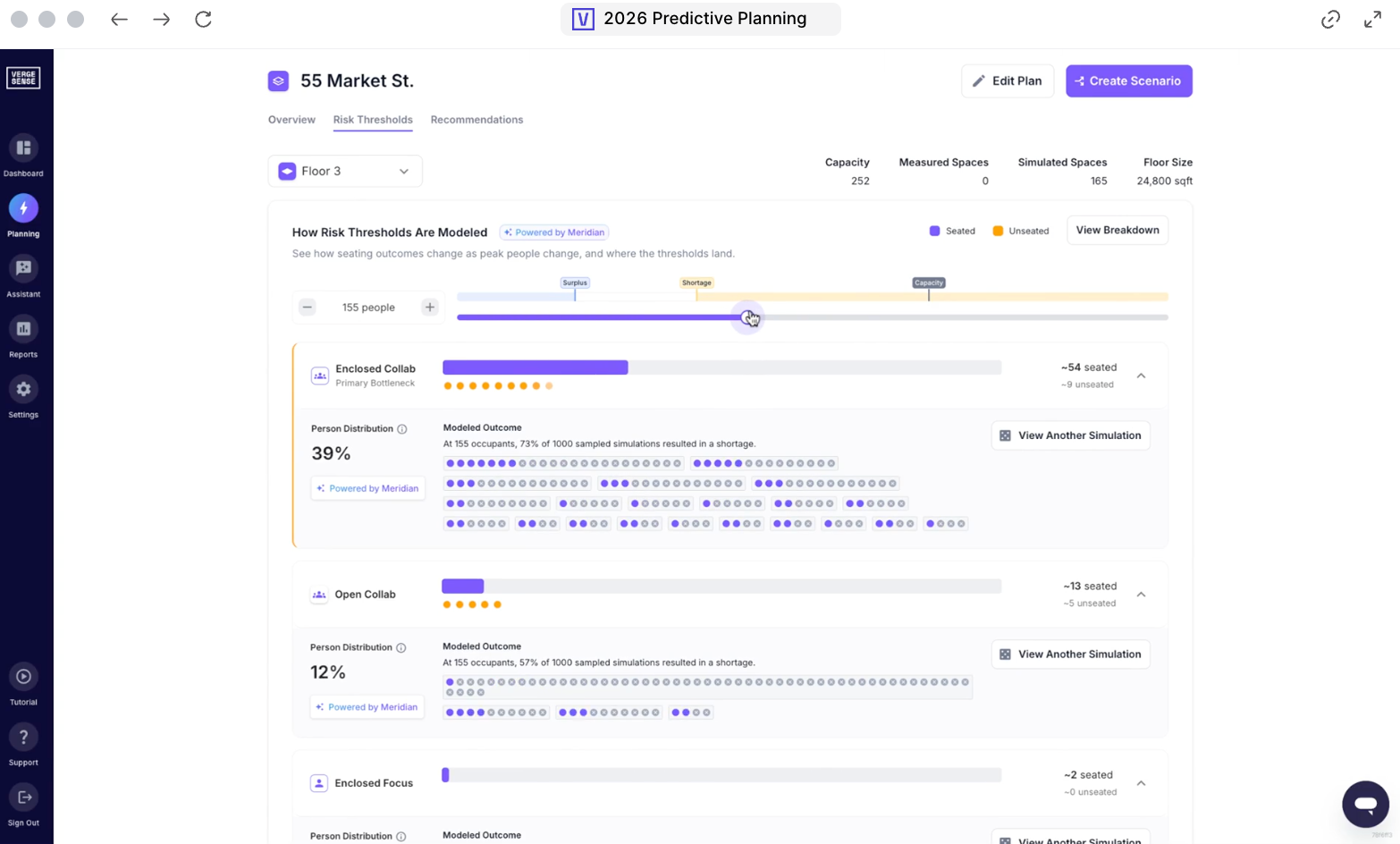
VergeSense brings occupancy measurement and scenario modeling into a single workflow.
The platform collects passive occupancy data through its Infinity Area Sensors, WiFi and badge integrations, and booking system connections, then feeds that measured utilization directly into Predictive Planning, its AI-powered scenario modeling and forecasting engine.
This doesn't just show you current utilization. VergeSense uses all that data to:
- Forecast demand under different scenarios (hybrid policy changes, headcount growth, consolidation options)
- Compare space mix alternatives before committing to a restack or lease decision
- Recommend right-sizing actions with quantified capacity and cost impact
Trebellar: Core Platform Overview and Market Position
Trebellar is an AI analytics tool for corporate real estate teams, focused on scenario modeling and decision support. It functions as an analytics layer on top of the data your team can supply from existing systems: IWMS records, badge logs, booking platforms, third-party sensors, and HRIS feeds.
It focuses on:
- Scenario modeling
- Portfolio planning
- Decision support
Two structural points shape how the platform performs in practice.
First, Trebellar doesn't generate occupancy data. The platform is data-agnostic, which means planning outputs depend entirely on the completeness and quality of inputs the customer provides. Second, Trebellar's AI models train per customer on that customer's data alone. There's no foundational behavioral model underneath, so a five-building portfolio gets AI trained on five buildings of data.
For teams with comprehensive, validated data across their portfolio, Trebellar can be an effective modeling layer. For teams missing data on key sites, planning quality reflects those gaps.
Where VergeSense and Trebellar Diverge: Key Differentiators
The differences between VergeSense and Trebellar come down to how each platform sources data and turns it into decisions.
Planning Inputs: Measured Occupancy vs. Supplied Data
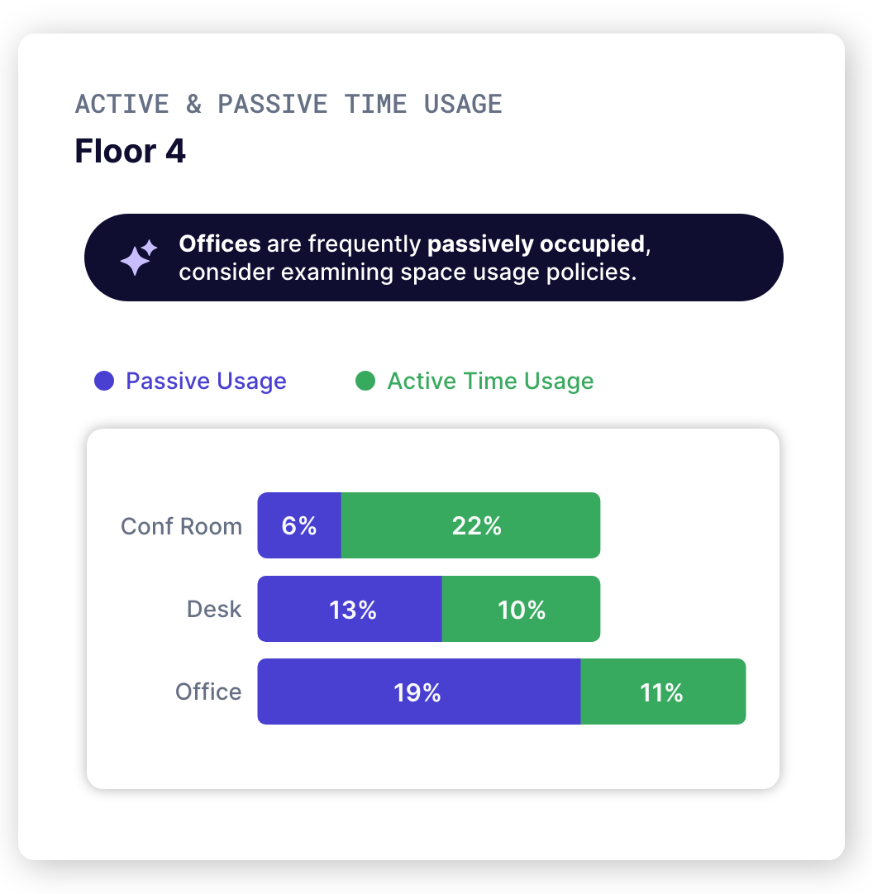
VergeSense and Trebellar first diverge on the data they work from.
VergeSense runs on its own measurement layer: Passive sensors, WiFi telemetry, badge swipes, and booking integrations all feed into one planning foundation, so forecasts start from observed behavior: actual desk occupancy by the hour, real meeting room demand curves, neighborhood peaks as they happen.
The Infinity Area Sensor adds passive occupancy, like a desk claimed by belongings when the person is in a meeting, or quiet-focus work that doesn't trigger motion-based sensors.
Trebellar takes the opposite approach: It works with the data your team can supply — IWMS records, booking platforms, badge logs — and for sensor coverage, it leans on partners, primarily Butlr's thermal sensing, which catches active presence but not passive occupancy.
Forecast Fidelity and How Each Platform Handles Uncertainty
VergeSense's forecasting runs on the Large Spatial Model, a foundational AI model trained on 200M+ sq ft of behavioral data across 200+ enterprises.
That cross-portfolio dataset means forecasts draw on patterns from thousands of similar spaces, not just your own historical data. It also means the model can flag where predictions are weak, so you know which assumptions to validate before committing to a decision rather than learning the gap from a failed plan.
Trebellar's models train per customer on the data you supply. A five-building portfolio gets AI trained on five buildings; a 50-building portfolio on 50. There's no foundational behavioral dataset underneath, so forecast quality scales with the completeness and consistency of your existing data, and new customers start with no behavioral benchmarks at all.
The Closed Loop Between Plan, Measurement, and Refinement
VergeSense closes the loop between planning and reality.
After you implement a space change, consolidating floors, right-sizing neighborhoods, converting desks to collaboration zones, the same sensors that informed the original forecast continue measuring outcomes. You see whether the plan delivered the expected capacity gains and which assumptions to adjust for the next planning cycle.
Trebellar models future states effectively, but measuring post-implementation results requires you to separately instrument those spaces and feed new data back into the system. That gap matters most for the decisions where being wrong is most expensive: lease renewals, restacks, and major policy shifts.
Scenario Modeling for Portfolio, Design, and Stacking Decisions
Both platforms support scenario comparison, testing different space mixes, stacking plans, or portfolio consolidation options.
VergeSense scenarios draw from measured demand curves. If you're evaluating whether to convert 20 desks to collaboration space, the model references actual desk utilization patterns and meeting room booking pressure, and behavioral patterns from thousands of similar conversions across the LSM dataset to forecast the trade-off.
Trebellar scenarios model based on your supplied inputs and planning assumptions, drawing only on your portfolio's data.
The practical difference:
- VergeSense answers "what will happen" based on observed behavior at portfolio scale across hundreds of enterprises
- Trebellar answers "what could happen" based on the data you've provided from your portfolio alone
Implementation and Operational Requirements
How quickly your team can start planning depends as much on the platform's data model as on its features. Three areas where VergeSense and Trebellar differ in practice:
Time-to-First-Plan and Data Readiness Requirements
Because VergeSense accepts a mix of inputs and can use the Large Spatial Model to forecast on unmeasured sites, you can start modeling scenarios on day one with the data you already have, generating a first plan in days and refining accuracy as measured occupancy comes online.
Trebellar's planning quality depends on the data you can already supply from existing systems. Time-to-first-plan is gated by your current data infrastructure, which often requires a multi-week data audit, format standardization, and validation cycle before the platform can generate credible scenarios.
Ongoing Refinement as the Workplace Changes
VergeSense maintains plan accuracy by validating every forecast against the same data streams that built it. When a neighborhood's peak occupancy shifts or a new policy changes desk demand, the platform surfaces the variance so you can adjust scenarios in real time.
Trebellar's refinement process depends on your team's ability to update and validate the data feeds it consumes. If your workplace changes faster than your data pipelines update, planning recommendations may lag behind reality.
Stakeholder Ownership Across CRE, Workplace Strategy, and IT
VergeSense supports distributed ownership across CRE, workplace strategy, and IT. Because it collects its own occupancy data through sensors, WiFi, and badge integrations, IT's role typically stays limited to initial setup and ongoing system health, freeing the CRE and workplace strategy teams to focus on planning decisions rather than data plumbing.
Trebellar's planning workflows depend heavily on the quality and completeness of data your organization can supply, which means IT or workplace analytics teams often carry more of the ongoing data preparation burden.
Integration Ecosystem and Data Unification
VergeSense is built to be the system of record for how space is used. That means occupancy data is unified with the other systems your team already runs on (sensors, WiFi, badge systems, booking platforms, BMS feeds) and folded into a single analytics framework.
That unified data layer feeds Predictive Planning and the Large Spatial Model directly, so portfolio-wide utilization benchmarks come online within weeks of connecting your first sources, and scenario forecasts draw on both your data and cross-portfolio behavior at the same time.
Trebellar functions as an analytics and planning layer on top of data sources you already provide. Before the platform can generate credible planning scenarios, your team needs to:
- Audit your existing data
- Identify gaps in coverage
- Standardize formats across systems
- Validate accuracy
The timeline for that process depends on your current data maturity.
Choosing the Right Platform for Your Real Estate Team
The split between these two platforms comes down to where the intelligence lives.
Trebellar sits on top of whatever feeds your team can deliver, and the analytics are as complete as the inputs you supply. Gaps in coverage become gaps in your recommendations, while teams that already have mature data across their portfolio can have a fast path to scenario modeling.
Teams with mature data pipelines may find a usable modeling layer; teams without them spend the early months building data infrastructure before planning can start.
VergeSense generates the occupancy data itself, then runs it through Predictive Planning in the same platform. As a result, your forecasting reflects behavior observed across hundreds of enterprises and hundreds of millions of square feet, not just the slice your organization has captured so far.
So if you're ending a lease, restacking floors, or rewriting a hybrid policy, base your platform decision on the foundation, not the feature list:
If your priority is building scenario modeling on top of data you already own, Trebellar is a workable analytics layer.
If your priority is making portfolio decisions backed by behavioral data at scale, VergeSense is built for the job.
See the difference a unified solution makes.
VergeSense combines real-time intelligence with predictive planning, so every recommendation you bring to leadership is backed by behavioral data from 200+ enterprises.
Get a Demo →
FAQs about VergeSense vs Trebellar
Does VergeSense Require Existing Sensor Infrastructure to Support Planning?
No. VergeSense's Predictive Planning works with whatever data you have today, including WiFi, badge, booking systems, or even just industry benchmarks and your space inventory. Once you deploy sensors, measured occupancy feeds directly into planning models alongside the Large Spatial Model's behavioral benchmarks, improving forecast accuracy with every iteration.
How Does VergeSense's Occupancy Data Improve the Accuracy of Space Planning?
Measured occupancy replaces assumptions with evidence. For example, knowing Conference Room 3B averages 42% utilization during core hours, not the 65% your booking system suggests, lets you confidently right-size your meeting room inventory.
VergeSense unifies data from sensors, WiFi, badge, and booking systems into a single view, then uses that ground truth to continuously train and refine the AI engine behind its Predictive Planning tool.
Can VergeSense Support Both Current-State Measurement and Future-State Planning in One Platform?
Yes. VergeSense combines occupancy intelligence and Predictive Planning in a single platform, so you measure current utilization and model future scenarios without switching tools or reconciling spreadsheets.
For example, you can model a 20% reduction in meeting room inventory, implement the change, then measure whether utilization matches your forecast and adjust the next phase accordingly.
What Is VergeSense's AI Trained On, and How Does That Compare to Trebellar's Approach?
VergeSense's Predictive Planning runs on the Large Spatial Model, a foundational AI model trained on more than 200 million square feet of real workplace behavior across 200+ enterprises and 8 years of operational data. Every customer benefits from cross-portfolio behavioral patterns from day one.
Trebellar's machine learning models train per customer on the data each customer supplies. There's no foundational behavioral dataset underneath, which means a five-building portfolio gets AI trained on five buildings of data alone, with no industry benchmarks to draw on.
How Does VergeSense Compare to a Trebellar+Butlr Stack?
A Trebellar+Butlr deployment combines two early-stage vendors: Butlr provides thermal sensing, and Trebellar provides the analytics layer on top. That means two contracts, two roadmaps, and data flowing between two systems, with thermal sensors that detect active presence but miss passive occupancy (focused desk work, belongings on a desk while someone is in a meeting).
VergeSense delivers sensors, data unification, and AI planning in a single platform, with passive occupancy detection built in and the Large Spatial Model trained on cross-portfolio behavior from day one.