


Workplace and real estate teams are under pressure to make faster, more confident decisions about space, and occupancy data is the foundation. Occupancy data is the foundation, but not all occupancy data is built for the same job.
VergeSense and Density both turn buildings into structured data. The difference is what that data lets you do.
- Density focuses on real-time people counting and utilization monitoring: how many people are in a space and when.
- VergeSense extends that data into planning, helping you model scenarios, forecast demand, and make portfolio decisions with confidence. That capability is powered by the Large Spatial Model, trained on more than 200 million square feet of workplace data, which is a different foundation than a real-time dashboard.
If you’re deciding between them, the choice comes down to whether you need visibility into current usage or tools to plan what happens next.
|
VergeSense |
Density |
|
|
Core focus |
Occupancy intelligence + predictive planning |
People counting + utilization |
|
Data output |
Forecasts, scenarios, planning recommendations |
Historical and real-time reporting |
|
Best for |
Right-sizing portfolios, planning future state, justifying real estate decisions to finance and the executive team |
Day-to-day space monitoring, conference room availability, facilities operations |
Need more than an occupancy dashboard?
See how VergeSense helps you plan, forecast, and optimize space across your portfolio.
Get a demo
VergeSense vs Density: Where Each Platform Excels
VergeSense and Density solve the same starting problem: understanding how space is used, but what you can do with that data is significantly different.
- Density is all about measurement. It tells you how many people are using a space, when usage peaks, and how that changes over time.
- VergeSense is built for planning. It connects occupancy data with other workplace signals and uses them to model demand, test space changes, and support planning decisions.
In practice, that means:
- With Density, you can see which spaces are underused or over capacity.
- With VergeSense, you can see what will happen if you consolidate floors, change desk ratios, or adjust hybrid policies before you commit to making any changes.
VergeSense: Occupancy Intelligence and Predictive Planning
VergeSense combines occupancy sensing with data from systems you already use, like badge access, WiFi, room booking, and building infrastructure, to give a complete view of how space is used across your portfolio.
Instead of looking at occupancy in isolation, you can see how usage patterns change over time, where bottlenecks appear, and how different spaces perform across buildings and regions.
Two capabilities set VergeSense apart:
Predictive Planning. Most occupancy platforms tell you what happened. VergeSense models what's likely to happen next, so you can compare space scenarios, forecast demand, and pressure test decisions before changing the floor plan or signing a lease.
Sensor coverage built for the modern workplace. The Infinity Area Sensor covers entire neighborhoods from the ceiling, with no under-desk hardware to install or maintain. That makes it faster to deploy, easier to scale across a portfolio, and better suited to dynamic, unassigned spaces.
You can also start without sensors. VergeSense can use your existing data (badge, booking, WiFi) to model demand and test scenarios on day one, then layer in sensors where you need more precision. That's not possible with a hardware-first platform.
Other capabilities include:
- Portfolio-level analytics to identify underused space and consolidation opportunities
- A unified view that combines sensor data with workplace systems like badge, booking, and WiFi
- AI-driven recommendations based on the Large Spatial Model
Density: People Counting and Space Utilization Monitoring
Density centers on measuring space usage in real time. Its platform tracks how many people enter and exit spaces, helping teams understand usage patterns across rooms, floors, and buildings.
Density’s hardware portfolio includes three main products:
- Open Area: a wired, ceiling-mounted sensor designed to monitor large spaces (up to ~1,000 sq ft), typically installed with Power over Ethernet (PoE)
- Entry: doorway sensors that count people as they move in and out of a space
- Waffle: a lower-cost, self-install radar sensor for smaller spaces like meeting rooms and desks
These sensors feed into Atlas, Density’s analytics layer, which focuses on descriptive reporting: utilization rates, peak occupancy, dwell time, and historical trends.
This setup works well for teams whose primary job is operational monitoring: which spaces are used most, when demand peaks, and how usage changes day to day.
Where Density stops short is planning. The platform reports what's happening and what has happened, but it doesn't model future demand, test space scenarios, or support portfolio-level decisions about what the workplace should look like next.
The bottom line: if your job is operating today's workplace, Density covers the basics. If your job is planning the next one, you need a system designed for decisions, not just dashboards.
Key Feature Differences: VergeSense vs Density
While both platforms measure occupancy, they differ significantly in sensor technology, analytics depth, and forecasting and AI capabilities.
Sensor Technology and Data Collection Methods
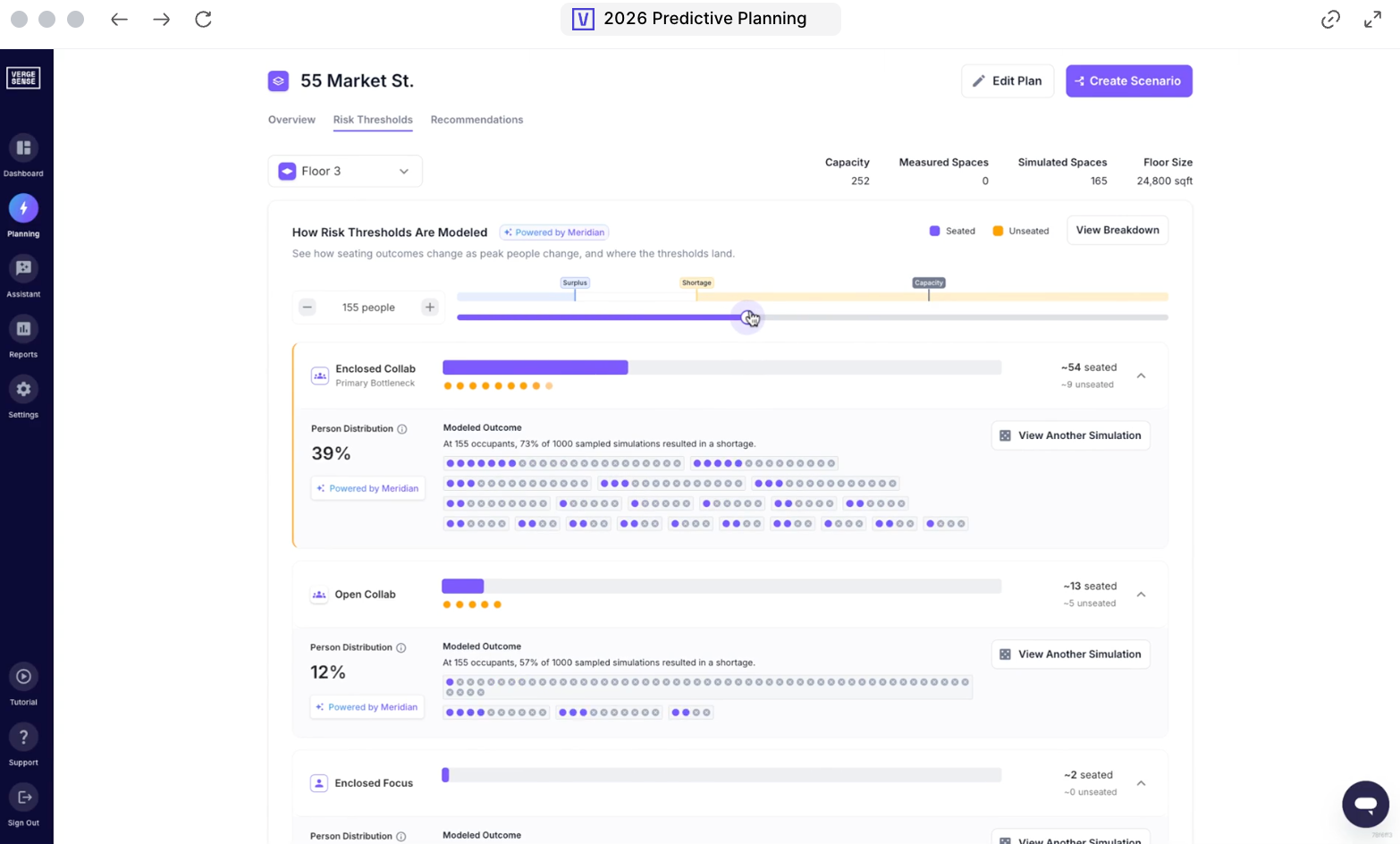
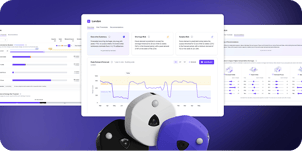
Alt text: VergeSense dashboard showing how Monte Carlo simulations forecast capacity bottlenecks across space types — at 155 occupants, 73% of 1,000 simulations result in a shortage in enclosed collab spaces.
VergeSense uses optical sensors, including the Infinity Area Sensor, to capture active and passive occupancy across open areas, meeting rooms, and individual workspaces, without requiring user interaction.
The sensors are wireless and battery-powered, with a 10-year battery life that effectively spans a full lease cycle. That makes deployment faster, less invasive, and easier to scale across a portfolio, especially in buildings where running new power lines would slow things down or in retrofits where electrical access is limited.
Density relies primarily on wired sensors:
- Entry sensors for doorway people counting
- Open Area sensors for larger spaces
- Waffle for smaller rooms and desks
These devices typically require power infrastructure (often PoE) and more coordination during installation, particularly in buildings with limited electrical access.
Density's portfolio also includes desk-level sensors, which add setup overhead and often raise employee and works council concerns about workspace-level monitoring. That friction can slow rollouts or limit which sites a deployment can reach, even when the technology itself is privacy-compliant.
Analytics Depth and Planning Capabilities
Density runs on descriptive analytics:
- How many people used a space
- When usage peaked
- How utilization changes over time
This is useful for understanding current performance, but it stops at reporting. There's no predictive layer, no scenario modeling, and no AI integrated across the platform to surface what's likely to happen next. The result is a workflow where teams react to what the data shows instead of planning around what it predicts.
AI is embedded across the VergeSense product suite: the Large Spatial Model that benchmarks utilization patterns against 200M+ sq ft of enterprise workplacedata, Predictive Planning models space scenarios before you commit to them, and demand forecasting projects how usage will shift under different headcount, return-to-office, and hybrid policy conditions.
The result is a platform that not only tells you what’s happened, but also what will happen. This means you can make defensible decisions based on concrete data. That's what turns occupancy data into decisions you can defend to finance, the executive team, and the business.
Integration Ecosystem and Data Unification
VergeSense is built to be the system of record for how space is used, which means occupancy data is unified with the other systems your team already runs on, not analyzed in isolation.
VergeSense connects with:
- Workplace platforms like Microsoft Places, ServiceNow, and the major room booking and calendar systems
- Badge and access control systems for entry and presence data
- Wi-Fi and network signals for device-level activity
- Building systems like HVAC and IWMS platforms
That unified data layer is what makes it possible to compare planned vs. actual usage (whether booked rooms are actually being used, how badge activity lines up with real occupancy, where booking behavior diverges from how teams actually show up) without exporting anything or stitching data together in BI.
It's also the foundation Predictive Planning runs on. Scenario modeling and demand forecasting are only as good as the data they pull from, and a single source of truth across sensor, badge, booking, and Wi-Fi signals is what makes those forecasts defensible.
Density takes a different approach. Its analytics are built primarily around data from its own sensors, with a more limited integration footprint focused on the hardware layer. Cross-system analysis (combining occupancy with badge, booking, or Wi-Fi data) typically means exporting data from Density and reconciling it elsewhere, often in a BI tool or spreadsheet.
For teams whose only goal is real-time people counts, that's workable. For teams trying to make portfolio decisions, it adds friction and slows the path from data to decision.
Planning and Forecasting Depth
Most occupancy platforms answer the wrong question for a planning decision. They tell you what already happened, when the buyer needs to know what's likely to happen next.
That's the wedge between VergeSense and Density.
VergeSense lets teams test changes before they make them. Model a floor consolidation, planned headcount growth, or change attendance policy, and see how that decision affects capacity, utilization, and employee experience before you commit.
Predictive Planning can run those scenarios using the occupancy data you already have (badge, booking, Wi-Fi) so you can pressure test decisions on day one, not after a six-month sensor deployment.
With VergeSense, you can:
- Know when a floor will hit capacity before signing the next lease
- Compare layout and policy options side by side, with projected impact on each
- Forecast how usage will shift under different headcount, return-to-office, or hybrid scenarios
- Build a defensible case for finance and the executive team, grounded in modeled outcomes rather than gut calls
Those forecasts are powered by the Large Spatial Model, which benchmarks your data against more than 200 million square feet of enterprise workplace activity. That's why the predictions are credible: they're not extrapolating from a single building's history, they're informed by how thousands of similar spaces actually perform.
Density doesn't offer planning capabilities of this kind. It reports what spaces did in the past and what they're doing now, but it doesn't model future demand, run scenarios, or use AI to forecast outcomes.
For day-to-day monitoring, that's fine. For a real estate decision worth millions of dollars, it's like driving by looking in the rearview mirror. The data is real, but it's pointed in the wrong direction.
How Each Platform Supports Portfolio Management Decisions
Portfolio decisions, (consolidating space, renewing leases, or adjusting workplace policies,) are some of the largest financial commitments a company makes outside of M&A. They affect thousands of employees and hundreds of millions of dollars over a lease cycle. They demand more than an occupancy snapshot.
Teams need to understand demand, test changes, and avoid capacity risk before they commit.
Density supports visibility into current usage:
- How many people used a space
- When demand peaks
- Which areas run over or under capacity
This helps teams track performance, but it doesn’t extend into planning future changes.
VergeSense supports those decisions directly. Teams can model different scenarios, compare outcomes, and identify where capacity constraints will appear before making changes.
For example, you can:
- Test whether two floors can be consolidated into one
- See when a floor will exceed capacity under different headcount assumptions
- Compare layouts or policy changes side by side
This type of planning has a direct cost impact. VergeSense customers have used it to:
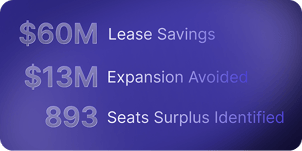
- Avoid $60M in lease costs at Fresenius Medical Care
- Avoid $13M in expansion costs at a global biotech company
- Eliminate 4,100 hours of ghost meetings per month at a global consulting firm
Instead of reacting to usage data, teams can make decisions based on what will happen next and quantify the impact before committing.
Implementation and Operational Considerations
Beyond features and analytics, day-to-day factors like deployment, infrastructure, and data governance also play a role in how each platform fits into your environment.
Hardware Requirements and Deployment Complexity
VergeSense keeps deployment simple. The Infinity Area Sensor runs on battery power and mounts directly to the ceiling, and lasts about 10 years on a single battery, which means teams don't need to run new wiring, coordinate electrical contractors, or build a battery replacement program over the lease cycle.
Teams can also start without sensors by using existing data sources like badge swipes or room bookings, and Wi-Fi signals, then layer in sensors where they need more precision. That means the platform can produce planning insight in days, not after a multi-month hardware deployment.
Density relies on wired sensors for both doorway counting and area coverage. These installations usually require power access (often PoE) and coordination with facilities, IT or contractors. In buildings with limited electrical access, or in portfolios where teams need to deploy across many sites quickly, that adds significant time and overhead.
For a single building it's manageable. For a portfolio of dozens or hundreds of sites, it's the difference between weeks and months.
Data Security and Privacy Frameworks
Both platforms take a privacy-first approach to occupancy data, but they use different technologies and message them differently.
Density leans on a "no cameras" narrative as a core part of its positioning. That framing is worth unpacking, because the underlying technical and operational picture is more nuanced than the marketing line suggests.
Density's Entry sensor uses depth-sensing technology that relies on a camera-based signal to detect movement, even though it doesn't capture identifiable images. The data is anonymous and the deployment is enterprise-compliant. So while the "no cameras" framing is rhetorically clean, in practice both platforms operate without collecting personal data and both meet the requirements for enterprise deployment.
VergeSense processes all visual data at the source. The system doesn't capture, store, or transmit personally identifiable information, and it doesn't track individuals. The platform meets enterprise security standards including SOC 2 Type II, ISO 27001, and GDPR compliance.
The more important difference isn't about cameras at all. It's about what each sensing approach can actually detect.
Radar-only sensing detects movement, which means it can miss occupancy: someone sitting still at a desk on heads-down work, a focused meeting where no one is moving much, an individual contributor deep in a task. For a platform measuring conference room turnover, that's a minor gap. For a platform claiming to represent how space is actually used, it systematically undercounts the most valuable work happening in the office.
VergeSense's optical approach captures presence across open areas without requiring movement, which is what makes the data trustworthy as a foundation for planning decisions.
Choosing Between VergeSense and Density for Your Portfolio
Both platforms solve the same core problem of understanding how space is used, but they support different types of decisions.
Density works well for teams focused on real-time visibility and workplace operations. Its wired sensors support frequent updates, which makes it a good fit for live way-finding displays and space availability tools.
The lower-cost Waffle sensor also offers an accessible starting point for teams running small pilots across rooms or desks. For teams whose primary job is keeping today's workplace running smoothly, that's a workable foundation.
VergeSense fits teams making the bigger calls: how to right-size a portfolio, when to consolidate, how to plan for return-to-office or hybrid policy changes, and how to build a defensible case for finance and the executive team.
It combines occupancy data with Predictive Planning and AI modeling powered by the Large Spatial Model, so you can pressure test decisions before committing to them.That's why VergeSense customers have used the platform to avoid tens of millions in lease and expansion costs and make portfolio decisions with confidence rather than guesswork.
If you need a system to monitor today's workplace, Density covers the basics.
If you need a system to plan the next one, VergeSense is built for the job.
Evaluating occupancy platforms and need more than people counts?
See how VergeSense combines accurate occupancy intelligence with predictive planning to help real estate teams make confident portfolio decisions.
FAQs about VergeSense vs Density
Does VergeSense require sensors to get started?
No. VergeSense can generate planning insights using existing data like badge swipes and booking systems before any sensors are installed, or just a floor plan. Sensors can be added later where teams need more precision. That's not possible with a hardware-first platform, where the data foundation depends on sensors being deployed first.
How does VergeSense go beyond occupancy monitoring into planning?
VergeSense models future demand and tests space scenarios, so teams can see how changes to headcount, policies, or layouts will impact capacity. Those forecasts are powered by the Large Spatial AI Model, which benchmarks against more than 200 million square feet of enterprise workplace data. Density reports historical and current usage but doesn’t offer forecasting or scenario modeling.
Can VergeSense support portfolio decisions across multiple sites?
Yes. VergeSense was built for portfolio-scale decision making, with data aggregated across locations so teams can compare performance, identify consolidation opportunities, and model changes at the portfolio level in one view. Density's analytics are oriented around individual sites, which means portfolio-level analysis typically requires exporting data from each location and reconciling it elsewhere.
How does deployment compare between VergeSense and Density?
VergeSense uses wireless, battery-powered sensors with a 10-year battery life that mount directly to the ceiling, so deployment doesn't require new wiring or electrical contractor work. Density uses primarily wired sensors that depend on power infrastructure (often PoE), which adds coordination and time, especially across multi-site portfolios.
What role does AI play in each platform?
AI is foundational to VergeSense. The Large Spatial Model, trained on more than 200 million square feet of enterprise workplace data, powers benchmarking, forecasting, scenario modeling, and recommendations across the platform. Density's analytics are descriptive, focused on historical and real-time reporting without predictive AI integrated across the product.