



Lease events, RTO shifts, hybrid policy changes, and consolidation pressure are landing at once. The traditional response is a consultant study that takes three to six months and delivers a static report built on assumptions. That timeline no longer works.
Space planning software compresses months into days. But the category is wide: planning-native platforms, IWMS suites with planning modules, occupancy intelligence platforms with planning layered on, and design-led test-fit tools. The right one depends on the decisions you're making and how much real-world usage data you want behind them.
This guide covers:
- How six leading space planning platforms compare
- The capabilities that separate effective planning tools from feature-heavy ones
- Questions to ask vendors when evaluating space planning software
- How to choose the right platform for your portfolio complexity and planning needs
Stop choosing between data depth and planning speed.
VergeSense gives CRE leaders accurate occupancy data and AI-powered Predictive Planning in one platform, built on the largest workplace occupancy dataset in the industry.
At-a-glance comparison of the best space planning software
The table below summarizes how the six platforms compare on data inputs, scenario modeling, and best-fit use case.
|
Tool |
Best For |
Core Approach |
Data Inputs |
Analytics & Planning Depth |
Best-Fit Buyer |
|---|---|---|---|---|---|
|
VergeSense |
Enterprise CRE teams needing planning grounded in real-world occupancy behavior |
AI-powered Predictive Planning + Occupancy intelligence |
Proprietary sensors, Wi-Fi, badge, bookings, floor plans |
Deep: scenario modeling, design scoring, stack planning, breakpoint analysis , ROI quantification. Powered by Large Spatial AI model trained on 200M+ square feet of measured data. |
CRE, occupancy planning, and workplace strategy leaders at enterprises making high-stakes lease, consolidation, and portfolio decisions |
|
Trebellar |
CRE teams wanting AI-powered analytics and generative reporting on top of existing data sources |
AI agent platform for portfolio planning and workplace analytics |
Manual data integration: badge, Wi-Fi, third-party sensors, HRIS, lease data, CSV uploads |
Moderate: scenario planning, location strategy, workplace effectiveness analytics. AI models train per customer on that customer's data only |
Organizations with strong data infrastructure, AI accuracy depends on the quality and completeness of data the customer provides |
|
Eptura |
Large orgs wanting a single vendor across IWMS and space planning |
IWMS suite with an integrated planning module |
IWMS operational data, manual inputs, limited sensor integrations |
Moderate: stack and block planning, scenario planning within broader IWMS context. Planning depth secondary to operational workflows. |
CRE and FM teams prioritizing vendor consolidation over planning sophistication |
|
OfficeSpace |
Teams focused on space management, layouts, moves/adds/changes, and neighborhood planning |
Modern space management with design-led interface |
Floor plans, org data, sensor and booking integrations |
Moderate: interactive stack plans, scenario layouts, MAC workflows. Strong on layout management; limited occupancy-driven portfolio intelligence |
Mid-market and enterprise teams where space management workflows take priority over occupancy-driven planning decisions. |
|
Tango (Locatee) |
CRE teams wanting lease management, site selection, and occupancy in one suite |
IWMS + lease management + Wi-Fi-based occupancy |
Wi-Fi data, lease data, portfolio inputs |
Moderate: portfolio reporting, location strategy, bundled CRE workflows. Occupancy accuracy tied to Wi-Fi, which can’t measure desk-level accuracy. |
Multi-site enterprises with strong Wi-Fi infrastructure needing suite breadth across lease, planning, and occupancy in a single platform. |
|
Saltmine |
Teams running design-led test-fits and layout exploration during consolidation or redesign |
Workplace design and test-fit modeling |
Floor plans, CAD files, design specs |
Moderate: test-fit scenarios, space ratio analysis, design collaboration. Purpose-built for design workflows, not portfolio-level planning |
CRE teams and architects involved in workplace redesign or consolidation moves who need design-layer scenario tooling. |
Best space planning software in 2026
1. VergeSense
VergeSense is built for enterprise CRE and workplace strategy teams making high-stakes portfolio decisions: lease exits, floor consolidations, restack scenarios, and hybrid policy changes.
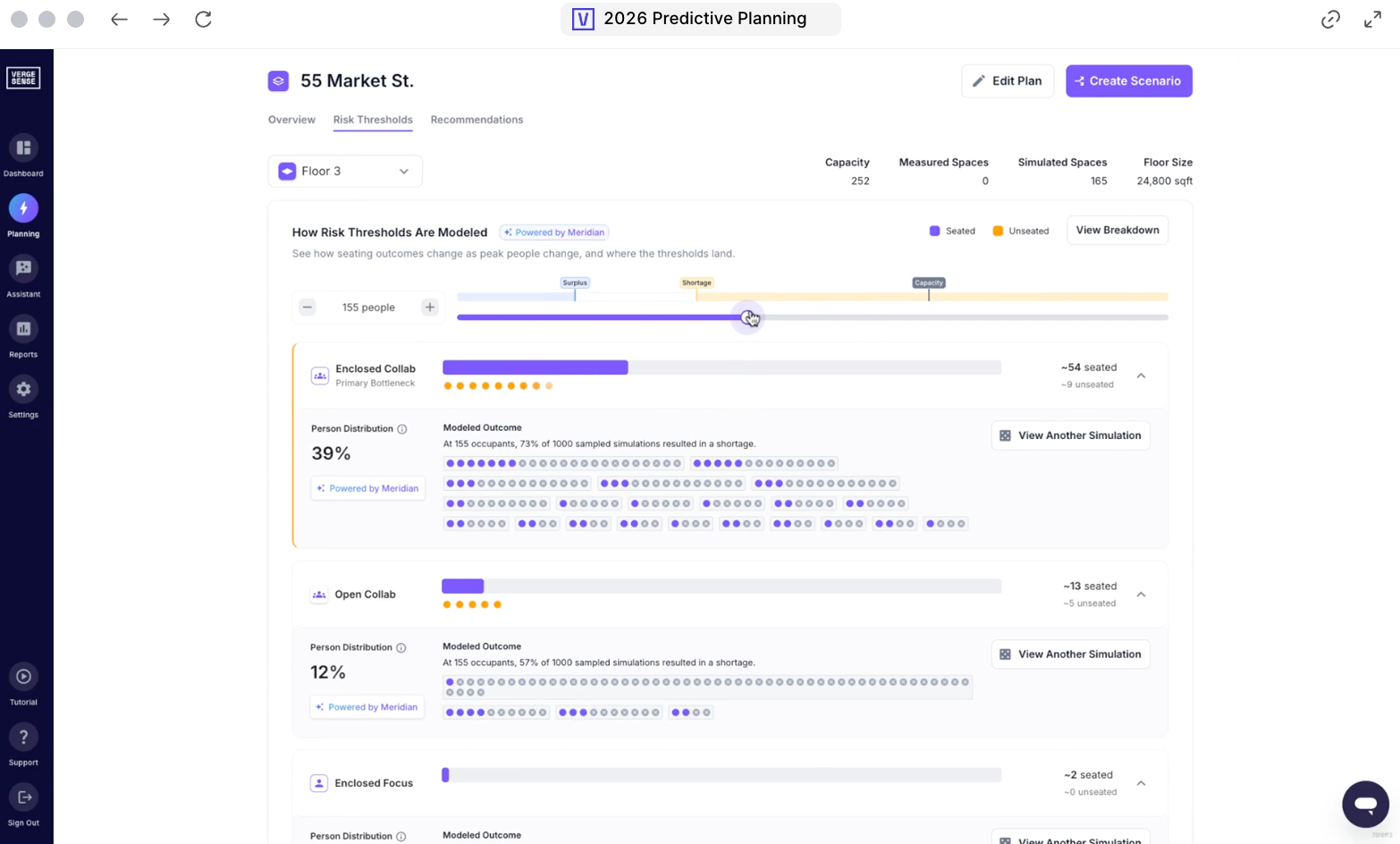
The platform combines Occupancy Intelligence with Predictive Planning, powered by the Large Spatial Model, a proprietary AI trained on 200M+ sq ft of real workplace behavior across 200+ enterprises. This approach is what separates behavioral forecasting from headcount math. You're not modeling assumptions. You're modeling how people actually use space.
The result: scenario outputs with cost savings, payback timelines, and ROI built in. Planning that moves in hours, not months.
Selected features
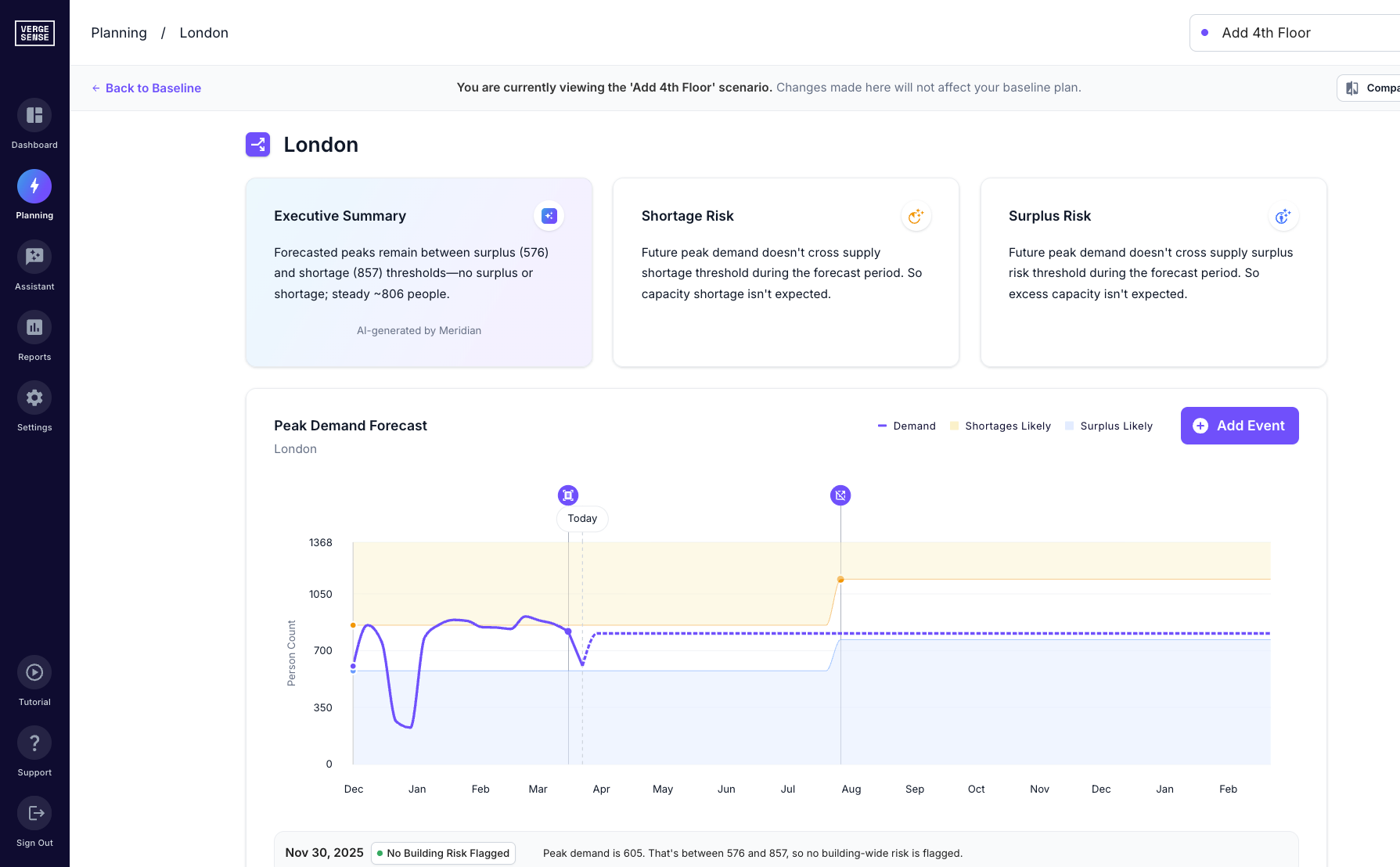
- AI-powered scenario modeling: Compare any portfolio scenario side-by-side with cost impact and utilization forecasts, with ROI cards ready for finance and executive review.
- Demand forecasting: Occupancy forecast backed by the industry’s only Large Spatial AI model trained on 200M+ sq ft of real workplace data, so predictions reflect how people actually use space, not industry averages or rules of thumb.
- Proactive capacity constraint detection: Probabilistic simulations surface where your space will break under different growth and policy scenarios, so you're acting on likely futures before they become problems.
- Floor-level supply and demand gap analysis: Model future space needs against current supply at the floor and neighborhood level, with gap identification by space type before shortages hit.
- Sensor-free planning: Upload existing floor plans and headcount data and start running scenarios immediately. No hardware, no deployment timeline required.
- Unified occupancy data: Sensors, Wi-Fi, badge systems, and bookings roll into a single view so no demand signal gets missed.
Best for
- CRE leaders coordinating planning across lease events and consolidation decisions
- Workplace strategy teams running scenario modeling for hybrid policy shifts
- Organizations moving from consultant-led studies to in-house planning capability
- Teams that need defensible data to justify portfolio decisions to finance and executive leadership
A real-life example of VergeSense’s impact
A global bank used VergeSense Predictive Planning to stress-test its standardized floor templates before committing capital across hundreds of floors.
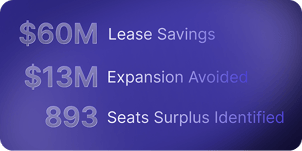
Before building out 36 floor templates across 2M sq ft, a global bank pressure-tested every design with VergeSense. Simulations revealed up to 80% unseated risk in certain configurations. They avoided $764K per floor, and had zero unseated employees after their planned rebalance.
Compress planning cycles from months to days.
VergeSense gives CRE leaders accurate occupancy data and AI-powered Predictive Planning on one platform, built on the industry's largest workplace dataset.
2. Trebellar
Trebellar is a planning-focused platform for corporate real estate teams. It targets CRE leaders who want planning-led tooling without native occupancy measurement. AI models are trained per customer on that customer's data, meaning forecast accuracy depends on the quality and completeness of data the customer provides.
Selected features
- AI portfolio management: Generate scenario modeling for consolidation, expansion, and location strategy decisions with AI-ranked recommendations.
- Location strategy and site selection tooling: Evaluate new locations and compare site options across your real estate footprint.
- Workplace effectiveness analytics: Access reporting on space allocation and performance metrics based on organizational data.
- Scenario-style planning views: Compare portfolio configurations and headcount distributions side-by-side.
- Demo-led onboarding: Get guided implementation with vendor support to configure your portfolio and establish planning workflows.
Best for
- CRE teams with mature data infrastructure that want an AI analytics layer on top of existing badge, WiFi, and sensor feeds
- Organizations prioritizing conversational AI and generative reporting over behavioral accuracy
- Teams evaluating location strategy and site selection alongside portfolio consolidation
The tradeoff
Trebellar's AI is only as accurate as the data you bring to it. That's a workable model if your data infrastructure is already strong. But for teams still consolidating sources, or planning for sites where occupancy data doesn't exist yet, the platform's outputs will reflect those gaps.
There's no foundational behavioral model to fill in what's missing. Every customer starts from their own data alone.
3. Eptura
Eptura is the IWMS suite that emerged from the merger of iOFFICE, SpaceIQ, Archibus, and Condeco, with space planning capability built into its broader workplace management offering. It targets CRE and facilities management teams that want one vendor across operational and planning workflows.
Selected features
- Space planning module with stack and block capabilities: Use mature planning tools inherited from the Archibus platform to create and modify stack plans, block layouts, and space allocation scenarios.
- Scenario planning: Model space changes, consolidations, and redesigns with visual feedback on capacity impact and cost implications.
- IWMS modules covering asset, maintenance, visitor, and booking management: Manage the full facilities lifecycle in one platform, from asset tracking to workplace reservations.
- Cross-workflow reporting: Connect planning decisions to operational data so recommendations account for real facilities costs and constraints.
- Enterprise deployment: Support complex organizational structures, multi-region deployments, and compliance requirements across large real estate footprints.
Best for
- Large CRE organizations wanting one vendor across IWMS and planning
- Teams prioritizing vendor consolidation over planning sophistication
- Organizations with mature IWMS workflows looking to add planning capability
The tradeoff
Eptura's strength is breadth: you get planning, operations, asset management, and booking in one platform. The planning module is mature and handles stack plans, block layouts, and scenario comparison well. Planning inputs rely primarily on IWMS operational data and manual assumptions rather than measured occupancy, so demand forecasting depth is limited compared to platforms built around behavioral data.
If your primary need is advanced portfolio scenario modeling or occupancy-driven planning, dedicated space planning platforms will go deeper.
4. OfficeSpace
OfficeSpace is a modern space management software built for CRE and workplace teams that need visual, layout-driven planning without the complexity of legacy IWMS tools. It centers on interactive floor plans, stack plans, and moves/adds/changes workflows.
Selected features
- Interactive stack and floor plans: Drag-and-drop interface for visualizing space allocation and neighborhood layouts across floors and buildings.
- Scenario layouts: Model different seating configurations and department placements before committing to changes.
- MAC workflows: Coordinate moves, adds, and changes with request tracking and approval routing.
- Neighborhood planning: Design and test neighborhood configurations with visual feedback.
- Sensor and booking integrations: Connect third-party occupancy sensors and booking systems to overlay usage data on floor plans. Planning inputs depend on the quality and completeness of connected data sources rather than native occupancy measurement.
Best for
- CRE and workplace teams whose planning work centers on layouts and MAC requests
- Mid-market and enterprise organizations wanting a modern UI over legacy IWMS platforms
- Teams running neighborhood configuration and design-led planning
The tradeoff
OfficeSpace excels at layout visualization and MAC workflows, and its interface is genuinely strong for teams whose daily work centers on floor plan management and move coordination. Planning inputs rely on data from connected systems rather than native occupancy measurement, so the platform is better suited to design and layout decisions than demand forecasting or portfolio-level scenario modeling. Strong for design questions; weaker for capacity questions
5. Tango (Locatee)
Tango Analytics combines IWMS, lease administration, and the Locatee WiFi-based occupancy product into a single real estate portfolio software solution. The planning use case sits inside a broader platform that handles site selection, lease management, and portfolio reporting.
Selected features
- IWMS + lease admin + Wi-Fi-based occupancy in one suite: Consolidates real estate workflows from lease event management through space utilization in a single platform.
- Portfolio reporting: Aggregates data across sites for benchmarking and cost analysis.
- Location strategy tooling: Supports site selection and market analysis for expansion or consolidation decisions.
- Wi-Fi-based occupancy sensing: Tracks space usage through existing network infrastructure without dedicated sensor hardware. Wi-Fi signals can identify presence at the building or floor level but cannot reliably detect occupancy at the desk or neighborhood level, and will miss people not actively connected to the network.
Best for
- CRE teams wanting planning bundled with lease administration and site selection
- Multi-site enterprises with strong Wi-Fi infrastructure
- Organizations seeking suite breadth across real estate workflows
The tradeoff
Wi-Fi-based occupancy provides building and floor-level presence data but cannot achieve desk-level accuracy. It will miss passive occupancy from people not actively connected to the network, and neighborhood or workpoint-level planning requires assumptions to fill the gaps that Wi-Fi can't measure.
For teams running continuous optimization or modeling demand under hybrid policy shifts, that gap matters. For organizations prioritizing suite consolidation over planning granularity, it's a workable tradeoff.
6. Saltmine
Saltmine is a workplace design and test-fit platform used by CRE teams and architects to model layouts, scenarios, and design options. It's strongest where planning is design-led: testing different floor plan configurations, ratios, and space mixes before committing to a buildout.
Selected features
- Test-fit modeling: Generate and compare multiple layout scenarios to evaluate space efficiency before committing to a design direction.
- Scenario layouts: Model different space mix ratios and visualize how changes affect capacity and flow.
- Design collaboration tools: Share layouts with internal teams, architects, and brokers for faster feedback cycles.
- Space ratio and mix analysis: Quantify the impact of design decisions on seat count and meeting room availability.
- CAD and design workflow integrations: Import floor plans and export scenarios to maintain continuity between planning and execution.
Best for
- CRE teams running test-fits and design exploration in-house
- Organizations heavily involved in workplace redesign or consolidation moves
- Teams that already have occupancy intelligence and need design-led scenario modeling on top of it
The tradeoff
Saltmine excels at design-led planning. Where it falls short is measurement. It helps you model what a space could look like, but it doesn't measure how your existing spaces are actually being used, and it has no behavioral data to inform whether a proposed design reflects how people will actually occupy it.
For teams already collecting occupancy data, Saltmine works well as a design layer on top. For those still building measurement capability, you'll need that foundation before design modeling becomes useful.
Key features to prioritize in space planning software
Feature lists can be misleading. The capabilities that matter are the ones that determine whether a platform actually supports the types of planning decisions CRE leaders need to make.
The following categories separate tools that deliver real planning capability from those that offer useful features without the foundation to back up recommendations.
Planning grounded in real usage data, not assumptions
Scenario modeling is only as good as the inputs behind it. Plans built on theoretical capacity, headcount projections, or booking data alone systematically miss real demand patterns:
- Unbooked collaboration in open neighborhoods
- Meeting rooms that show available but fill with ad-hoc teams
- Desks assigned but rarely used
Traditional space planning relies on assumptions about how spaces should be used. Modern platforms integrate real-time occupancy data from sensors, WiFi, badge systems, and booking platforms to inform data-driven demand forecasting and to really see how your spaces will respond to proposed changes.
In most enterprise portfolios, a significant share of actual space usage goes untracked by badge data or booking systems alone. That gap between what disparate sources show (which weren’t designed to be reliable sources of occupancy in the first place) and what's actually happening separates defensible recommendations from guesswork.
Scenario modeling and forecasting
Retrospective utilization reports tell you what happened last quarter. CRE and workplace leaders facing lease renewals, consolidation decisions, or hybrid work shifts need to model what comes next.
- What happens if headcount changes?
- What happens if you adjust your in-office mandate?
- What happens if you consolidate two floors into one?
The best platforms let you compare scenarios side-by-side with supply-vs-demand forecasting, breakpoint identification, and ROI projections.
Predictive Planning capabilities compress what used to require consultant studies into workflows you can run in-house, continuously, as conditions change. A reporting tool shows you what happened. A planning tool helps you make informed decisions about what to do next.
Portfolio-level breadth with floor-level depth
Capacity breakpoints show up on specific floors during specific peak hours. Your planning platform needs to surface that detail without forcing you to switch tools or export data between views.
You should be able to move from portfolio-wide comparisons down to floor-level detail: which neighborhoods are over capacity, where meeting room supply doesn't match demand, and where design changes would free up the most space.
Optimizing these neighborhood configurations requires platforms that surface floor and neighborhood-level insight, not just portfolio-level dashboards.
Defensible outputs for leadership conversations
Consolidation scenarios need to justify themselves to finance. Lease renewals need to hold up to C-suite scrutiny. That requires outputs that quantify impact: ROI analysis showing savings per scenario, scenario rankings comparing options side-by-side, and supply-vs-demand visuals that surface capacity constraints for non-technical stakeholders.
Integration with your existing tech stack
Plans don't get implemented in a vacuum. For example, VergeSense needs to connect in two directions: pulling in occupancy signals from sensors, badge systems, Wi-Fi, and booking platforms to ground plans in real usage data, and pushing outputs to the systems that execute them, including IWMS for asset and move management and lease administration systems for portfolio coordination.
Without those connections, you're manually moving data between tools, planning on inputs that are already out of date, and creating version control problems that compound with every planning cycle.
Speed compared to consultant-led studies
Consultant-led studies take three to six months. Modern planning software compresses that to days, with continuously updated inputs that let you refresh plans as conditions change. Lease decisions have hard deadlines, hybrid policies shift mid-quarter, and consolidation pressure arrives with a 90-day window. Plans built on three-month-old data are already stale.
How to choose space planning software for your CRE team
The questions below will narrow the field quickly. They're designed around portfolio complexity, decision-making maturity, and the planning problems you're actually trying to solve. Your answers will reveal which platform fits your constraints and which ones you can rule out.
Questions to ask internally
- What's triggering this planning cycle? Lease event, RTO policy shift, consolidation directive, or ongoing optimization?
- How do you make planning decisions today? Consultant studies, spreadsheets, employee feedback, or existing occupancy data?
- What's your portfolio scope? Single site, multi-site regional, or global?
- Do you have occupancy data today? If so, where does it come from and how complete is it across your portfolio?
- Who needs to sign off on recommendations? CRE team only, or finance, workplace strategy, and executive leadership?
- How often do plans need to be refreshed? Once per lease cycle, quarterly, or continuously as policies and headcount change?
Questions to ask vendors
- What is your AI or forecasting model trained on? How many square feet of behavioral data, across how many enterprises?
- What data sources power your planning engine? Headcount projections, booking data, badge swipes, sensor-based occupancy, Wi-Fi telemetry, or a combination?
- Can you model scenarios without full sensor coverage? Some platforms require wall-to-wall deployment before planning can begin; others forecast from floor plans alone.
- How granular can you get? Portfolio, building, floor, neighborhood, or workpoint level?
- What does a scenario output actually look like? Request samples: ROI analysis, scenario rankings, supply-vs-demand visuals, or analyst dashboards?
- What's time-to-value compared to a consultant study? Days, weeks, or months to first actionable recommendation?
- How does your platform integrate with our existing CRE and workplace tech stack? IWMS, lease admin, booking systems, badge data, and building systems all feed planning decisions.
Stop choosing between data depth and planning speed.
VergeSense gives CRE and workplace leaders accurate occupancy data and AI-powered Predictive Planning in one platform, built on the largest occupancy dataset in the industry.
FAQs about space planning software
What is space planning software?
Space planning software helps CRE teams allocate, optimize, and forecast space needs. Modern platforms combine real occupancy data from sensors, Wi-Fi, and bookings with scenario modeling.
CRE leaders can model headcount changes, hybrid policy shifts, and consolidation scenarios with defensible data, compressing planning cycles from months to days.
How is space planning software different from IWMS?
IWMS handles operational workflows like asset tracking, maintenance, visitor management, and booking. Space planning software focuses on portfolio optimization, scenario modeling, and demand forecasting.
Some IWMS suites include planning modules, but planning-native platforms offer deeper scenario modeling and tighter integration with real-world usage data. The choice depends on whether you need operational breadth or planning depth.
Do you need sensors to use space planning software?
Platforms like VergeSense offer Predictive Planning from floor plans alone, using AI trained on 200M+ sq ft of real workplace data to forecast demand without sensors.
That said, sensor-based occupancy data delivers the most accurate foundation, especially for hybrid policy modeling or right-sizing decisions where booking data and badge swipes don't capture actual usage.
How does AI-powered space planning differ from traditional planning tools?
Traditional tools rely on static inputs like headcount projections, theoretical capacity, space ratios, and booking rates. They require manual scenario building.
AI-powered platforms ingest real occupancy data, identify patterns across millions of square feet of actual usage, and generate scenario forecasts, breakpoint analysis, and ROI-ranked recommendations automatically. The difference: retrospective reporting versus forward-looking decision support.
Can space planning software replace consultant-led space studies?
For most ongoing planning decisions, yes. Consultant-led studies take three to six months and deliver static snapshots. Modern space planning software compresses that to days, uses continuously updated occupancy data, and lets in-house teams model scenarios on demand as conditions change.
Consultants still add value for complex one-time transformations where external objectivity or specialized expertise matters. But lease planning, hybrid policy modeling, floor consolidation scenarios, and ongoing portfolio optimization no longer require external engagements to get to a defensible recommendation.