

Employees Say There Are No Desks. The Data Says There Are. Here's What's Actually Broken

VergeSense is the industry leader in providing enterprises with a true understanding of their occupancy and how their offices are actually being used.
It's one of the most common complaints workplace teams hear: there isn't enough space. Employees send feedback, managers escalate, and the request lands on someone's desk asking for more workstations.
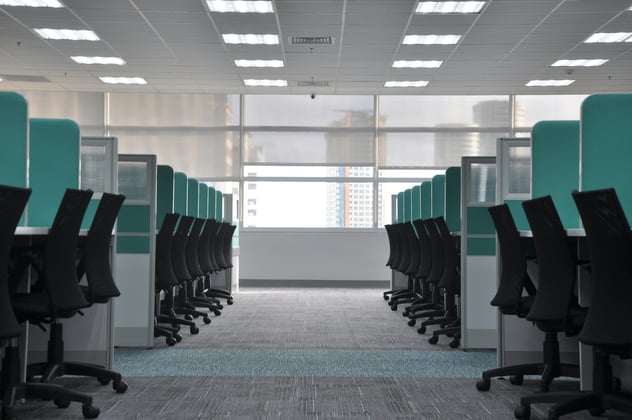
Then the data comes back. The floor is 40% vacant. There are desks everywhere.
So what's actually going on?
The desk is a scapegoat
When employees say they can't find space, they rarely mean desks. They mean they can't find a conference room for the 10 a.m. call. They can't find a quiet focus space. They walked in, scanned the floor, and their regular spot was taken or looked taken, and the feeling of not belonging somewhere translated into a complaint about capacity.
There's a psychological dimension to this. For many employees, a desk isn't just a place to sit. It's a signal of belonging. A sense of having a place. When that anchor is gone, the experience of the office shifts from familiar to uncertain, and uncertain reads as inadequate.
Across VergeSense's benchmark dataset, desk demand remains low while enclosed conference rooms and focus spaces hit shortage rates of 80%+ between 10 a.m. and 2 p.m. on peak days.
What a shortage actually means
VergeSense defines a shortage as a condition where 80% or more of a specific space type is simultaneously in use. When 80% of your small conference rooms are occupied at 10 a.m. on a Tuesday, any employee looking for one faces a shortage. They may find a room, but with difficulty and friction.
That friction matters. It affects productivity. It affects the employee's perception of the office. And it affects whether they choose to come back the following week.
Shortage data across the VergeSense benchmark shows a consistent pattern: enclosed collaboration spaces and enclosed focus spaces hit shortage conditions regularly between 10 a.m. and 2 p.m. on weekdays. Open desks, meanwhile, remain well below shortage thresholds throughout the same windows.
The dirty dishes case study
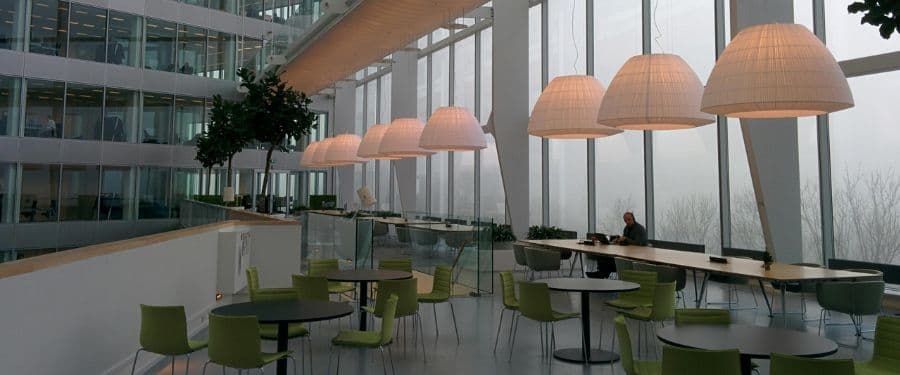
One VergeSense customer experienced a concrete version of this dynamic when their office dishwasher broke. Plates accumulated on desks. Personal items spread across workstations. To anyone walking the floor, the office looked full.
But sensor data told a different story. Occupancy was normal. The desks weren't occupied. They were claimed, passively, by the artifacts of the people who'd been sitting there earlier and had moved on.
The qualitative experience and the quantitative data were in direct contradiction. Employees escalated a space problem. The actual problem was a broken appliance and the downstream behavior it triggered.
This isn't an unusual situation. It's a concentrated version of what happens across office floors every day: space that looks full isn't full, and the complaints that follow are symptoms of a different underlying issue.
The Tuesday-Thursday compression problem
Layer the day-of-week pattern on top of this and the picture gets worse. Attendance concentrates on Tuesday through Thursday across nearly every portfolio in the VergeSense dataset. Monday is beginning to recover as stricter policies take hold, but Friday remains low.
The result is that the same space that feels oversupplied on Monday and Friday feels undersupplied on Tuesday and Wednesday. The building hasn't changed. The demand has concentrated.
Some organizations are beginning to use team rotation and staggered booking to distribute demand more evenly across the week. Without data on when and where shortages are actually occurring, those interventions are guesswork.
The question shortages are actually asking
Shortages aren't necessarily a failure. An organization that runs at 80% capacity on its conference rooms on Tuesday afternoons is, in one interpretation, making efficient use of its real estate investment.
The question is whether that level of compression is acceptable, and the answer depends on the organization's priorities. A team that's recently rightsized its portfolio may accept more frequent shortages as the cost of a leaner footprint. A team prioritizing employee experience may set a lower threshold.
What's not acceptable is not knowing. Organizations that can't answer basic questions about which space types are under pressure, when, and how often, can't make defensible decisions about what to build, reconfigure, or cut.
VergeSense Predictive Planning, powered by the Large Spatial Model trained on 200 million square feet of real occupancy data, lets teams model space supply against real demand patterns, including the peak conditions that drive employee experience complaints, before making layout or portfolio commitments.
Diagnosing the right problem
The most effective response to an employee complaint about space isn't to add desks. It's to ask what kind of space the employee actually needed, when they needed it, and whether that type of space was genuinely unavailable or simply hard to find.
More often than not, the answer points to conference room availability, focus space supply, or the perception of fullness created by how the floor looks, not how it's actually used. The data is there. Most organizations just aren't looking at it.
See how VergeSense Predictive Planning can help your team stop reacting and start planning. Request a demo, or watch the full 9th Edition Occupancy Intelligence Index webinar to see the complete data.
.jpg)