




If you've been in workplace strategy or corporate real estate for the past few years, you've probably lived some version of this cycle: new leadership comes in, attendance policy tightens, the office doesn't get meaningfully fuller, and six months later you're replanning against a budget that doesn't match the space, the behavior, or the mandate. Then it happens again.
It's not one thing going wrong. It's everything shifting at once, and the playbook most teams are running wasn't built for this kind of compounding pressure. The numbers make it plain.
12% Stricter. 1–3% Fuller.
Between mid-2024 and Q3 2025, U.S. companies increased required in-office days by 12%. Actual attendance over the same period only increased by 1-3%. Badge data still shows offices at roughly 56% of pre-pandemic levels. Remote work days have held steady at about 2.5 per week since mid-2023.
That's the headline. But the story underneath it is worse, because the pressure is coming from everywhere at once.
The Cascade Nobody Planned For
CEO turnover hit historic highs in 2024 and 2025, over 2,000 departures in the U.S. alone. A third of newly named CEOs were interim appointments, and when new leadership arrives, the pattern is predictable: tighten attendance policy first, because it’s the cheapest, fastest lever a new executive can pull.
So the cycle runs on repeat: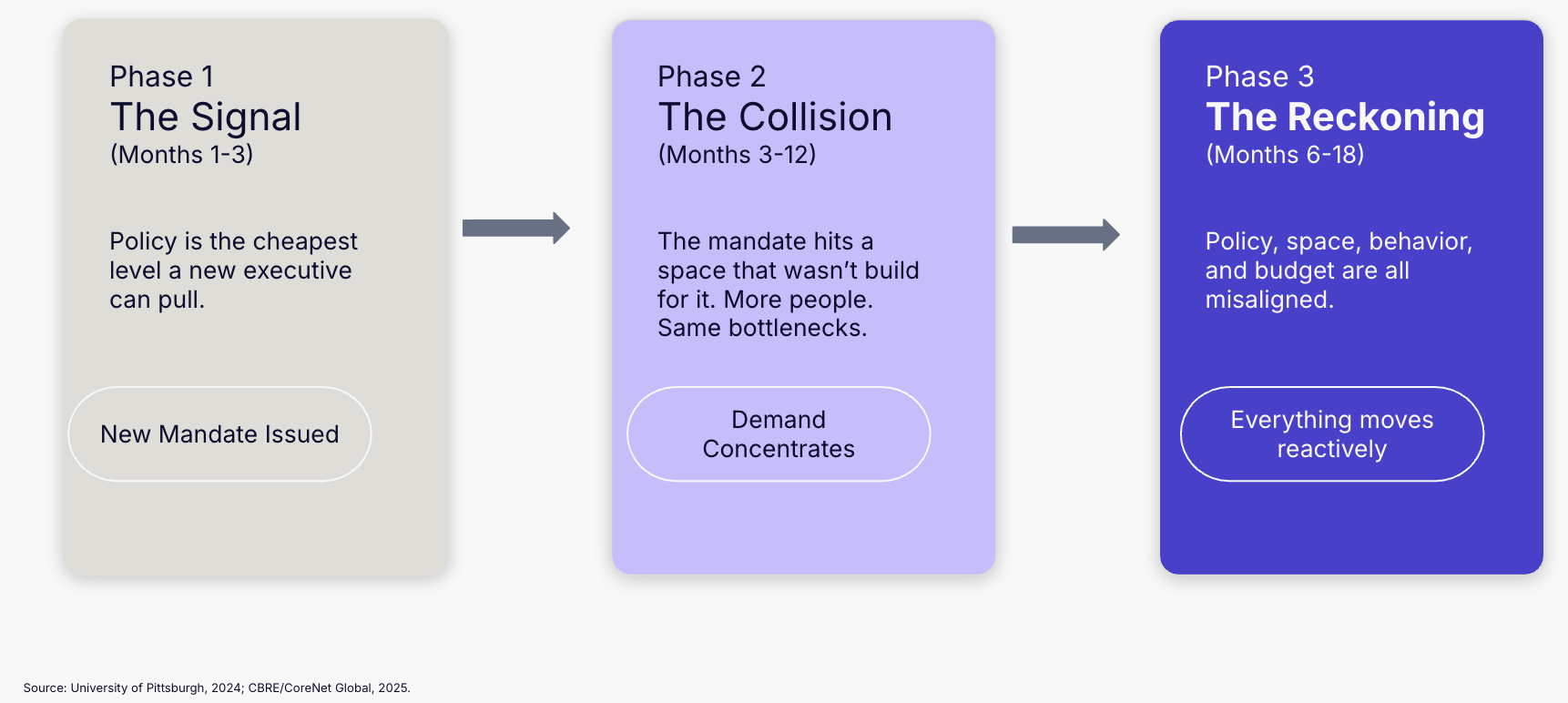
When a third of incoming CEOs are interim appointments, the strategy they bring is temporary. The space decisions employees live with are not.
"A new CEO comes in, their numbers look bad on the first earnings report, and now it's anticipated they're going to cut. That one leadership change impacts everything: space, policy, budget, all at once." — Brad Golden, Workplace Insights & Advisory
The AI Smokescreen

Layer on one more pressure: layoffs framed as AI-driven efficiency. When companies restructure in the name of transformation, real people lose their jobs, and the workplace absorbs the impact regardless of the actual driver.
For the teams trying to plan through this, one of the dangers is that these layoffs muddy the signal. When you're trying to read behavioral data to make space decisions, and the headcount underneath that data keeps shifting for reasons that have nothing to do with workplace strategy, the ground you're planning on becomes unreliable. The chaos compounds.
"Some of what gets blamed on AI-efficiency layoffs is really a real estate and business strategy problem wearing a press release." — Izzy Cannell, Workplace Insights & Advisory
The Compounding Problem
This is what the top-down playbook misses. It's not one failed mandate. It's the compounding effect. Leadership changes trigger policy changes, which trigger enforcement that doesn't produce results, which triggers budget pressure. Each layer widens the gap between what employees are told will happen and what they actually experience.
And people feel it. The first thing that changes after a leadership transition isn't the floor plan. It's certainty. Employees lose the ability to predict what their work environment will look like next quarter. You can mandate presence. You can't mandate stability.
The instability isn't a phase. For most workplace teams right now, it's the operating condition. And if the last three years have felt like chaos, this is a big part of why.
The answer isn't to stop making policy or stop responding to leadership changes. It's to stop planning as though the ground is stable when it clearly isn't. The organizations that navigate this well won't be the ones with the strictest mandates. They'll be the ones with systems that can absorb the volatility and adapt in real time, instead of replanning from scratch every time the snow falls again.
The Q1 2026 Index is live now, and it puts our occupancy data next to the external trends shaping the planning landscape, floor by floor, hour by hour. If what you've read here resonates, the full report tells a sharper story.
Download the Q1 2026 Workplace Occupancy & Utilization Index


.png)