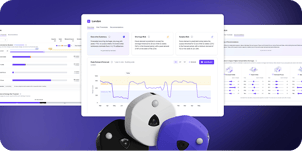

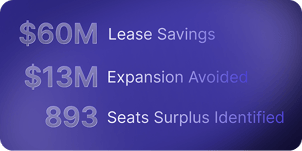



A lease decision is three months out, the attendance policy just changed again, and leadership wants to know whether you can hand back a floor without breaking the ones you keep. The platform you pick for space planning and utilization decides whether you answer that with measured evidence or an educated guess.
This guide compares six platforms on what separates them on the decision-making process and outcome: how accurately each measures occupancy, how far its planning and forecasting reach, how it holds up across a global portfolio, and whether its outputs survive a CFO review.
They cover the two sides of the decision CRE leaders are weighing, the platforms built to plan space and the platforms built to measure it:
- VergeSense: AI-driven predictive planning with occupancy intelligence
- OfficeSpace Software: Booking-led workplace management with utilization analytics
- Kadence: Hybrid workplace operations with AI-assisted space planning
- Trebellar: Data-agnostic AI analytics and portfolio planning
- XY Sense: Sensor-based occupancy measurement and analytics
- Density: People-counting sensors with workplace analytics
Working through portfolio decisions without data to back them?
See how VergeSense helps CRE leaders measure real utilization, model future demand, and make portfolio decisions with confidence in minutes, not months.
At-a-Glance Comparison of Space Planning and Utilization Platforms
Use this table to compare platforms on approach, data and analytics, planning depth, and fit.
|
Tool |
Best For |
Core Approach |
Data Inputs |
Analytics & Planning Depth |
Best-Fit Buyer |
|
VergeSense |
Turning measured occupancy into portfolio, lease, and capital decisions |
Occupancy intelligence with AI-driven predictive planning on the Large Spatial Model, trained on 250M+ sq ft across 200+ enterprises |
Infinity Area Sensors, WiFi, badge, booking, floor plan data, video conferencing data |
Scenario modeling, demand forecasting, and CFO-ready outputs from portfolio, design, and zone level |
Enterprise CRE and workplace strategy teams making high-cost decisions |
|
OfficeSpace Software |
Running booking and utilization reporting on one platform |
Booking-led workplace management with floor plans and analytics |
Booking, presence, and third-party sensor data (including VergeSense) |
Strong for reporting on what already happened; lighter on forward planning and financial modeling |
Workplace and facilities teams managing daily operations |
|
Kadence |
Running booking, attendance, and planning on one platform |
Hybrid workplace operations (WorkOps) plus AI-assisted planning (SpaceOps) |
Desk and room bookings, check-ins, attendance, and team-cluster data |
AI planning agent, scenario modeling, stack planning, and move management |
Mid-market workplace teams wanting plan-to-execute in one tool |
|
Trebellar |
Unifying scattered CRE data under an AI analytics layer |
Data-agnostic, AI-native analytics over whatever data you bring |
Badges, WiFi, third-party sensors, bookings, lease/OPEX, HRIS, market data |
Conversational AI agent, scenario modeling, generative reports, site selection |
CRE teams with data in many systems who want an AI copilot |
|
XY Sense |
Wide-coverage sensor measurement of open and meeting spaces |
Wired ceiling sensors paired with analytics dashboards |
Area Pro and Presence sensors (people count; no object detection) |
Measures and visualizes utilization in detail; planning and financial modeling sit outside the platform |
Teams prioritizing sensor coverage and fast polling |
|
Density |
Accurate, privacy-first people counting |
Radar and depth sensors plus the Atlas analytics platform |
Open Area, Entry, and Waffle sensors (real-time people count) |
Measures and visualizes occupancy continuously; forecasting and portfolio planning sit outside the platform |
Design-conscious orgs wanting always-on, camera-free counting |
Best Platforms for Space Planning and Utilization in 2026
Every platform below was assessed on four areas: the accuracy of its occupancy data, the depth of its decision-support and planning tools, its ability to scale across a global portfolio, and how directly it moves teams from measurement to action.
1. VergeSense
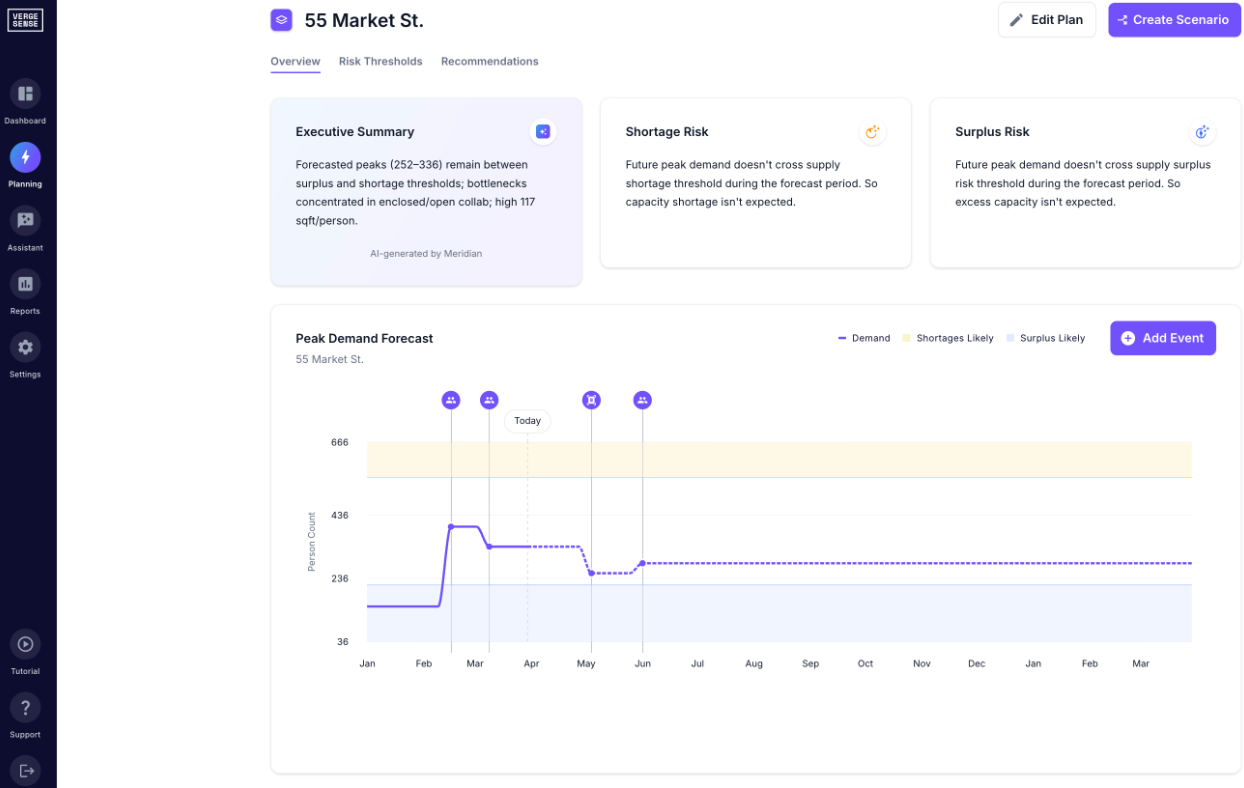
VergeSense is built for CRE leaders who need two things at once: accurate measurement of how space is actually used, and a forward-looking planning layer that turns that measurement into decisions.
Occupancy Intelligence captures utilization from portfolio down to individual zones, while Predictive Planning models changes to headcount, policy, and layouts to see the impact on space demand using the Large Spatial Model, trained on 250M+ sq ft of measured workplace data.
The result is a platform that supports the full arc from current-state measurement to future-state portfolio strategy.
Selected features
- Predictive Planning: models headcount, policy, lease, and layout scenarios against measured demand before any capital is committed
- Large Spatial Model: the AI foundation behind Predictive Planning, trained on 250M+ sq ft of real workplace behavior so forecasts reflect how people actually use space
- Occupancy Intelligence: measures real utilization from portfolio level down to individual zones, beyond what badges and bookings capture
- Portfolio-to-zone granularity: drills from whole-portfolio trends to neighborhood- and zone-level detail for precise planning decisions, based on any occupancy signals you have, from floor plans, badge, videoconferencing data, WiFi, sensors, and more
- Infinity Area Sensor: wireless sensor with 10 year battery life that captures ground-truth usage with 95% accuracy, plus the ability to detect passive occupancy
- Workplace Assistant: conversational AI layer for querying occupancy and planning data in plain language
- Integrations: native connections to Logitech, Microsoft Places, ServiceNow WSD, Juniper Mist, and Cisco Meraki so insights flow into systems teams already run
Best for
- Portfolio right-sizing and lease cost avoidance grounded in measured utilization, drawing on sensor, badge, WiFi, and booking inputs together, backed by 250M+ square feet of real, measured data
- Modeling policy and headcount changes against measured demand before committing to a layout, lease, or consolidation
- Justifying capital and lease decisions to CFO and executive stakeholders with scenario outputs built for leadership review
- Connecting current-state occupancy to forward-looking planning in a single platform, so measurement and strategy never live in separate tools
A real-life example: the floor they almost gave back
A global technology company was about to surrender a floor in its Tokyo office: average utilization looked low enough to justify the cut. VergeSense data showed the opposite risk: peak usage was trending above 50%, past the team's own benchmark, which meant giving up the floor would have triggered overcrowding on the busiest days.
They kept it. Then they used the same occupancy data in the other direction, removing 50–100 genuinely idle workstations per floor elsewhere in the office, which allowed them to shed space where it sat empty while protecting capacity where demand actually peaked.
Comparing platforms but unsure what support your decisions actually need?
See how VergeSense models the impact of your proposed changes to plan your spaces with confidence.
Book a Demo →
2. OfficeSpace Software
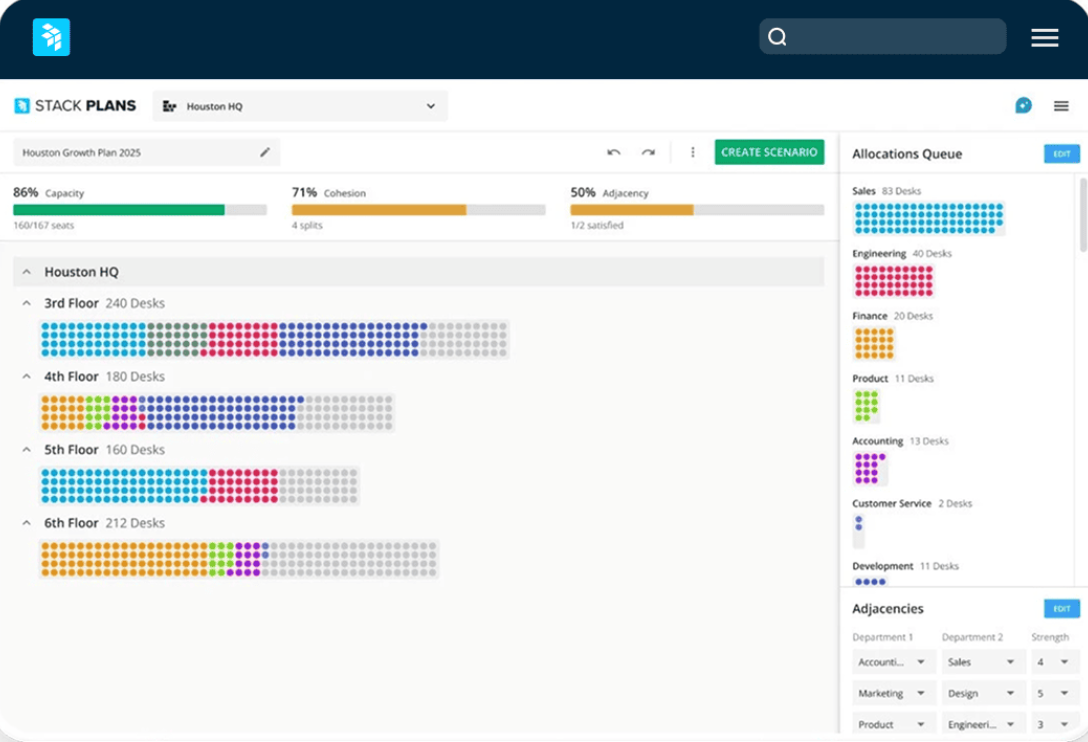
OfficeSpace Software is a booking-led workplace management platform that puts interactive floor plans, desk and room booking, and utilization analytics on one system.
Its analytics run primarily on booking and presence data; for sensor-grade occupancy, it integrates with third-party sensors, including VergeSense.
Backed by a $150M investment from Vista Equity Partners and serving 800+ customers, it fits workplace teams that want to run daily booking operations and retrospective utilization reporting side by side, with AI-assisted stack planning added through its Dojo AI acquisition.
Selected features
- Interactive floor plans
- Desk and room booking
- Insights Agent for plain-language queries
- Heat maps and trend reports
- Move management and stack planning
Example use cases
- Managing daily desk and room booking alongside retrospective utilization reporting in one platform
- Heat-mapping desk and room usage to flag underused space across floors
- Pairing cost and utilization views to support facilities-led optimization conversations
3. Kadence
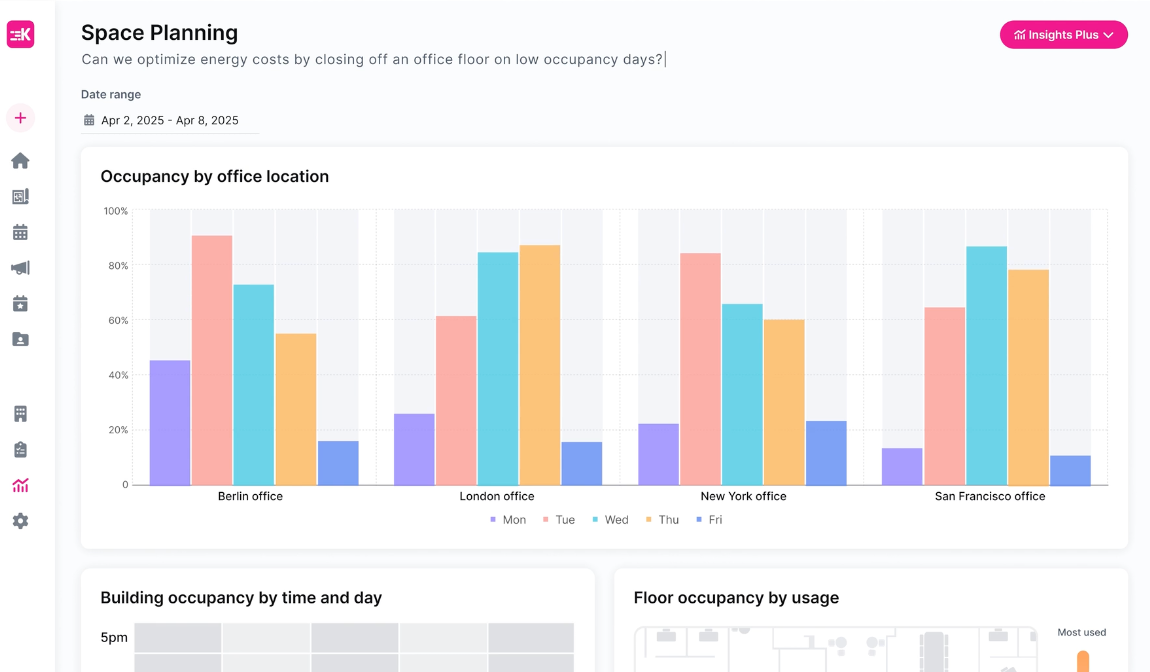
Kadence is a hybrid workplace platform that pairs everyday operations with space planning in one system. Its WorkOps product handles desk and room booking, visitor management, check-in, and team scheduling, while SpaceOps, launched in 2026, adds AI-assisted scenario modeling, stack planning, and move management.
Backed by a $20M Series A and serving 600+ customers across 40+ countries, including Boeing, it fits fast-moving mid-market teams that want booking, attendance, and planning under one roof.
Selected features
- AI Planning Agent: conversational planning in plain language ("consolidate to two floors, keep Engineering next to Product"), with headcount and cost impacts shown inline
- Scenario modeling: forecast seat demand under different attendance policies and model headcount growth, consolidation, or downsizing
- Dynamic stack planning: drag-and-drop layouts across floors and buildings, with cost and collaboration impacts updating in real time
- Move management: automated allocations, dependency tracking, and approval workflows linked directly to updated floor plans
- WorkOps booking suite: desk and room booking, visitor management, automated check-in, and team scheduling feeding the planning layer
Example use cases
- Running desk and room booking, check-in, and team scheduling for a hybrid workforce on a single platform
- Modeling a floor consolidation or policy change and carrying it straight through to seat allocations and moves
- Giving mid-market workplace teams a plan-to-execute workflow without standing up a separate planning tool
The tradeoff
SpaceOps is built on booking, check-in, and attendance signals, which capture what people scheduled rather than what a space actually held. A desk booked and never used reads as occupied; a room booked for twelve and used by three reads as full.
For lease, consolidation, and capital decisions where the gap between intent and measured use runs to millions, teams will want a measured-occupancy layer, and insights from a large benchmark dataset included in the plan.
4. Trebellar
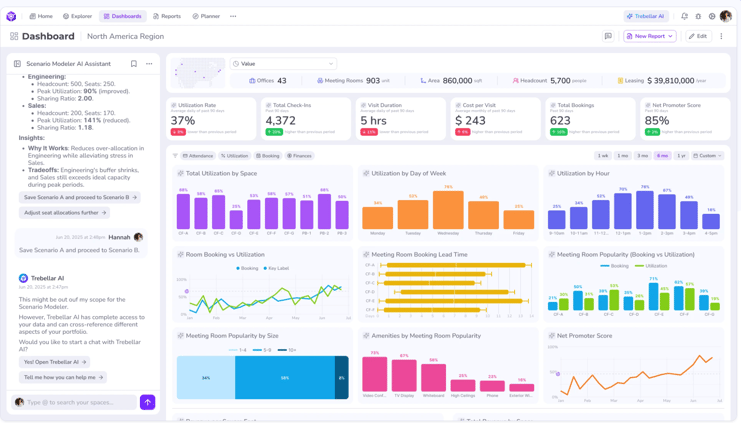
Trebellar is a data-agnostic, AI-native analytics platform for CRE teams, founded in 2022 by ex-Salesforce and ex-Google/Waymo engineers and billed as "the first agent-based AI platform for real estate."
It ingests data from almost any source, badges, WiFi, third-party sensors, bookings, lease and OPEX records, HRIS, and market data, then layers a conversational AI agent, scenario modeling, and generative reporting on top. It fits CRE teams whose data is scattered across systems and who want an AI copilot to unify and interrogate it.
Selected features
- Trebellar AI Agent: conversational copilot that answers portfolio questions, runs analysis, and generates reports from natural-language prompts
- Portfolio Manager: AI-assisted location scoring, lease optimization, and supply/demand rebalancing, built with LiquidSpace flex-space benchmarks
- Unified data layer: data-agnostic ingestion of badges, WiFi, sensors, bookings, lease, HRIS, and market data, with automated normalization
- Predictive analytics: per-customer ML forecasting and anomaly detection across team size, meeting frequency, and peak usage
- Generative reports: AI-written analysis and presentations exportable to PDF or PowerPoint and shareable by link
Example use cases
- Pulling occupancy, lease, and cost data from many systems into one queryable place
- Asking portfolio questions in plain language and generating an exec-ready report from the answer
- Modeling consolidation or lease scenarios and scoring locations for a site-selection decision
The tradeoff
Trebellar's AI copilot and data-agnostic ingestion are real strengths, and its market-research tools cover site selection that occupancy platforms skip. The tradeoff: it generates no occupancy data of its own and trains per customer, so its forecasts go only as deep as the data each team brings, with no underlying cross-portfolio behavioral benchmark.
5. XY Sense
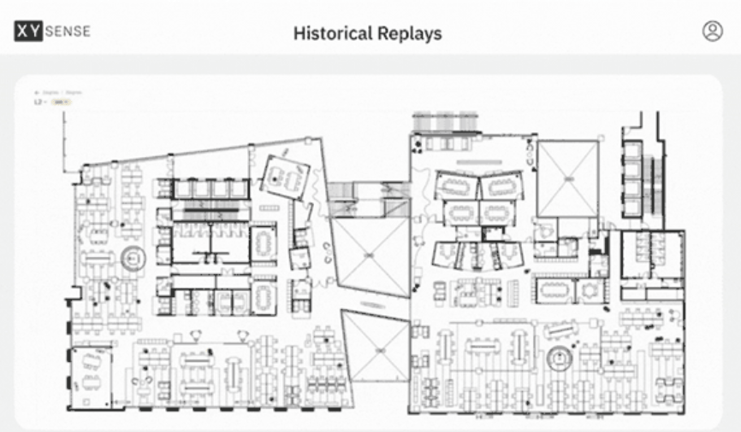
XY Sense is a sensor-based occupancy measurement platform: wired ceiling sensors paired with analytics dashboards. Founded in Australia and now operating across the US, UK, and India, it reports 59,000+ spaces monitored.
Its 2026 Area Pro sensor claims up to 3,000 sq ft of coverage and detection of up to 255 people per sensor, with a separate wireless Presence sensor for pods and phone booths. It fits teams that want broad sensor coverage and frequent polling across open and meeting spaces.
Selected features
- Area Pro sensor: wired ceiling sensor with up to 3,000 sq ft coverage, on-device AI, 2-second updates, and a claimed ~99% counting accuracy
- XY Sense Presence: wireless, battery-powered sensor for small enclosed spaces like pods and phone booths
- Live views and heatmaps: real-time floor visualizations of how open and meeting spaces are occupied
- Replays: play back historical occupancy to see how a space filled and emptied across a day
- Desk and room analytics: utilization reporting across workstations and meeting rooms, with self-service commissioning
Example use cases
- Covering large open floors and meeting areas with fewer sensors per square foot
- Monitoring real-time and historical utilization of desks and meeting rooms across a building
- Standing up sensor coverage quickly, with self-service recommissioning after a floor reconfigure
The tradeoff
While XY Sense measures and reports occupancy, it stops short of predictive planning or scenario modeling, can’t detect passive occupancy, and relies on wired hardware.
6. Density
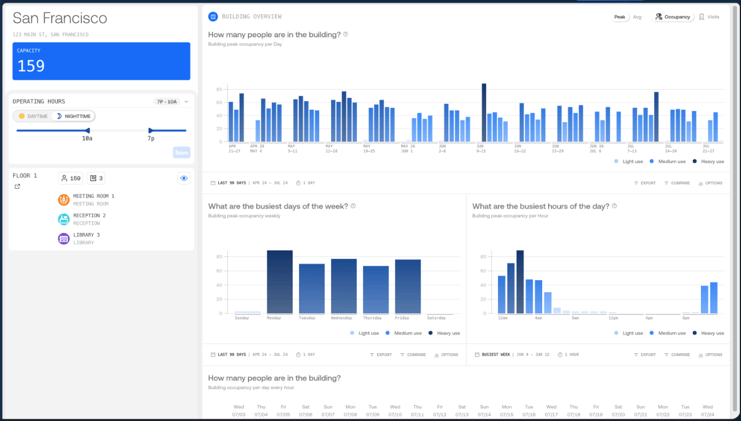
Density is an occupancy sensor and analytics company founded in 2014, built around radar and depth sensors paired with its Atlas analytics platform. Its hardware counts people in real time without cameras, a privacy-first stance it markets heavily, and its 2024 Waffle line added a low-cost, self-install option for rooms and desks.
It fits design-conscious organizations that want accurate, always-on people counting and real-time space-availability displays for employees.
Selected features
- Open Area sensor: ceiling-mounted millimeter-wave radar that counts exact headcount across spaces up to ~1,000 sq ft
- Waffle: $149 self-install radar sensor for rooms and desks, counting 0, 1, 2, or 3+ people with sub-second updates
- Atlas analytics: utilization, heatmaps, dwell time, and surplus metrics across floors and spaces
- Live Wayfinding: real-time maps and a mobile app showing employees which spaces are open right now
- Adaptive Cleaning: occupancy-driven cleaning schedules that follow actual use
Example use cases
- Counting people in open areas and meeting rooms in real time without deploying cameras
- Standing up low-cost room or desk sensing quickly with self-install Waffle units
- Driving live space-availability displays and occupancy-based cleaning from one platform
The tradeoff
Atlas provides descriptive analytics, so it reports what happened without forecasting demand or modeling scenarios, it needs Density's own hardware to see anything, and radar counts people but misses passive occupancy, a desk claimed by belongings.
Key Features and Capabilities to Prioritize in Space Planning and Utilization Platforms
A feature checklist will not separate these platforms. Most include dashboards, data ingestion, and some form of analytics. What separates them is how well each capability holds up when a real decision is on the line, and that is what the dimensions below are built to test.
Planning and Forecasting Capabilities
The highest-value questions in space planning are forward-looking. What happens to floor demand if headcount grows? If the attendance policy moves from two anchor days to three? If a lease renewal forces a consolidation, will the remaining floors actually support the expected demand for space?
Forward-looking modeling is where most tools fall short. They can describe last quarter in detail but offer little when you need to plan next year. Predictive Planning addresses this directly: teams can model headcount changes, policy shifts, lease scenarios, and floor plan redesigns against demand patterns learned from measured workplaces, before any capital is committed.
AI Capability and How the Model Is Trained
Most platforms now claim AI capability, but the label says little on its own. What matters is what the model learned from. AI trained on a single customer's history can only replay that customer's past, while AI trained on broad, measured workplace behavior across many buildings and organizations can recognize patterns a single portfolio never sees.
When a vendor cites AI-driven forecasting, ask what data trained the model, how large and how real that dataset is, and whether it reflects observed behavior rather than assumptions.
Historical Reporting Depth Versus Decision Support
There is a meaningful difference between dashboards that describe what happened and platforms that help teams decide what to do next. Utilization trends, heat maps, and peak-versus-average charts are table stakes. They answer "how is the space being used?" but not "should we renew this lease?" or "which floor do we give back?"
The decision-support layer is what closes that gap: predictive planning, scenario modeling, and what-if capabilities that attach a forecast and a financial impact to each option. When evaluating, ask to see how a platform supports an actual decision, not just how it visualizes data.
Occupancy Data Accuracy & Deployment Approaches
No single data source tells the whole story of how space is used. Badge data captures building entry, not what happens once people are inside. Booking data captures intent, including rooms reserved and never occupied. WiFi gives building-level counts with little room-level precision. Each source answers part of the question and undercounts actual usage, and each can mislead in the other direction too.
The better path is not picking one source but combining the inputs you already have. Badge, booking, WiFi, and videoconferencing data each add a layer, and passive occupancy detection adds what the others miss by measuring what is actually happening in a space, including belongings claiming it. Together they fill in occupancy trends for spaces you may not measure directly, giving you a more complete view of how the portfolio is actually used without instrumenting every room first.
The stakes of getting this right are visible in the data: the 9th-edition Workplace Occupancy & Utilization Index found average utilization held between 9% and 11% while peak usage reached as high as 60%. Averages built from bookings and badges alone miss the moments when space is actually constrained, which is exactly when planning decisions go wrong.
This flexibility also shapes how quickly you see value. Tapping into the occupancy inputs you already have, badge, booking, WiFi, and videoconferencing data, means you can stand up a view of utilization or forward-looking planning without waiting on hardware. Sensor deployment adds depth where you need it, but rolling out hardware across a portfolio takes time, and that lag is a gap in time to value.
Starting with existing data lets you begin planning now and layer in sensor precision where it makes the most sense.
Enterprise Readiness and Scalability
A platform that works for one headquarters building may not survive contact with a global portfolio. Evaluate for multi-country deployment, coverage across space types (open desks, meeting rooms, collaboration areas, labs), and multi-stakeholder access so CRE, workplace strategy, facilities, and finance teams can each work from the same data.
Integrations matter at this scale as well. Native integrations with Microsoft Places, ServiceNow WSD, Juniper Mist, and Cisco Meraki work in both directions: they pull the occupancy, badge, booking, and space inputs that feed accurate planning, and they push intelligence back into the tools an enterprise already runs rather than creating another silo.
Outputs That Different Stakeholders Can Use
The same underlying data and the plans built on top of it, should serve different audiences without manual rework. Real estate teams need cost-justification outputs: scenario comparisons with financial impact attached, ready for a capital or lease review. Workplace strategy teams need planning views that show how a layout or policy change plays out before it is committed, plus experience data on where space helps or hinders how people work.
Facilities teams need operational data granular enough to act on, down to cleaning schedules and service routing.
A platform that can only speak to one of these audiences, or that measures well but cannot turn those measurements into forward-looking plans, pushes the translation work back onto your team. Look for evidence that outputs are generated for each stakeholder from the same underlying data, not exported and rebuilt in slides.
How to Choose a Space Planning and Utilization Platform for Your Team and Workflows
The questions below narrow the field based on three things: your portfolio's maturity, the data environment you already have, and the decisions the platform needs to support. Answer the internal questions first; they determine which vendor answers matter.
Questions to Ask Internally
- Are we trying to measure current utilization, forecast future space demand, or both?
- What signals do we trust today, whether badge, booking, sensor, or WiFi, and which gaps are blocking decisions?
- Do we need portfolio-level insight, floor-level insight, or neighborhood- and room-level planning detail?
- Are we optimizing for lease cost avoidance, capital planning, employee experience, or design decisions?
- Will we need to justify high-cost lease, layout, or consolidation decisions to leadership with hard data?
- How important is deployment flexibility: sensors, WiFi, software-only inputs, or a mix?
- Who will use the tool day-to-day: CRE, workplace strategy, planners, facilities, finance, or design?
Questions to Ask Vendors
- How is occupancy measured, and how accurate is that method in spaces where bookings underrepresent actual use?
- What data sources can the platform ingest besides its own native product?
- Can the platform support planning and forecasting, or is it limited to historical reporting?
- What level of granularity does the product support: portfolio, building, floor, neighborhood, room, desk?
- Can the platform model the impact of headcount changes, policy changes, or floor plan changes?
- What does deployment look like, and what is typical time-to-value?
- How are insights surfaced to different stakeholders, and what outputs are usable in leadership discussions?
- What differentiates the platform from badge data, booking tools, or general IWMS software?
See your portfolio as it is actually used, then plan what comes next with confidence.
VergeSense helps CRE leaders turn real occupancy into lease, capital, and design decisions they can defend.
FAQs About Space Planning and Utilization Platforms
What is the difference between a space planning platform and an IWMS?
An IWMS is a system of record. It manages what already exists: leases, assets, maintenance, and current space inventory. A space planning and utilization platform measures how space is actually used and forecasts how demand will change before you commit to a lease, layout, or consolidation. One tells you what you have; the other tells you what to do next. Many enterprises run both, with the planning platform feeding inputs to the IWMS.
Can WiFi-based occupancy data replace sensor data for space planning decisions?
On its own, no, but it doesn’t have to be a choice between them. WiFi data is useful and fast to deploy for directional, building-level trends, and it becomes more valuable as one input among several.
This is where the Large Spatial Model matters: trained on 250M+ sq ft of real occupancy across 200+ enterprises, it interprets the inputs you already have, WiFi, badge, booking, and videoconferencing data, against learned behavioral patterns, so you get a fuller read on utilization even in spaces you have not instrumented with sensors.
The strongest approach combines those existing signals with sensor measurement, where you need room- and desk-level precision. High-stakes lease and layout decisions draw on the fullest picture, not a single source.
How does space planning software support lease renewal and portfolio decisions?
By replacing assumptions with evidence. Measured utilization shows how much space is genuinely needed, and scenario modeling forecasts how demand changes under different headcount or policy conditions. That lets teams quantify the impact of renewing, downsizing, or consolidating before signing.
How long does it take to deploy a space planning and utilization platform?
It varies by deployment model. Software-only and WiFi-based setups can be live in days by tapping data you already have. Wireless sensor deployments typically take weeks, since they install without cabling. Predictive Planning can start even sooner: scenario modeling requires only a floor plan and workforce inputs, no sensors required.