



If you’re responsible for real estate planning, workplace strategy, or facilities operations, you’re living in the gap between what people say they need and the reality of what the building can support. Data can only get you so far - you need to also be prepared to defend your recommendations. The moment a stakeholder asks, “How confident are we in this?” or “Where is that number coming from?” the conversation shifts from insight to credibility.
This month’s VergeSense product updates are built to close that gap. We focused on two things:
- Predictive Planning: making forecasts more explainable and decisions more defensible
- Occupancy Intelligence: making the underlying data clearer, more connected, and easier to trust
Read on to learn more about what’s changed and what it unlocks for the decisions you’re making right now.
Predictive Planning: From Insight to Defensible Action
One of the hardest parts about planning is getting alignment amongst stakeholders and feeling confident that the path you choose you can explain, defend, and move forward with.
February’s Predictive Planning updates enable you to:
- Build further confidence in the forecast
- Quantify employee experience tradeoffs
- Define realistic capacity boundaries
- Answer “what if” questions faster (without rebuilding the story in a deck)
Defensible forecasts, powered by updates to the Large Spatial Model (LSM)
.gif?width=1182&height=684&name=Untitled%20design%20(3).gif)
The upgraded Large Spatial Model now runs 1,000 Monte Carlo simulations to surface the highest-probability expected usage. Instead of a single-point estimate, you get a probabilistic view of how the space is most likely to perform. A single forecast number is rarely enough. Leaders want to know why it’s the likely outcome, and what the range of outcomes looks like if attendance shifts.
Why it matters: This changes the tone of the conversation from: “Here’s what we think will happen” to “Here’s what the model shows is most likely, and how confident we are.”
It’s the difference between a directional forecast and a plan you can stand behind in a leadership meeting.
Measuring Employee Experience Risk Tradeoffs
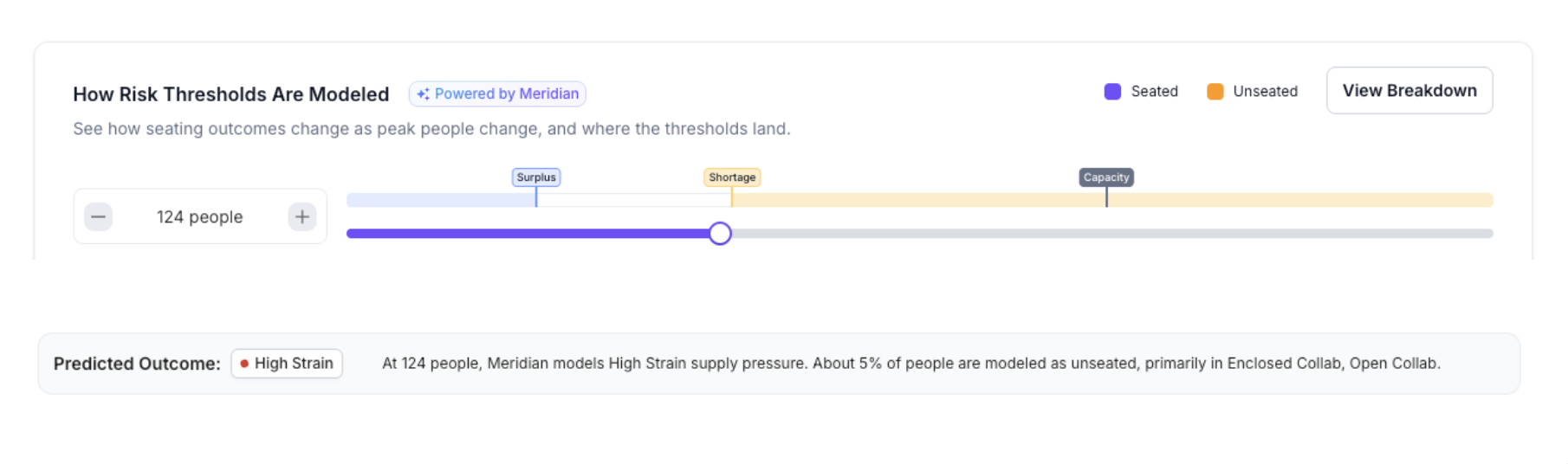
Employee Experience Risk is now a measurable output. The LSM can now quantify the percentage of employees likely unable to find their desired space type at any given attendance level and floor plan design.
With these updates, you can now:
- Model experience tradeoffs before policy or design changes
- Compare scenarios side by side using a consistent metric
- Align leadership on a clear risk threshold (instead of debating anecdotes)
When someone asks, “What happens if Tuesdays jump by 20%?” you can answer with specificity, not speculation.
Identifying the Optimal Operating Window with Capacity Boundaries
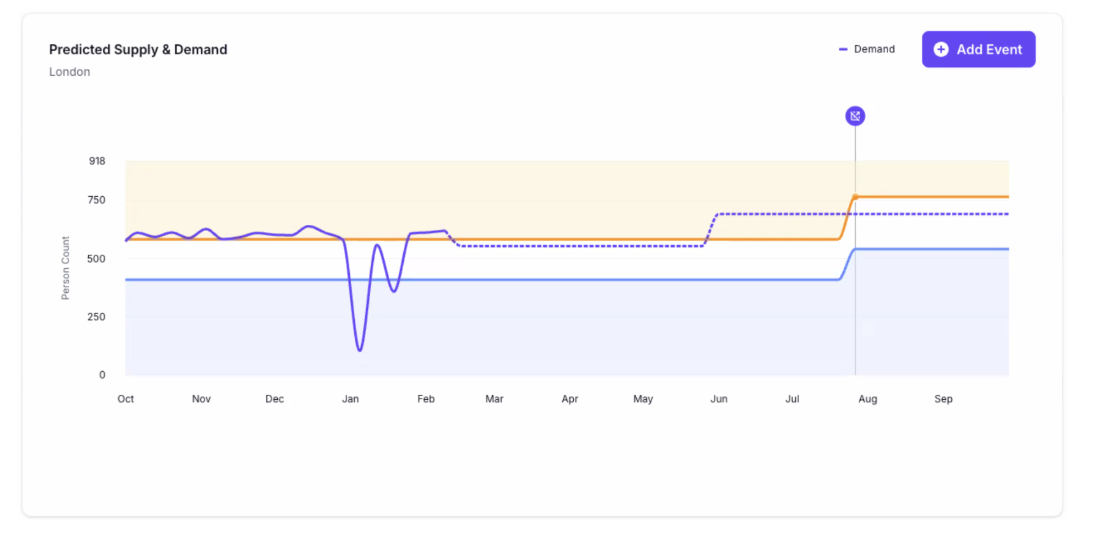
Meridian now defines capacity boundaries by identifying the optimal operating window for each floor, grounded in how people actually show up, not a theoretical maximum.
You get:
- A sustainable capacity range for each floor
- A clear view of when demand shifts push a floor into surplus or shortage
- A shared line in the sand for when a space is truly undersized or oversized
This update makes consolidation and growth decisions concrete. Instead of debating whether the latest numbers represent a blip or a trend, the platform draws the boundaries, so you can point to the operating window and say: we’re here, and here’s what needs to change.
Accelerate Your Planning Cycles
Use the arrows on the top-left of the image to navigate through these updates!
Even with a trusted forecast and clear risk metrics, teams still lose time translating insights into action: re-running scenarios, turning outputs into recommendations, and rewriting the narrative for executives.
We’ve released three updates to help speed up your decision-making processes:
- More actionable space design recommendations for design teams: “+1 conference room” instead of generic capacity outputs like “+15 seats.”
- Model new scenario event types: Model headcount growth, policy changes, attendance rates, and peak show-up.
- AI-powered executive summaries: Every plan now comes with a personalized, contextual summary, including where you have surpluses or shortages.
Occupancy Intelligence: Measure with Clarity, Act with Confidence
The best planning strategy falls apart if you don’t trust the data behind it. These updates are about making sure the occupancy data flowing into your dashboards is complete, connected, and unambiguous, so you can act on it without second-guessing.
Native Integration Support for Juniper Mist WiFi Data

We know that for some buildings or projects across your portfolio, tapping into your existing WiFi infrastructure is the fastest way to capture occupancy trends at scale. That’s why VergeSense now supports a native Juniper Mist WiFi integration, managed directly within the platform. If your organization runs Juniper wireless infrastructure, you can ingest and analyze WiFi-based occupancy data alongside your existing sensor data, without separate setup or switching between tools.
With this integration, teams managing large portfolios can layer building-wide and neighborhood-level WiFi trends alongside granular space-level observations from area sensors. That combination gives you a more complete signal for decisions like consolidation, restacking, and targeted improvements—especially when you need scale and detail.
Clearer Labels for Floor Metrics vs. Space Metrics
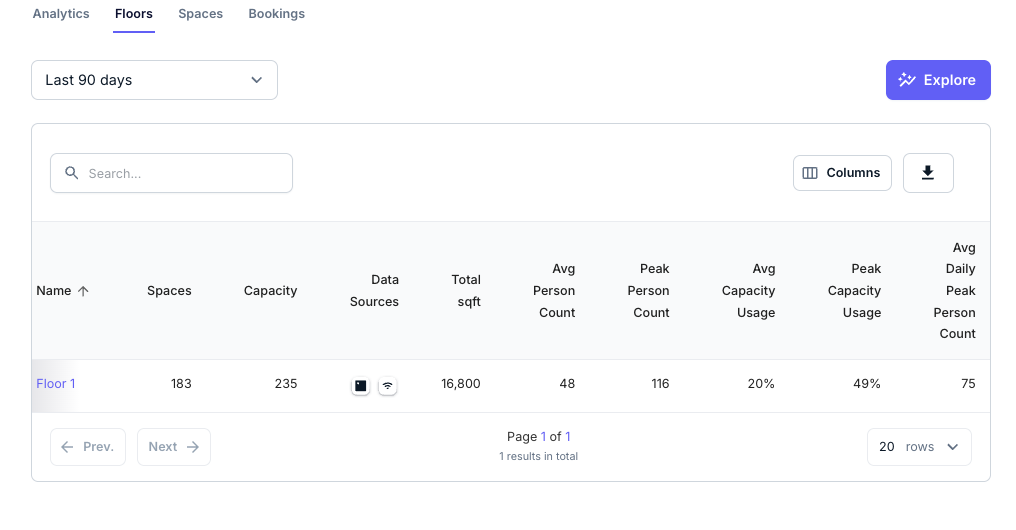
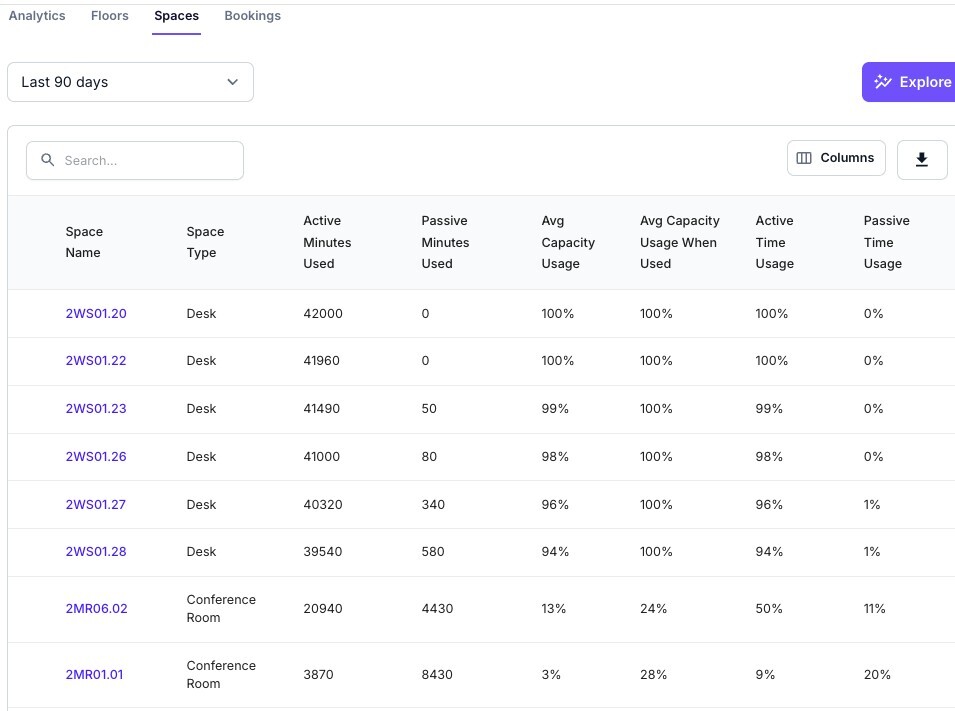
The question we kept hearing: “Which counts are floor-wide, and which are coming from individual spaces?”
We’ve reorganized and relabeled metrics across the platform so the source is clear at a glance:
- Floor metrics (WiFi, entryways) are grouped together
- Space metrics (area sensors) are organized separately
- New labeling makes it obvious what’s driving what you’re seeing
See How These Updates Work for Your Portfolio
Whether you’re consolidating floors, justifying a growth plan, or pressure-testing return-to-office scenarios, these updates were built for the decisions you’re making right now, so you can plan with confidence and align faster.
Want to learn more about these updates? Book a Demo.