


The answer is no, and the data shows exactly where it breaks. Floors don't run out of desks. They run out of enclosed collaboration space, in the middle of the day, every month of the year.
Key takeaways
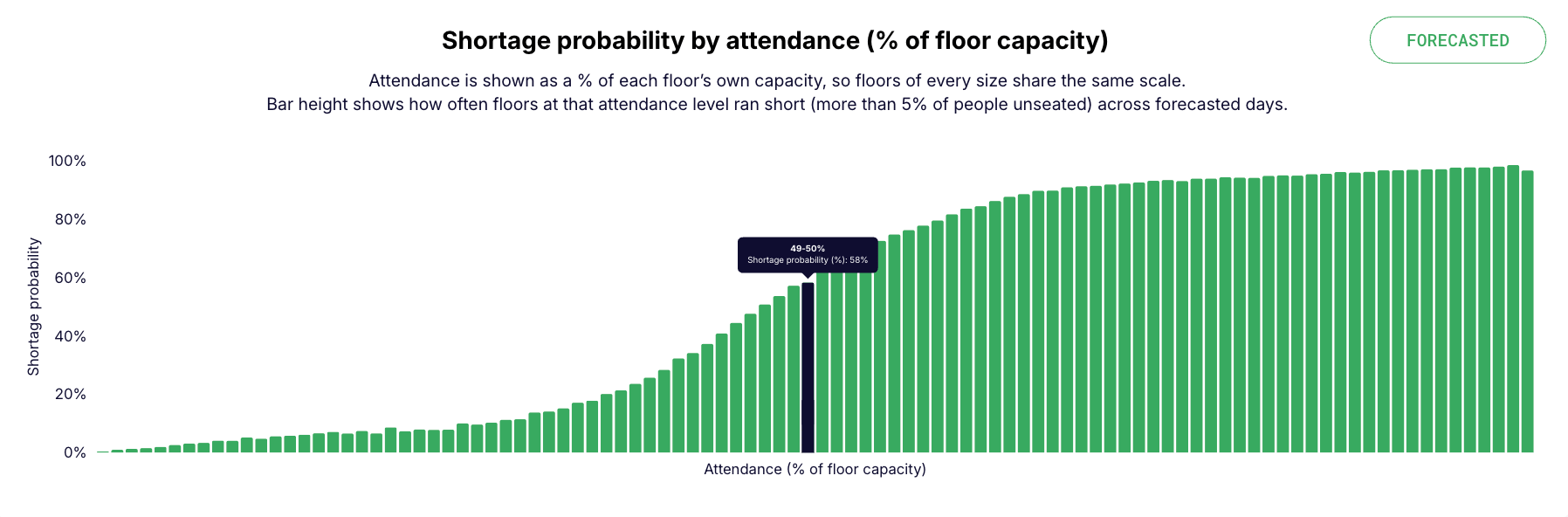
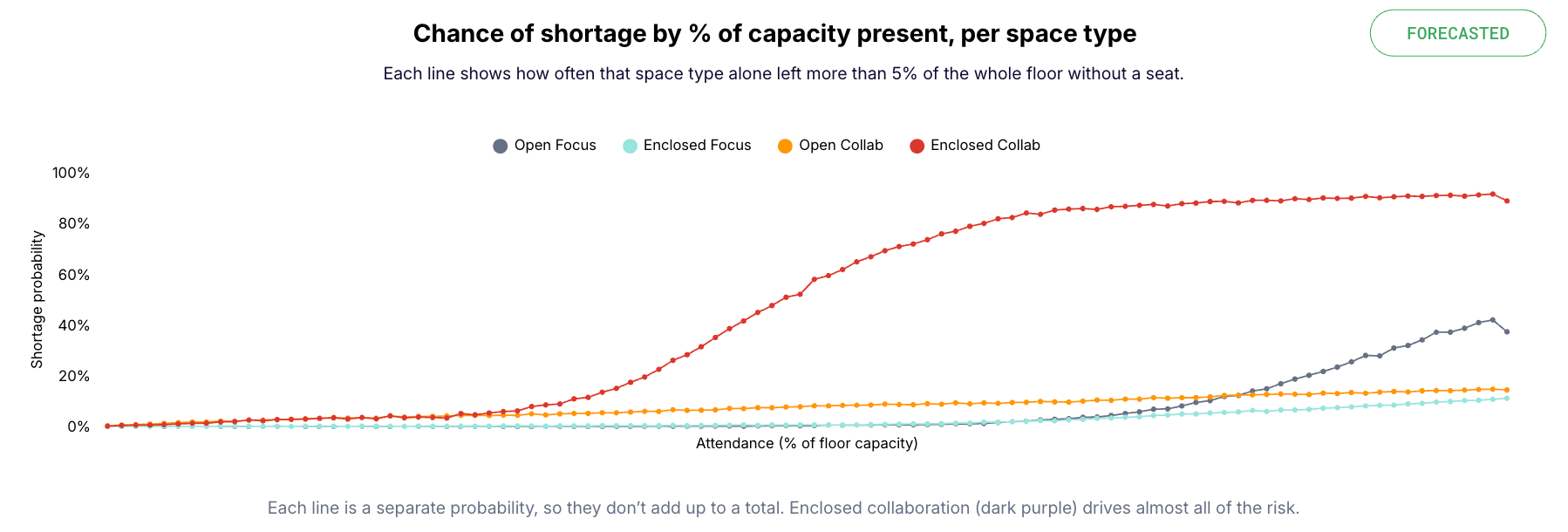
- At 50% of seat capacity, an office floor already has a 58% chance of running short.
- Enclosed collaboration (conference and meeting rooms) drives almost all floor-level shortage risk. Open focus space (desks) doesn't start running short until floors are about 75% full.
- The median floor's Functional Zone, the range where it has enough seats without carrying excess, runs from 31.1% to 42.5% of seat capacity. That's about 11 points of margin.
- Rooms built for 12 or more people are used most, but even at their busiest they rarely fill more than a third of their seats. The average group is under three people.
- Shortage peaks between 10 AM and 2 PM, at about double the rate of the start and end of the day.
How Does VergeSense Measure Office Space Shortage?
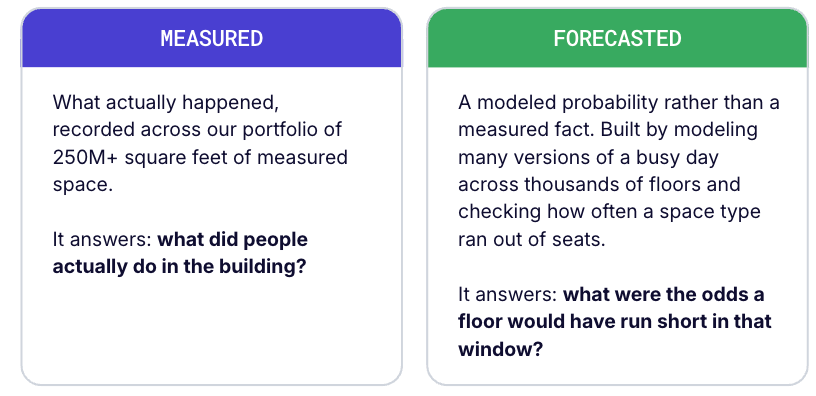
VergeSense measures office space shortage two ways. Measured shortage is a historical event: any hour in which 80% or more of a space type's spaces on a floor were actively in use. Forecasted shortage is a modeled probability: how often a floor would run short, with "short" meaning 5% or more of the people present go unseated.
Shortage is the clearest test of whether a building fits its people. Attendance, cost per seat, and square feet per person describe the building. Shortage describes the moment the building fails a person standing inside it.
At What Attendance Level Does an Office Floor Run Short?
An office floor has a 58% chance of running short at 50% of its seat capacity, according to VergeSense's forecasted data. Shortage risk stays near zero below about 30% of capacity. It climbs steeply from 40% to 70%, from about 30% risk to about 90%. Above 80% of capacity, a shortage is nearly certain.
A floor doesn't fill up. It falls off a cliff.
Planners are usually handed one number and told to plan to it: this floor holds 200 people. The data says that number was never a hard limit. The same floor is nearly safe at 30%, a coin flip at 50%, and almost guaranteed to fail at 80%. There is no single point where a floor becomes full. There is a band where it stops working.
Which Space Type Causes Most Office Shortages?
Enclosed collaboration spaces (conference and meeting rooms) cause most office shortages. In VergeSense's forecasted data, enclosed collaboration alone passes a 50% chance of leaving 5% or more of a floor unseated when the floor is only half full. Open focus space (desks) don’t cause issues until a floor is about 75% full.
By the time desks run short, the floor is already almost certain to fail. Plotted together, the enclosed collaboration curve tracks the whole floor's shortage curve almost exactly. In practice, a floor's breaking point is its meeting rooms' breaking point.
Be precise about what this measures. It counts how many people a shortage reaches, not how often a single space fills. Phone booths fill constantly, but they rarely leave 5% of a floor stranded at once. What the data shows is that when a floor fails at scale, enclosed collaboration is nearly always the reason.
Do People Use Meeting Rooms or Desks More?
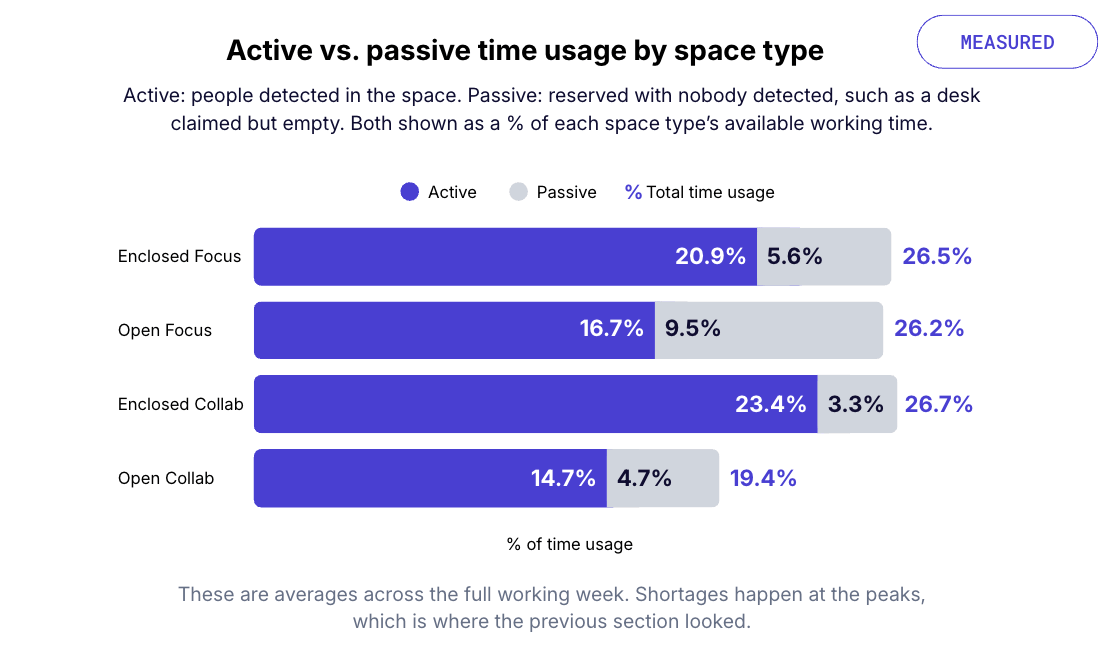
People use meeting rooms more than desks. Enclosed collaboration has the highest Active Time Usage of any space type at 23.4% of available working time, compared with 16.7% for open focus. Desks also sit reserved but empty far more often: 9.5% Passive Time Usage, nearly three times enclosed collaboration's 3.3%.
That means more than a third of the time a desk looks occupied, it's holding someone's bag rather than someone. When a meeting room looks occupied, it genuinely is, about seven times out of eight. Floors are short of the space people come in to use, and oversupplied with the space they claim and leave.
Active Time Usage is time a space is in use with people detected in it. Passive Time Usage is time it is held or reserved with nobody detected. Both are averages across the full working week. Shortages happen at the peaks.
Want to see which spaces run short on your floors?
See how VergeSense helps workplace teams find the space types driving shortage before people feel it.
What Is the Functional Zone?
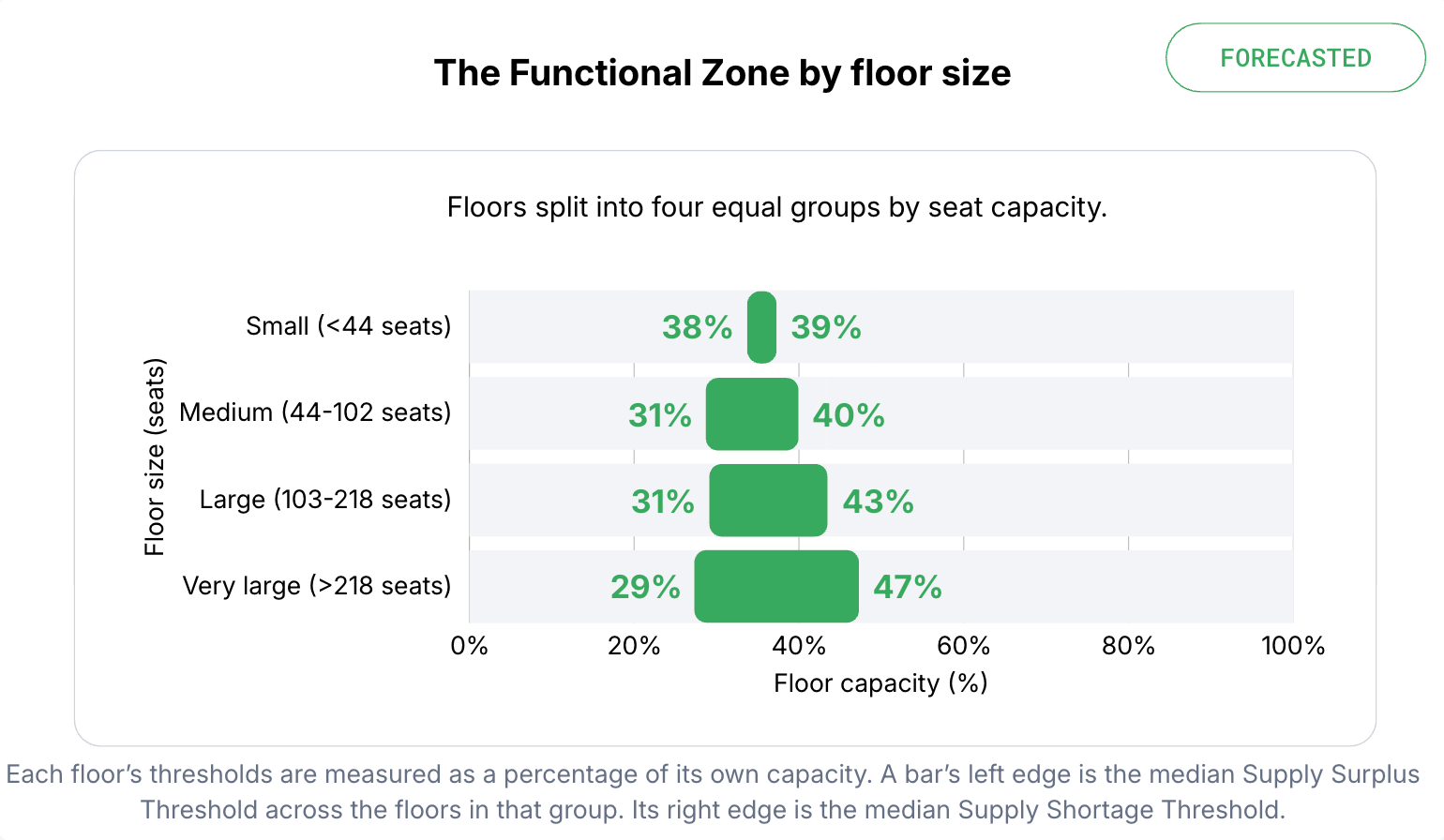
The Functional Zone is the range of attendance where a floor has enough seats for everyone without carrying more space than it needs. It runs from the Supply Surplus Threshold, below which a floor has excess space, to the Supply Shortage Threshold, the attendance level at which about 5% of people present would go unseated.
VergeSense introduced the Functional Zone in the 10th Index. For the median floor, it runs from 31.1% to 42.5% of seat capacity. That's about 11 points of margin. The median Supply Shortage Threshold of 42.5% sits right where the steep part of the shortage curve begins.
How Does Floor Size Change the Functional Zone?
The Functional Zone gets wider as floors get bigger. Very large floors have about 19 points of margin. Small floors have one, and tip into shortage almost the moment they stop being underused. On a 40-seat floor, that's less than one person between surplus and shortage.
How Does Space Mix Change the Functional Zone?
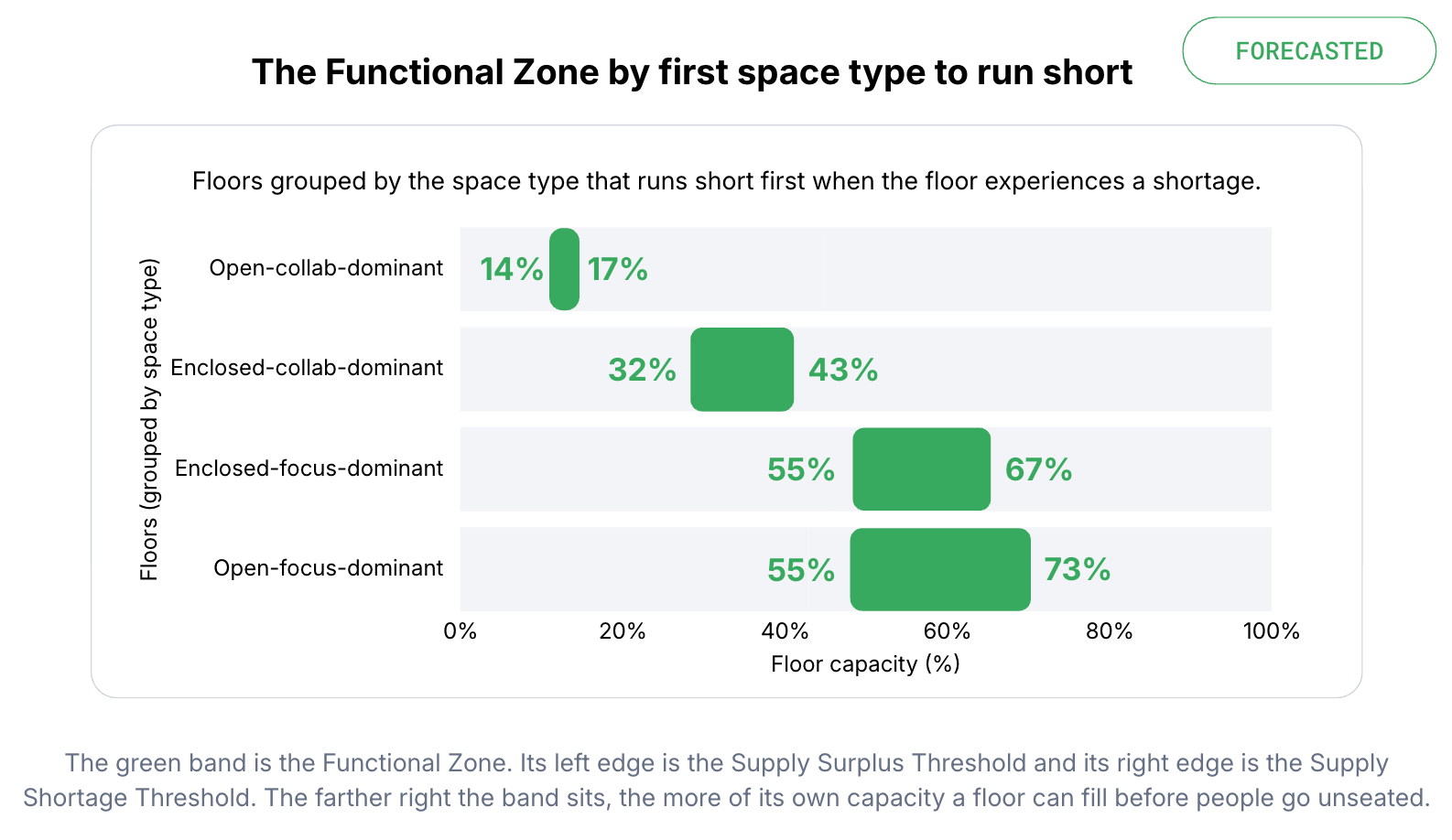
Where the Functional Zone sits depends on which space type runs short first. Floors limited by focus space (desks and focus rooms) can fill past half their capacity before running short. Floors limited by enclosed collaboration run short at about 43%. Floors limited by open collaboration run short at about 17%.
Same metric, same threshold, and the only difference is what the floor was built out of. A building is at its most fragile exactly where it's doing the thing people came in for.
Why Do Meeting Rooms Run Out When Their Seats Are Empty?
Meeting rooms run out because a floor runs out of rooms, not seats. Each room is taken whole by one group, and groups are small: a 4-seat room holds 1.4 people on average, an 8-seat room 1.9, and an 11-seat room 2.3. Large rooms get booked by small groups, and the seats inside them become unavailable to anyone else.
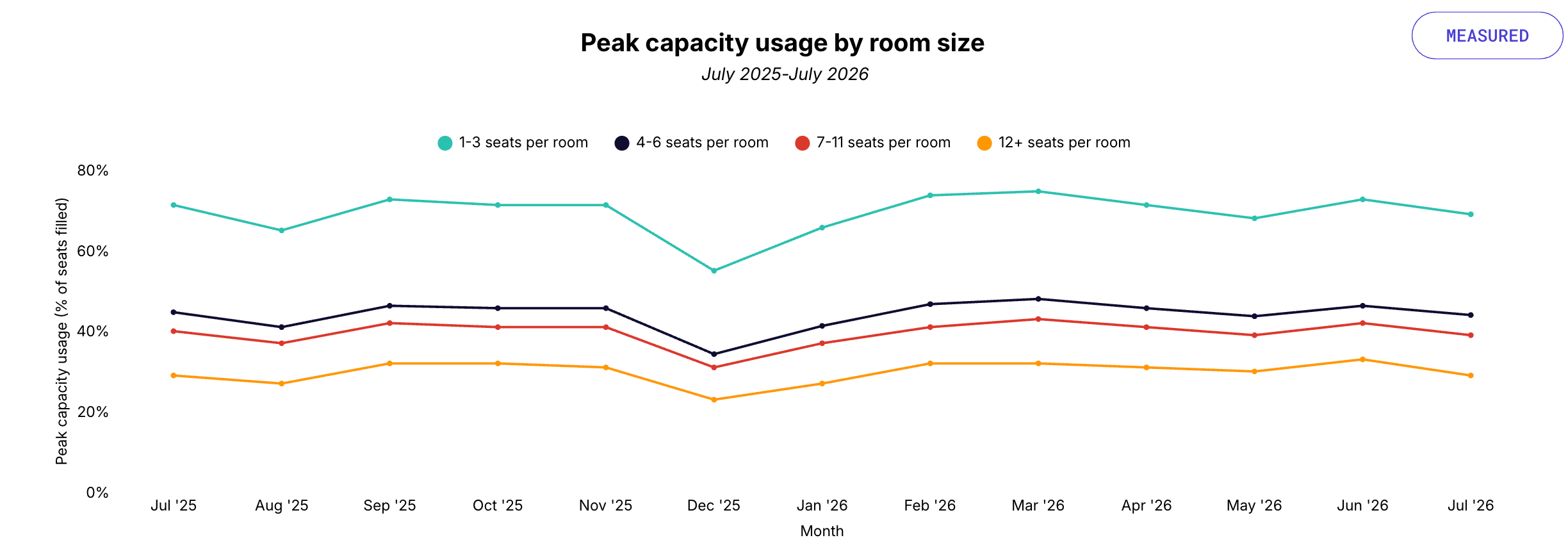
Two measures from VergeSense's measured data run in opposite directions. Rank rooms by Active Time Usage, the share of the working day with at least one person in the room, and the order tracks room size. Rank by Peak Capacity Usage, the share of seats filled at a room's busiest, and the order flips. Neither ranking reverses in any of the 13 months measured.
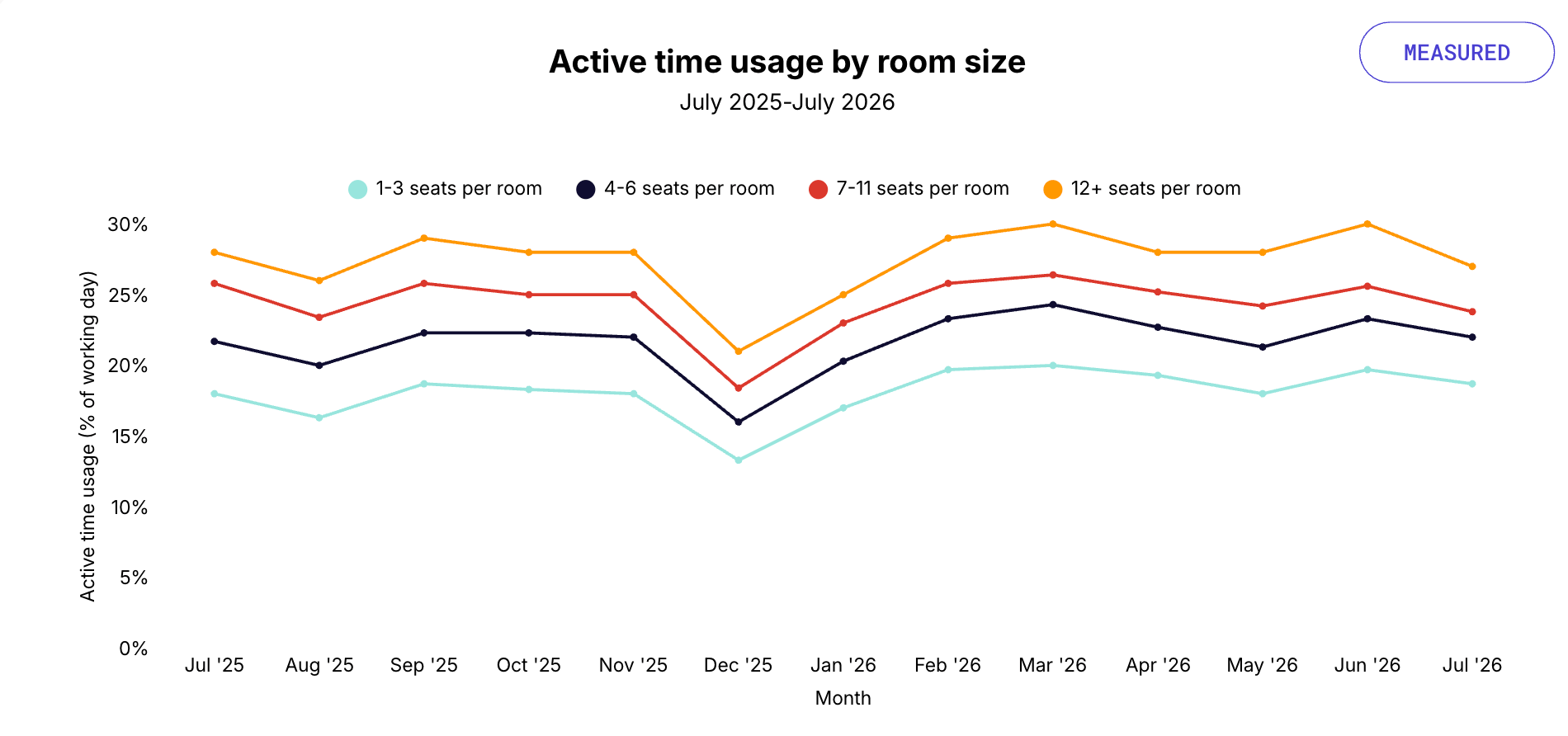
The largest rooms are the most used space on the floor, and the emptiest while in use. Room size nearly triples from 4 to 11 seats, and group size grows by less than one person. Even in March and June, the busiest months in the dataset, rooms built for 12 or more top out at a third of their seats.
Picture a floor with five 8-seat meeting rooms: 40 collaboration seats on the plan. Five groups of about two arrive and each takes a room, so roughly 10 of the 40 seats are in use. A sixth group arrives and finds nothing. Thirty seats sit empty behind closed doors, and the floor has run out of rooms. The plan promises 40 seats. The floor delivers five rooms.
When During the Day Do Offices Run Short?
Offices run short in the middle of the day. In VergeSense's measured data, 4.8% of hours run short at 8 AM. That rises to an average shortage rate close to 9% from 10 AM through 2 PM, peaking at 1 PM, then falls to 3.5% by 6 PM. Midday runs short at about double the rate of either end of the day.
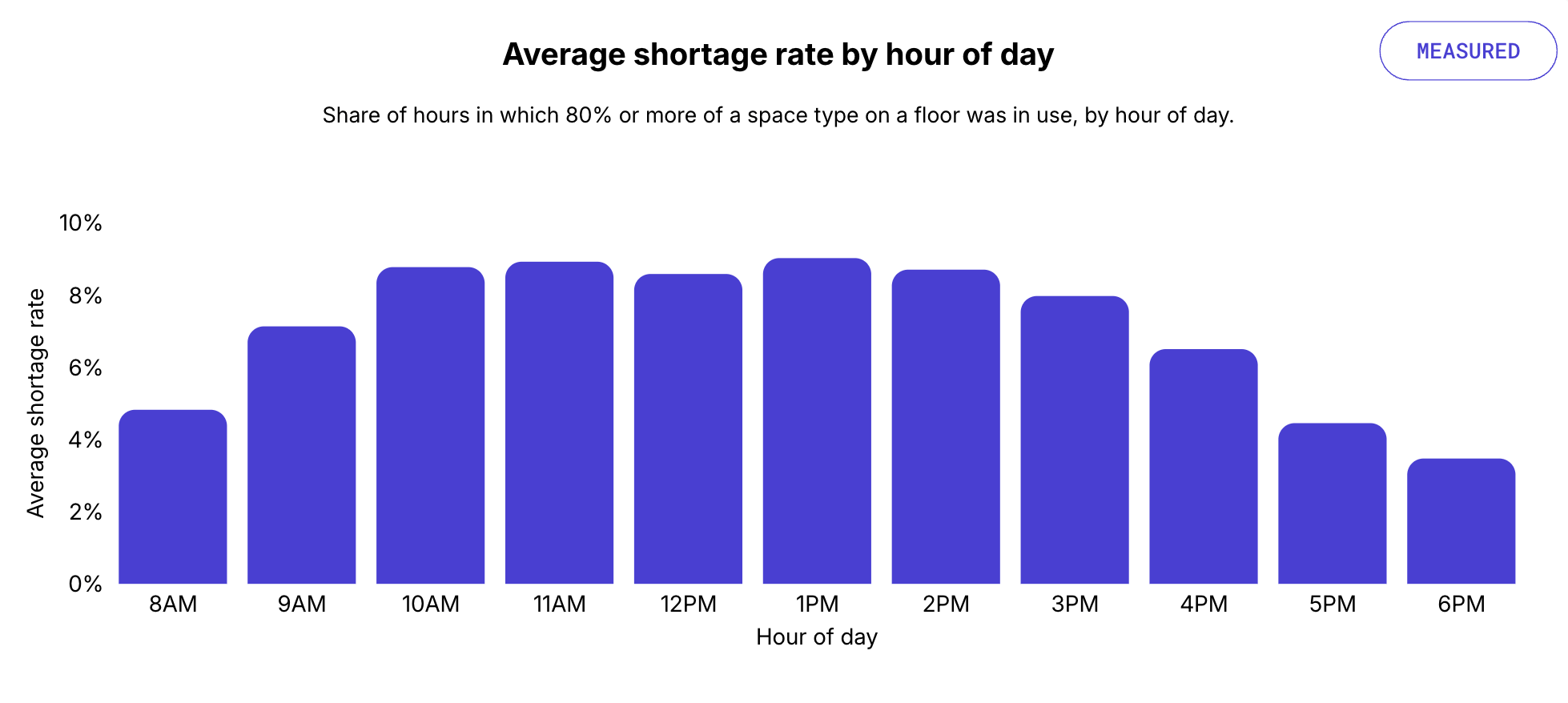
The hours when a floor is least able to give people what they came for are the hours when the most people are on it.
The pattern holds every month. Across 13 months, enclosed collaboration ran short in 7% to 12% of measured hours and open collaboration in 8% to 12%. Open focus never exceeded 5% in any month. Even in December, the quietest month, collaboration space ran short more often than desks did in their worst month.
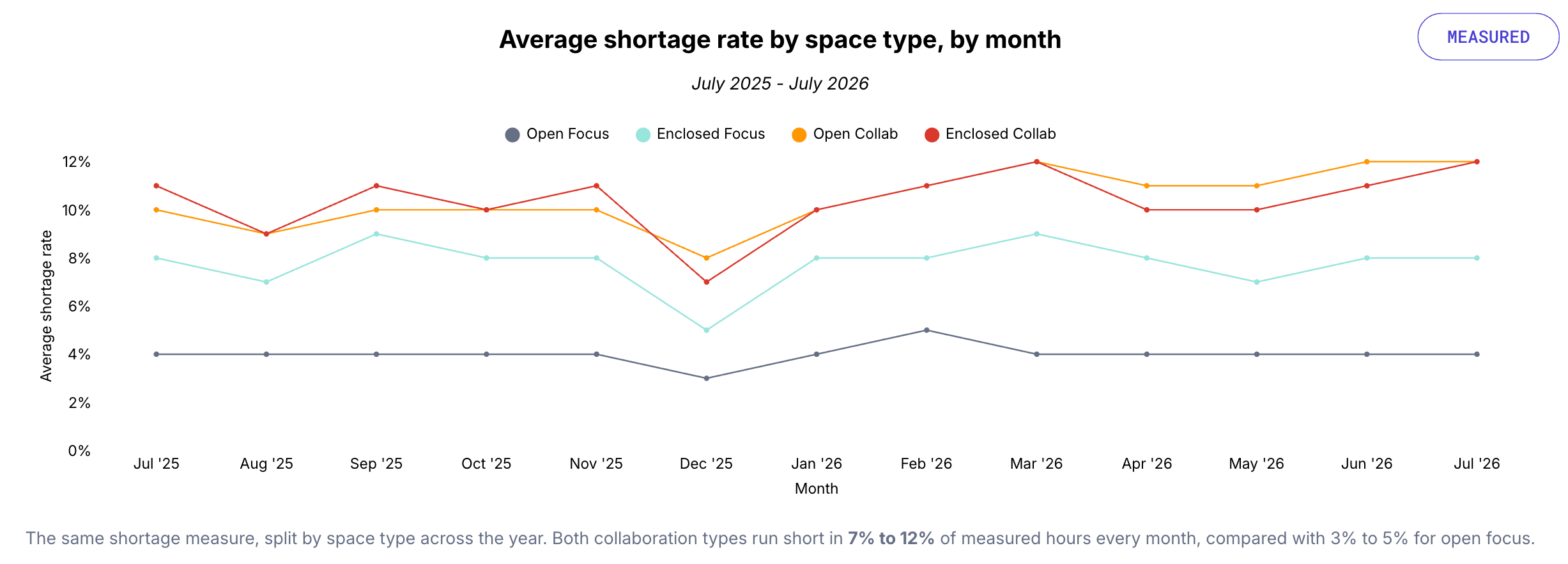
There is no season when desks are the constraint, and no month when collaboration space isn't. Part 3 covers where to look first.
Need to know where your floors break before a lease decision?
See how Predictive Planning in Meridian forecasts shortage risk by space type, starting from just a floor plan.
FAQs About Office Space Shortages
At What Occupancy Does an Office Feel Full?
An office floor has a 58% chance of running short at 50% of its seat capacity, according to VergeSense's 10th Workplace Occupancy & Utilization Index. Risk climbs steeply between 40% and 70% of capacity and is nearly certain above 80%. The median floor's Supply Shortage Threshold is 42.5% of seat capacity.
Why Are There Never Enough Meeting Rooms?
There are never enough meeting rooms because each room is taken by one group, and most groups are two or three people. VergeSense data shows rooms built for 12 or more rarely fill more than a third of their seats, even at their busiest. Floors run out of rooms while collaboration seats sit empty.
What Is Passive Time Usage?
Passive Time Usage is the share of available time a space is held or reserved with nobody detected in it, such as a desk claimed with a bag but left empty. In VergeSense's 10th Index, open focus space (desks) had 9.5% Passive Time Usage, nearly three times the 3.3% for enclosed collaboration.
What Time of Day Do Offices Run Out of Space?
Offices run out of space most often between 10 AM and 2 PM, when close to 9% of measured hours hit shortage, peaking at 1 PM. That's about double the rate at 8 AM (4.8%) and 6 PM (3.5%), according to VergeSense's measured data from July 2025 to July 2026.